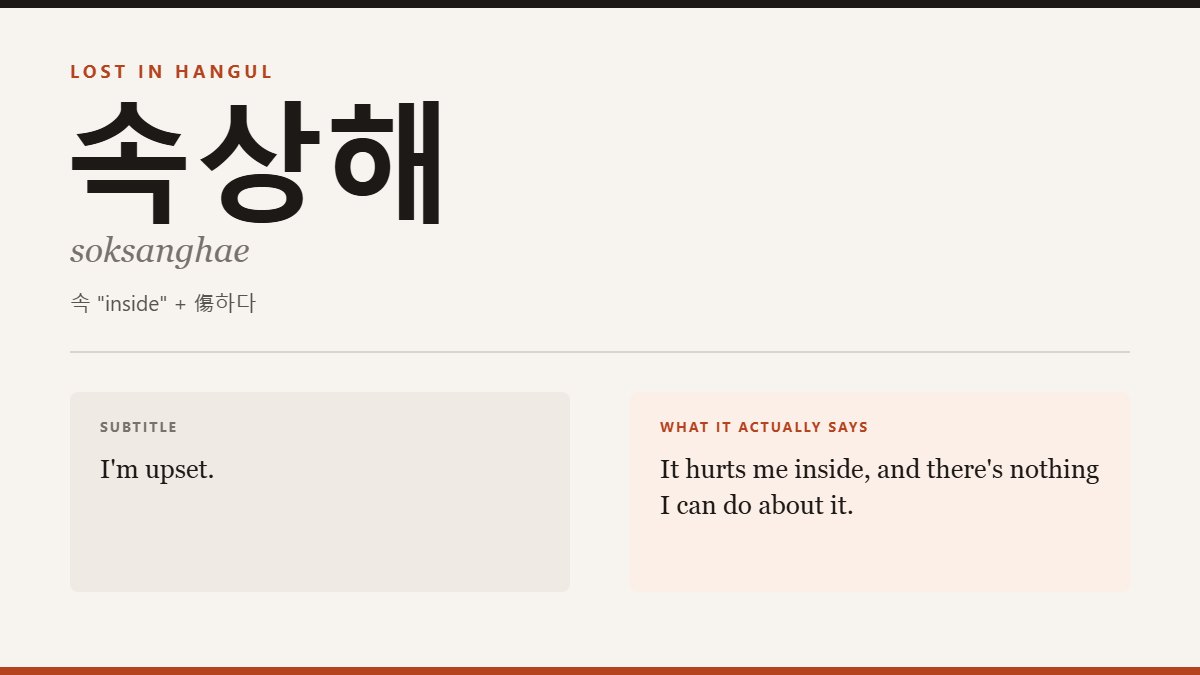
Short version: 속상해 means you are upset, but in a quiet, inward way. Something has gone wrong — to you or to someone you care about — and it hurts and frustrates you at the same time. It is not anger aimed at someone. It is the ache of watching something go badly.
Where the word comes from
속 is a native word for the inside: the stomach, the gut, the heart. 상하다 comes from 傷, “to be hurt, to be damaged,” and is also what you say about food that has spoiled. So 속상하다 is literally “the inside is hurt” or “the inside has gone bad.”
속 appears in a whole family of feeling words:
- 속이 타다 — “the inside burns,” anxious and desperate
- 속 시원하다 — “the inside feels cool,” a sense of relief
- 속이 쓰리다 — heartburn, and also bitter regret
- 속을 썩이다 — “to rot someone’s inside,” to cause constant worry
That last one is what parents say about difficult children: 속 썩이지 마, “stop giving me grief.”
When people say it
- A mother whose son failed an exam he studied hard for.
- Someone who dropped their new phone and cracked the screen.
- A friend who lost a match they should have won.
- Watching a friend stay in a bad relationship.
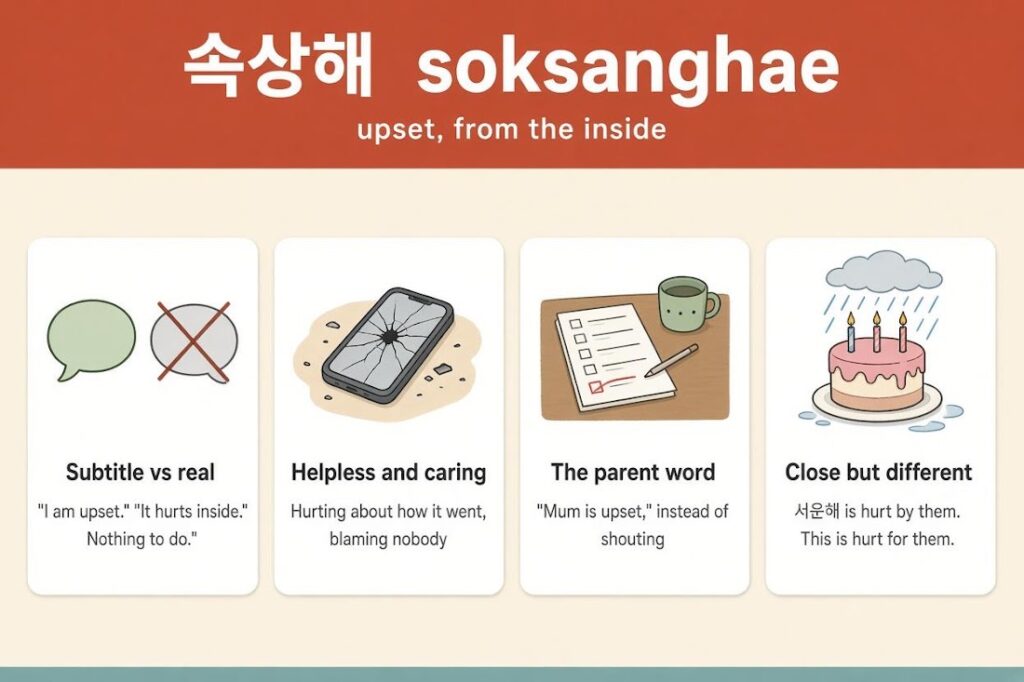
The common thread is helplessness plus care. You’re not blaming anyone, necessarily. You just wish it had gone differently, and it hurts.
How it differs from nearby words
| Word | Core | Aimed at |
|---|---|---|
| 화나다 | Anger | Usually someone |
| 서운하다 | Hurt that someone close fell short | A specific person |
| 답답하다 | Frustration at being stuck | A situation or person |
| 속상하다 | Inner hurt at how things turned out | Often nobody |
The easiest contrast is with 서운하다. If your friend forgets your birthday, you are 서운해 — hurt by them. If your friend’s birthday party gets rained out, you are 속상해 for them.
The parent’s word
속상해 is heard constantly from parents. When a child gets hurt, fails, or makes a bad choice, a Korean parent is more likely to say 엄마 속상해 (“Mum is upset”) than to shout. It turns disappointment into something the child is responsible for easing — which can be affectionate and also quite effective guilt.
You’ll also hear it as comfort. 속상했겠다 — “you must have been so upset” — is the standard sympathetic reply when a friend tells you something bad happened. It says “I see why that hurt” without offering advice.
What subtitles do
“I’m upset,” “It hurts,” “I feel bad.” All fair. The trouble is that English “upset” often implies anger, and can make a mother’s quiet 속상해 sound like she is angry at her child. 속상해 is closer to heartache. A better fit, when space allows, is something like “It breaks my heart” or “I hate seeing this.”
Read next
- “Seounhada” (서운하다) — the hurt you feel slightly embarrassed about
- “Dapdaphae” (답답해) — not frustrated. Something tighter than that.
- “Aswipda” (아쉽다) — a shame, and not the same as 서운하다
Last reviewed: September 26, 2026