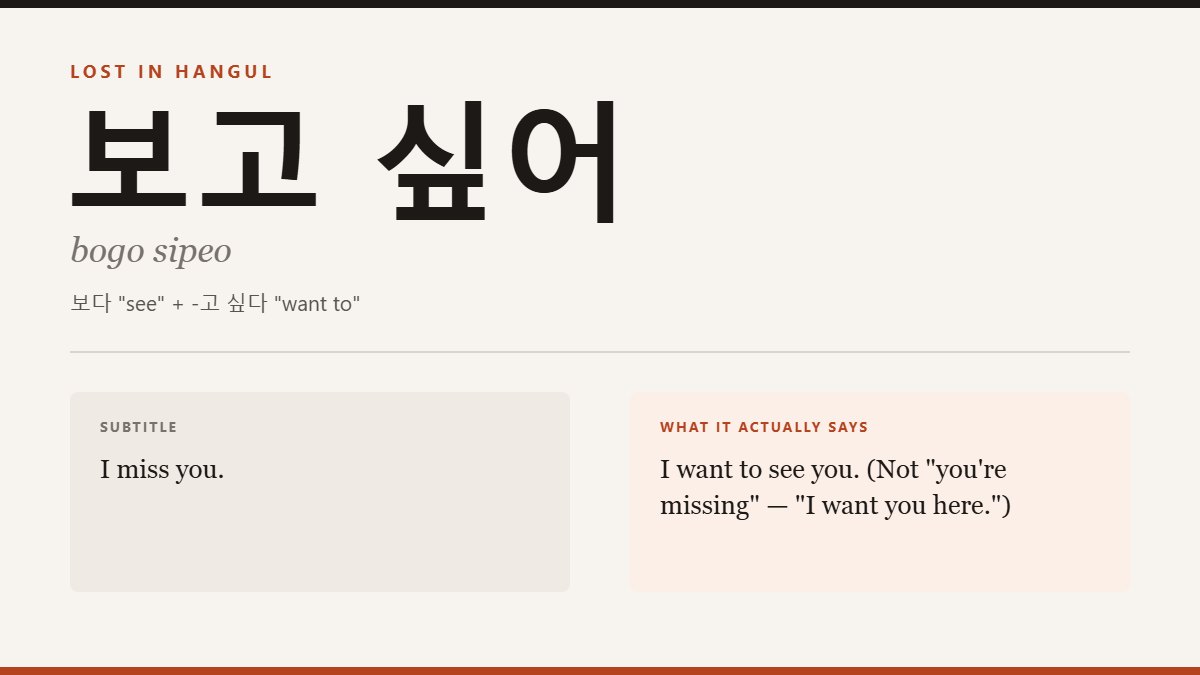
Short version: 보고 싶어 is the standard Korean way to say “I miss you.” Literally, it means “I want to see you.” English frames missing someone as an absence; Korean frames it as a wish. It is the same feeling, pointed the other way.
How it is built
보다 means “to see” or “to look at,” and –고 싶다 means “to want to.” So 보고 싶다 is simply “want to see.” The same pattern gives 먹고 싶다 (“want to eat”) and 가고 싶다 (“want to go”).
| Form | Use |
|---|---|
| 보고 싶어 | Casual: partner, friends, family |
| 보고 싶어요 | Polite: parents, fans, anyone older |
| 보고 싶었어 | “I missed you” — on seeing them again |
| 보고 싶다 | Said to yourself, or written |
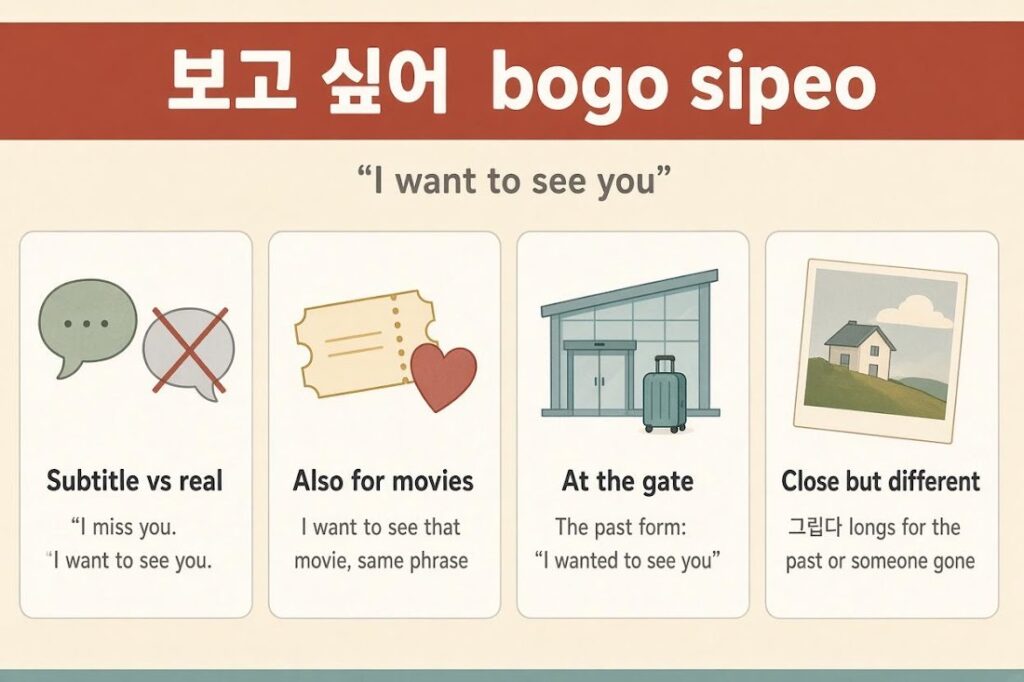
보고 싶었어 is worth noticing. It is what you say at the airport arrivals gate: “I wanted to see you (all this time).” The English “I missed you” matches it well.
The double meaning
Because it literally means “want to see,” the same phrase works for anything you want to watch:
- 그 영화 보고 싶어 — I want to see that movie
- 바다 보고 싶다 — I want to see the sea
- 엄마 보고 싶어 — I miss Mum
Context usually makes it clear. But it allows small jokes: a friend saying 보고 싶어 over text might add “…your dog,” or a drama might play on whether someone means a person or a film.
그립다 — the longing word
Korean has another word, 그립다, that also translates as “miss.” It is different in feel:
- 보고 싶다 — active, everyday, about someone you could see again
- 그립다 — wistful longing, often for the past, a place, or someone gone
You say 보고 싶어 to a partner who is away for a week. You say 고향이 그립다, “I long for my hometown,” or 그 시절이 그립다, “I miss those days.” 그립다 is more poetic and appears a lot in song lyrics and writing.
Where the pattern comes from
Both 보다 and 싶다 are native Korean. The “want to” construction is basic grammar learners meet in their first months. What is interesting is that Korean made the ordinary “want to see” into the standard expression of longing, rather than developing a separate verb for it the way English did with “miss.”
When someone is gone for good, 보고 싶다 still gets used, and it is devastating in context. A child saying 엄마 보고 싶어 about a mother who has died is saying “I want to see Mum,” which is the plainest and saddest way to say it.
What subtitles do
“I miss you” — and that’s correct nearly every time. The loss is the literal wish. In a scene where someone says 보고 싶어 and the other replies 나와, “come outside” — because they’re standing at the door — the joke works in Korean because “I want to see you” has an answer. “I miss you” / “Come outside” is a little harder to follow in English.
Read next
- "Saranghae" (사랑해) — "I love you," and how rarely it used to be said
- “Seolleda” (설레다) — the flutter that only happens beforehand
- “Aswipda” (아쉽다) — a shame, and not the same as 서운하다
Last reviewed: September 26, 2026