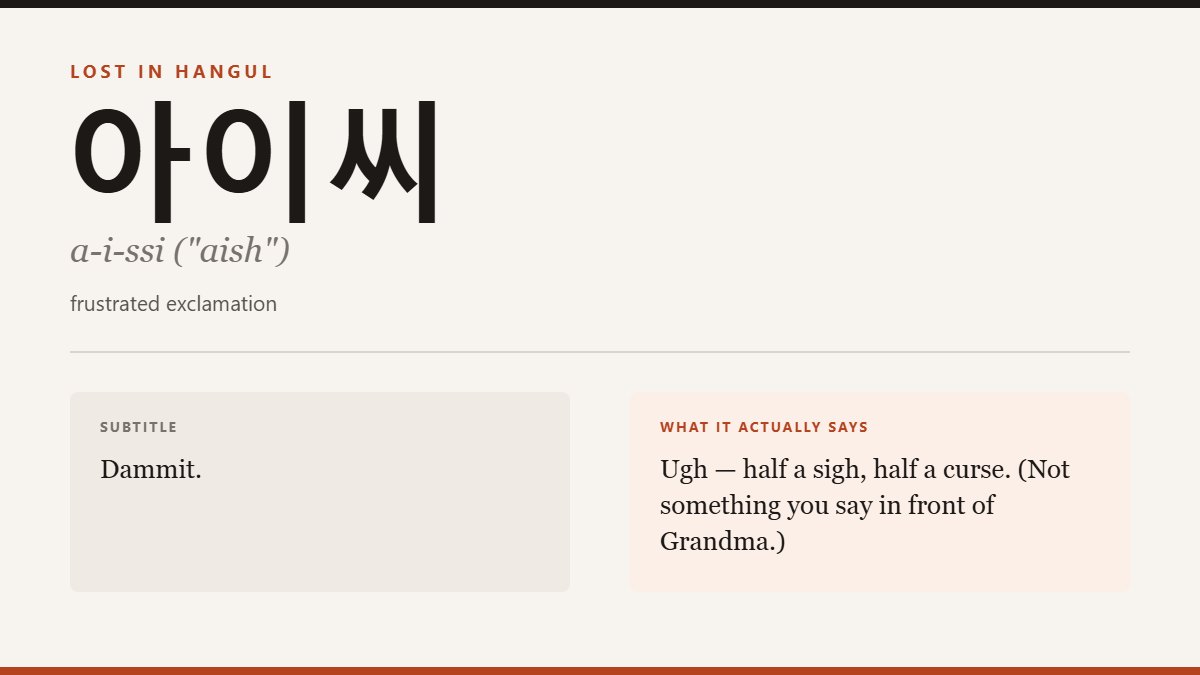
Short version: what fans write as “aish” is usually 아이씨, 아씨 or 에이씨 — a muttered burst of frustration. It sits right on the line between a sigh and a swear word. Among friends it’s harmless. Aimed at a person, or said in front of an elder, it’s rude.
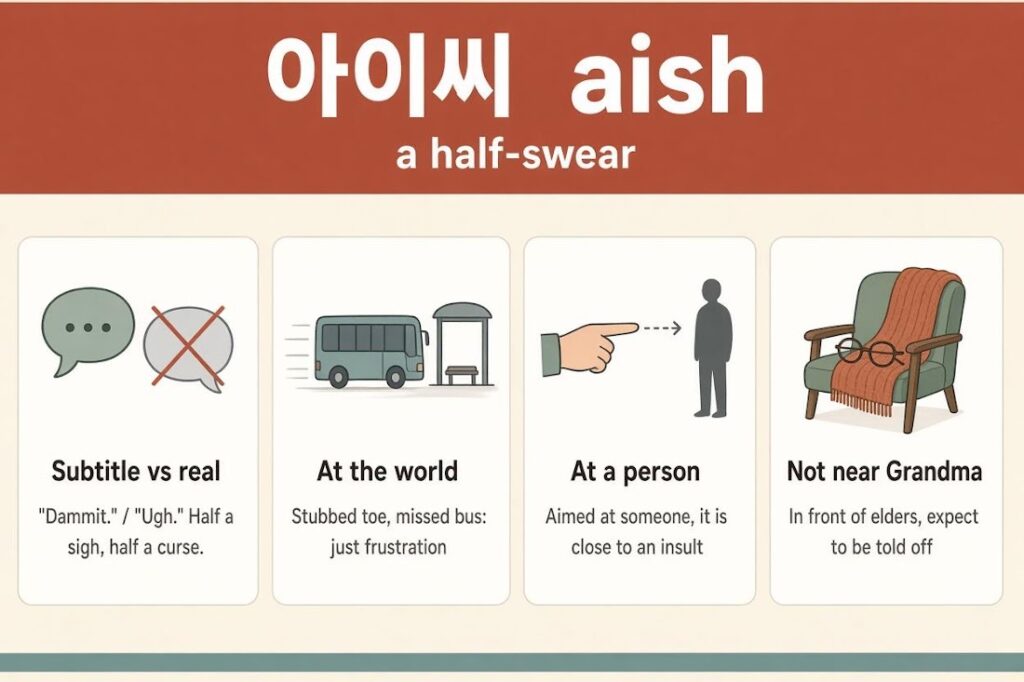
What it sounds like, and when
- You stub your toe: 아 씨…
- The bus pulls away as you reach the stop: 아이씨!
- Your computer crashes before you saved: 에이씨
- Someone cuts in front of you and you glare: 아이 씨…
The first three are frustration at the world. The last one, aimed at a person, is closer to an insult. Same sound, different target.
Where it comes from
아이 and 에이 are ordinary exclamations of annoyance — like “argh.” The 씨 part is where the argument lives. Many Korean speakers hear it as the first syllable of a much stronger swear word, cut off before it’s finished. Others treat it as an independent noise with no clear origin. Both views are common, and I don’t think the question can be settled from the sound alone.
What matters in practice is how people hear it. Enough speakers hear the clipped curse that it’s treated as mildly vulgar. Parents tell children not to say it, and TV broadcasters sometimes bleep or caption it with care.
How rude is it?
| Situation | How it lands |
|---|---|
| Alone, to yourself | Normal frustration |
| Among close friends | Casual, not shocking |
| At work, muttered | Unprofessional |
| In front of parents or elders | Rude; expect to be told off |
| Directly at someone, with a glare | Hostile — can start a fight |
“Aish” as a spelling is mostly a fan creation. The final “sh” is how 씨 sounds to many English speakers when it’s said quickly and under the breath. Koreans writing online would type 아씨 or 아 ㅆ.
Softer substitutes
People who don’t want to sound rude use cleaner alternatives, the way English speakers say “shoot” or “darn”:
- 아이고 — the all-purpose sigh, safe with anyone
- 에이 — mild “oh come on”
- 헐 — shock, rather than annoyance
- 아… — just a long exhale
What subtitles do
“Dammit,” “Crap,” “Shoot,” “Ugh,” and sometimes “Oh, come on.” Translators usually pick by character: a rough character gets “Dammit,” a gentle one gets “Ugh.” That’s a reasonable call. What’s lost is the social risk. A young character who says 아이씨 and then glances nervously at their grandmother makes Korean viewers laugh, because they know exactly what line was crossed. In English, “Ugh” crosses no line at all.
Read next
- Why the swearing gets cleaned up in subtitles
- “Aigoo” (아이고) — one sound doing six different jobs
- “Eotteokhae” (어떡해) — not a question, despite appearances
Last reviewed: September 26, 2026