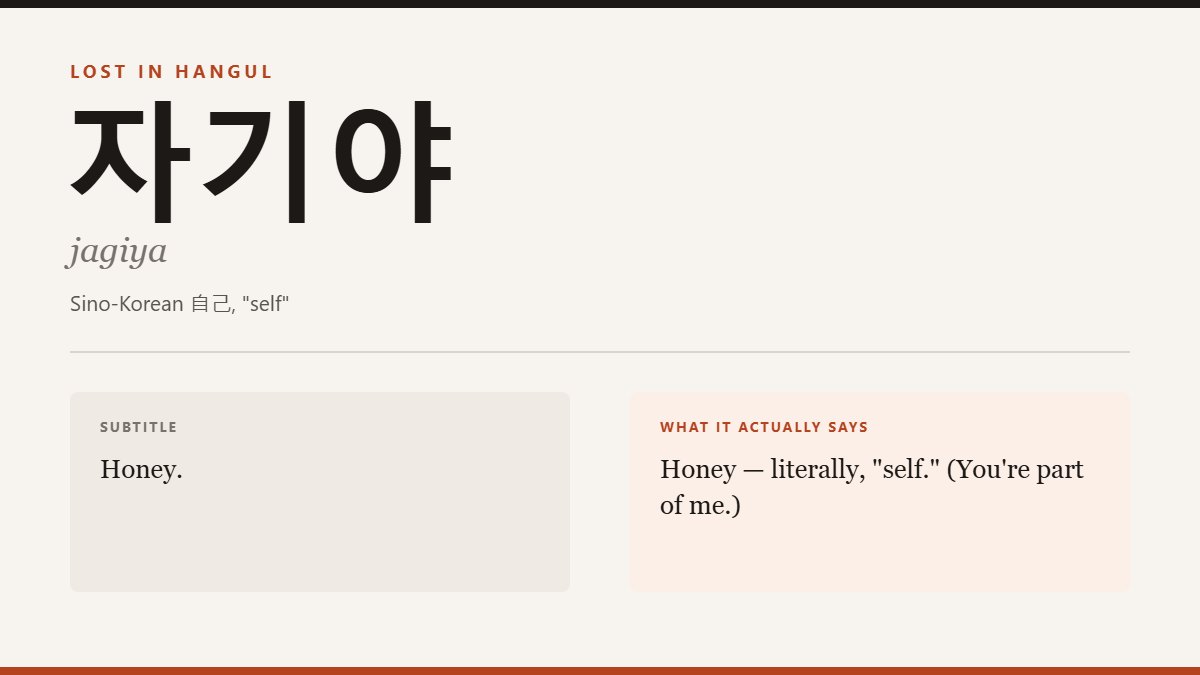
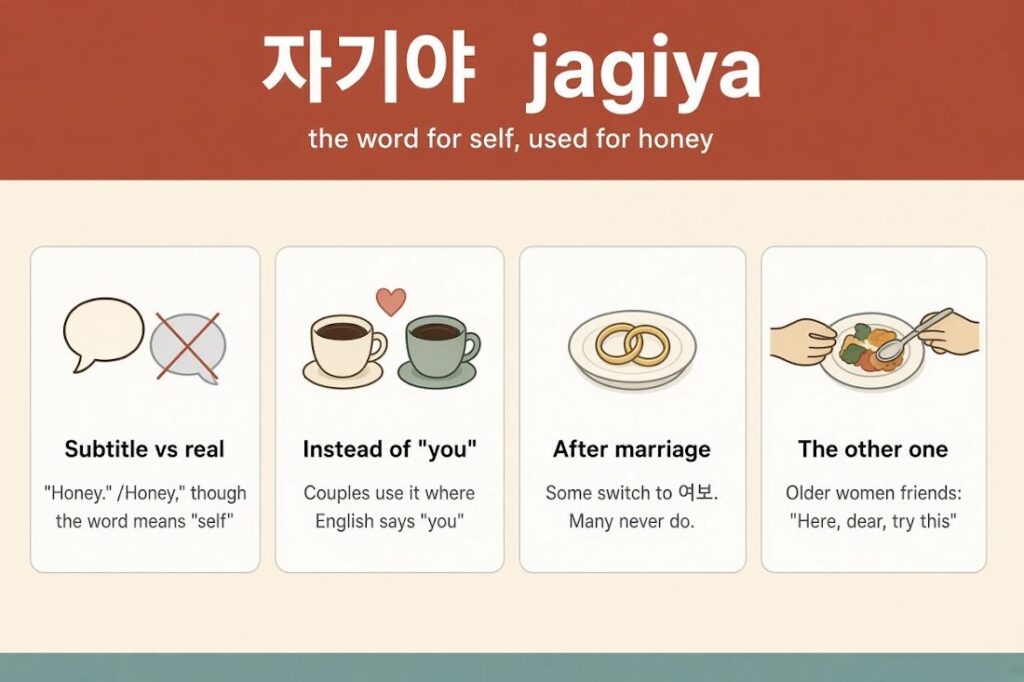
Short version: 자기 means “oneself,” but 자기야 is one of the most common pet names between Korean couples, roughly “honey” or “babe.” Married couples also use 여보. Oddly, 자기 has a second life among older women friends, where it means something like “dear.”
The couple’s word
- 자기야 — calling out: “Honey!”
- 자기 — as “you”: 자기 뭐 먹을래? “What do you want to eat, babe?”
- 자기가 — “you” as a subject, affectionate
That second use is worth noticing. Korean avoids saying “you” to people directly, and couples solve it by using the pet name where English would use a pronoun. 자기 뭐 해? is “What are you doing, honey?” and also simply “What are you doing?”
Where the word comes from
자기 is Sino-Korean, 自己: “self, oneself.” It’s a normal word in that sense — 자기 소개 is a self-introduction, 자기 자신 is “oneself.” How it came to be a term of endearment isn’t documented cleanly. It is widely used from at least the late twentieth century, and people offer the romantic explanation that your partner is “your other self.” That’s a nice story, and it may be why the usage stuck, but I wouldn’t state it as the origin.
자기 vs 여보 vs 오빠
| Term | Who | Feel |
|---|---|---|
| 자기야 | Dating and married couples | Sweet, a little playful |
| 여보 | Married couples | Settled, domestic, “dear” |
| 오빠 | A woman to an older boyfriend or husband | Affectionate, age-based |
| Name + 아/야 | Many younger couples | Casual, equal |
여보 is traditionally what husbands and wives call each other. Couples often switch from 자기야 to 여보 after marriage, sometimes after having children, when 여보 feels more fitting. Many never switch and stay with 자기야 for life.
The other 자기
You may hear middle-aged women using 자기 with friends or even new acquaintances: 자기 이거 먹어 봐, “Here, dear, try this.” It’s warm and familiar, used between women who are roughly equals. It has nothing romantic about it. Occasionally it turns up in offices too, used by an older female colleague to a younger one.
Be careful using 자기 yourself. Between a man and a woman who aren’t a couple, it can sound flirtatious or overfamiliar. It’s a word learners usually recognise long before they have a reason to say it.
What subtitles do
“Honey,” “babe,” “sweetie,” “darling.” All workable. When 자기 is used as “you,” subtitles simply drop it: “What do you want to eat?” That’s the right choice for readability, but it hides how often the couple is using the pet name. A couple who say 자기 in every sentence are signalling a certain kind of sweetness that Korean viewers find either adorable or exhausting.
Read next
- Why she calls him “Oppa” (오빠) — and why the subtitle just uses his name
- “Uri” (우리) — why she says “our mom” about her own mother
- "Saranghae" (사랑해) — "I love you," and how rarely it used to be said
Last reviewed: September 26, 2026