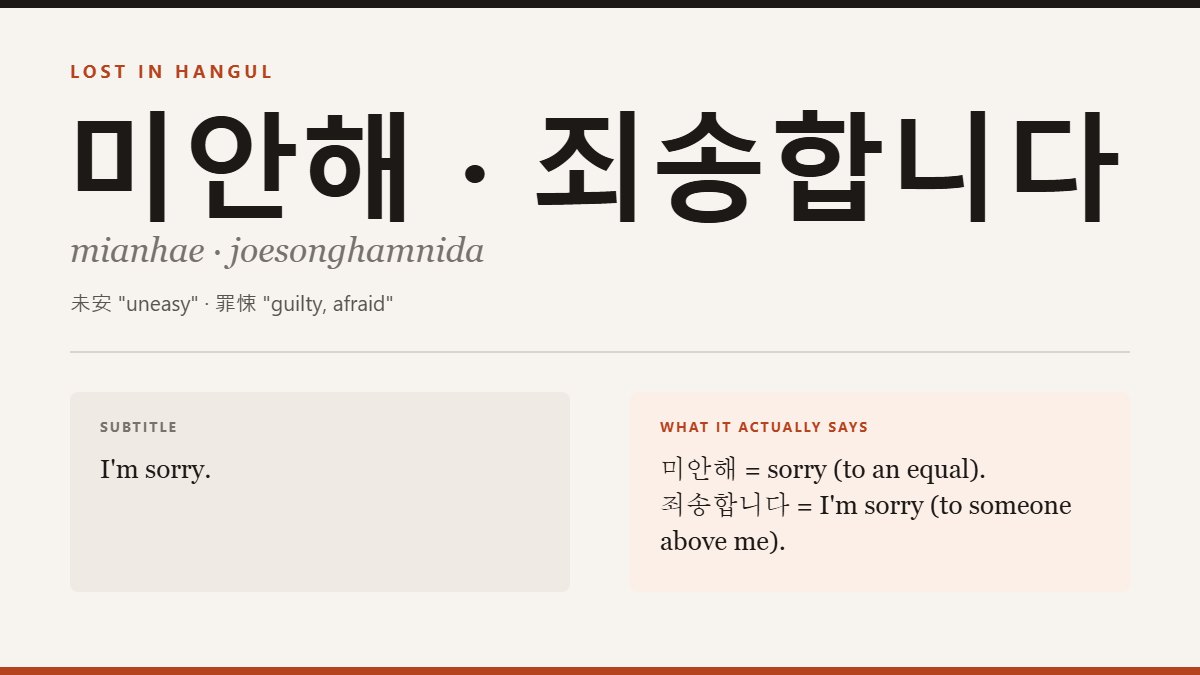
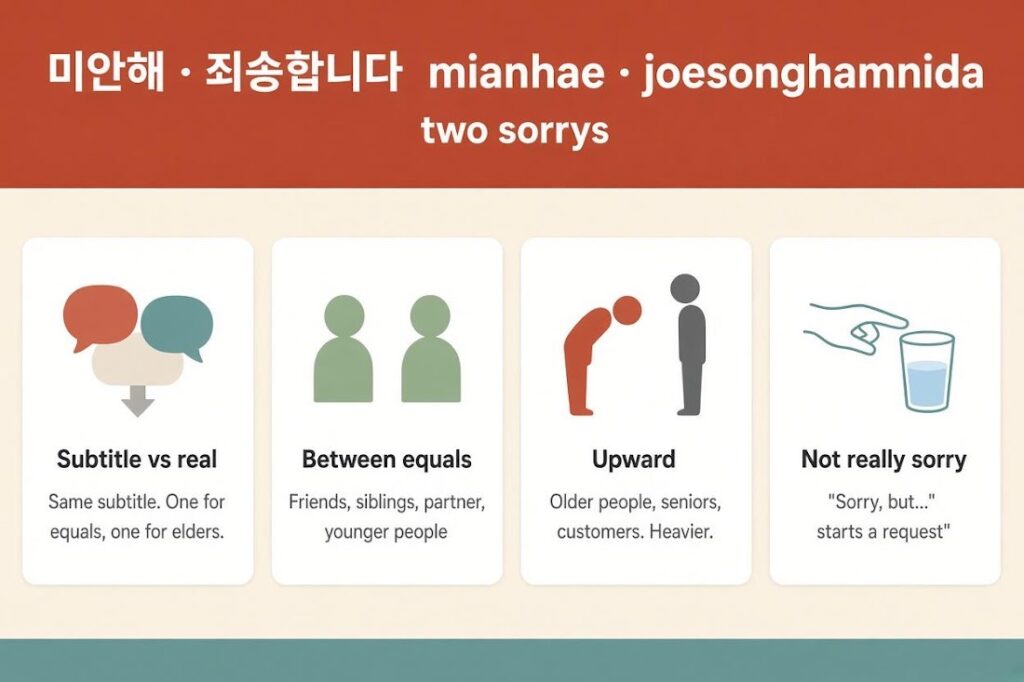
Short version: 미안해 and 미안해요 are apologies between equals or to people younger than you. 죄송합니다 is the apology you owe to someone older, senior, or a customer — and it’s heavier. There’s no casual form of 죄송, and saying 미안해 to your boss would be a small shock.
Where the words come from
Both are Sino-Korean, and their characters describe different feelings:
- 미안 — 未安, “not at ease.” You feel uncomfortable about what you did.
- 죄송 — 罪悚, “guilt” and “fear.” You feel you did wrong and are anxious about it.
That difference still shows. 미안 is discomfort among equals. 죄송 is the posture of someone apologising upward.
Which to use
| Form | To whom |
|---|---|
| 미안해 | Friends, siblings, partner, people younger |
| 미안해요 | Polite, but still between near-equals |
| 미안합니다 | Formal, public, but not deeply deferential |
| 죄송해요 | Older people, seniors, customers |
| 죄송합니다 | The standard serious apology upward |
Notice there’s no 죄송해 — you can’t make it casual. Like 감사합니다, the heavier Sino-Korean word resists informal speech.
미안한데 — not really sorry
A very common use of 미안 isn’t an apology at all. 미안한데… or 미안하지만… means “Sorry, but…” and introduces a request:
- 미안한데 물 좀 줄래? — “Sorry, could you pass me some water?”
- 죄송한데 사진 좀 찍어 주실 수 있어요? — “Excuse me, could you take a photo for us?”
That’s the Korean equivalent of “excuse me” or “sorry to bother you.” Learners who think every 미안 is an apology can misread these moments.
Public apologies
Korean public apologies — from companies, celebrities, politicians — use 죄송합니다 with a deep bow, often at 90 degrees, and sometimes 사과드립니다, “I offer an apology.” These have a set form, and Korean viewers judge them closely: how deep the bow was, whether it was read from a paper, whether the person said 죄송 or only “I regret.”
Between a couple, 미안해 is standard, and sometimes the most serious apology is the plainest one. A partner who suddenly says 죄송합니다 in a fight is being sarcastic — putting distance where there shouldn’t be any.
What subtitles do
“Sorry,” “I’m sorry,” “I apologise.” English uses one word regardless of rank, so the choice of 미안 or 죄송 disappears. That matters when a young character says 미안해요 to an older one and gets a sharp look — Korean viewers catch the slip, English viewers don’t. It also matters with 미안한데: subtitles often translate it as “Sorry,” which makes a simple request look like an apology.
Read next
- “Gomapseumnida” and “Gamsahamnida” — two thank-yous, one English word
- “Gwaenchanayo” (괜찮아요) — it also means “no thank you”
- The moment they switch to 반말 — what just happened between them
Last reviewed: September 26, 2026