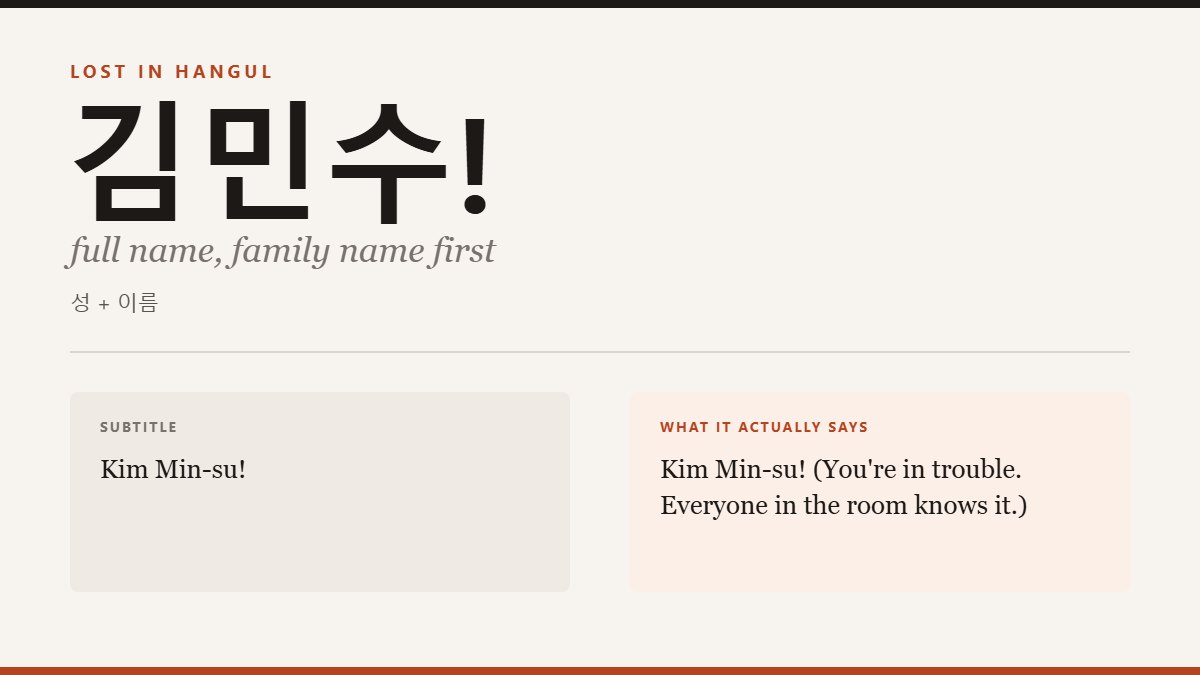
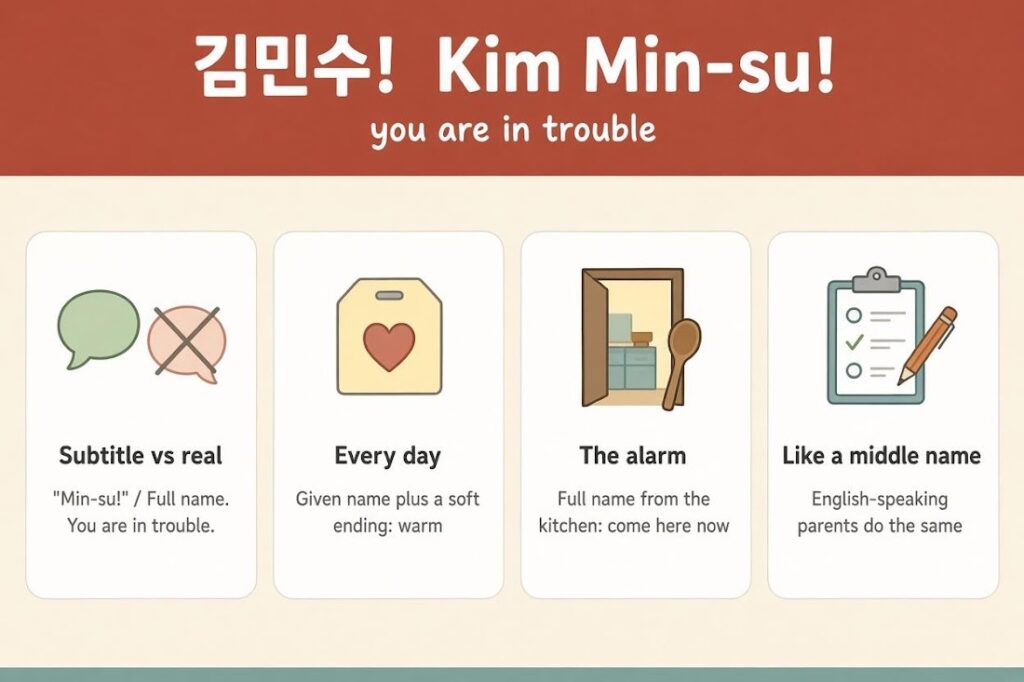
Short version: people close to you in Korea usually call you by your given name with a little ending — 민수야, 지은아. When your mother, your partner or your teacher suddenly uses your full name, family name first, something has gone wrong. English does the same thing with middle names. Subtitles print the name and the alarm goes silent.
How names are normally used
| Form | Example | Feel |
|---|---|---|
| Given name + 아/야 | 민수야, 지은아 | Close, casual, warm |
| Given name alone | 민수, 지은 | Neutral among friends |
| Full name + 씨 | 김민수 씨 | Polite, workplace |
| Full name, bare | 김민수! | Roll call — or trouble |
The ending 아 comes after a name ending in a consonant (지은아), and 야 after a vowel (민수야). They are vocative particles — the grammar of calling someone. Close people use them without thinking.
The full-name alarm
When a parent drops the 야 and adds the family name, the child knows. 김민수! from the kitchen means “come here now.” It’s the same effect as an English-speaking parent using a middle name. Teachers do it too — the bare full name is how you get called out in class.
Partners do it as well. A girlfriend who normally says 민수야 and suddenly says 김민수 is either furious or, in a playful mood, pretending to be.
Where this comes from
Korean names put the family name first, and there are relatively few family names: 김, 이 and 박 alone cover a very large share of the population. That’s why family names are rarely used alone as a form of address. “Kim!” could mean anyone. The given name is what identifies someone personally, and adding the family name back makes it official — like reading from a register.
Using a family name alone with 씨 — 김 씨 — is actually rude when speaking to someone. It sounds like you’re addressing a labourer from a distance. Polite address needs the full name or the given name with 씨: 김민수 씨, 민수 씨.
Other shifts in naming
- Given name → 선배 or 형: suddenly respectful, maybe asking for something
- Pet name → given name: cooling off in a couple
- Given name → 너 or 야: angry
- Given name + 씨 → given name + 야: the relationship just became closer
Each of these tells Korean viewers something about the scene before a single emotion is spoken.
What subtitles do
They print the name, usually as the given name alone, because that’s what English viewers expect. So 민수야 and 김민수! both appear as “Min-su!” — and the alarm is lost. Some translators add “Kim Min-su!” when the full name matters, and some add a word: “Min-su, get over here.” Both help. More often, the only clue left is the actor’s tone.
Read next
- The moment they switch to 반말 — what just happened between them
- “-ssi” and “-nim” (씨 · 님) — the suffix that sets your rank
- “Uri” (우리) — why she says “our mom” about her own mother
Last reviewed: September 26, 2026