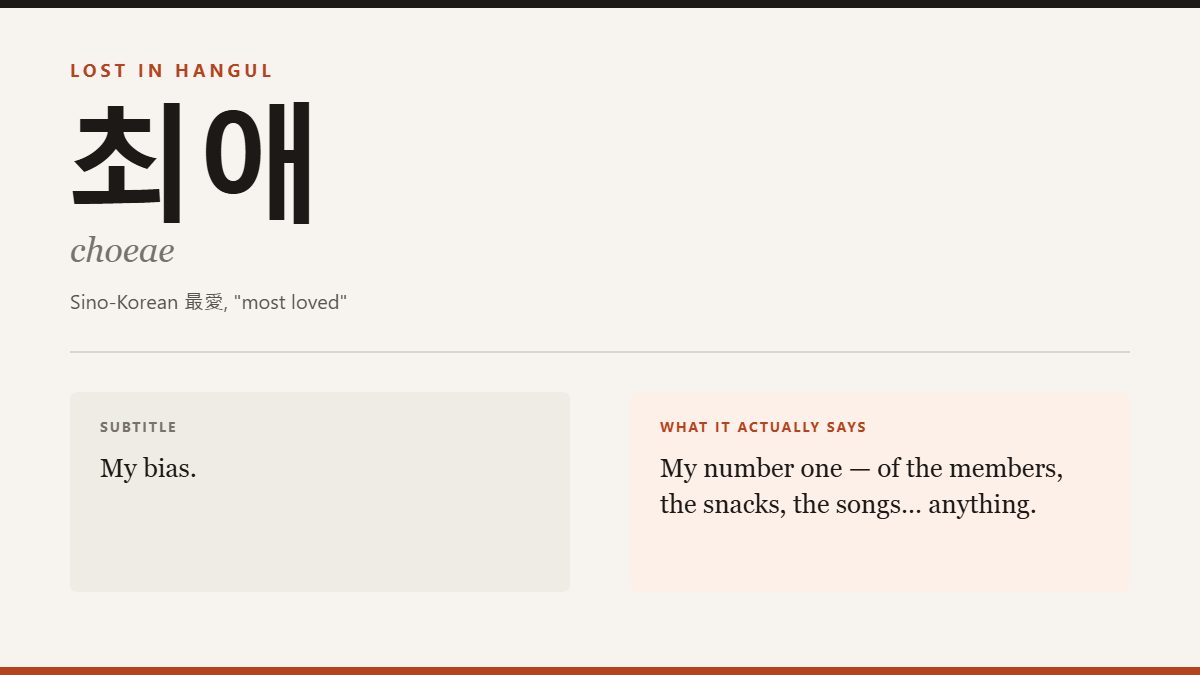
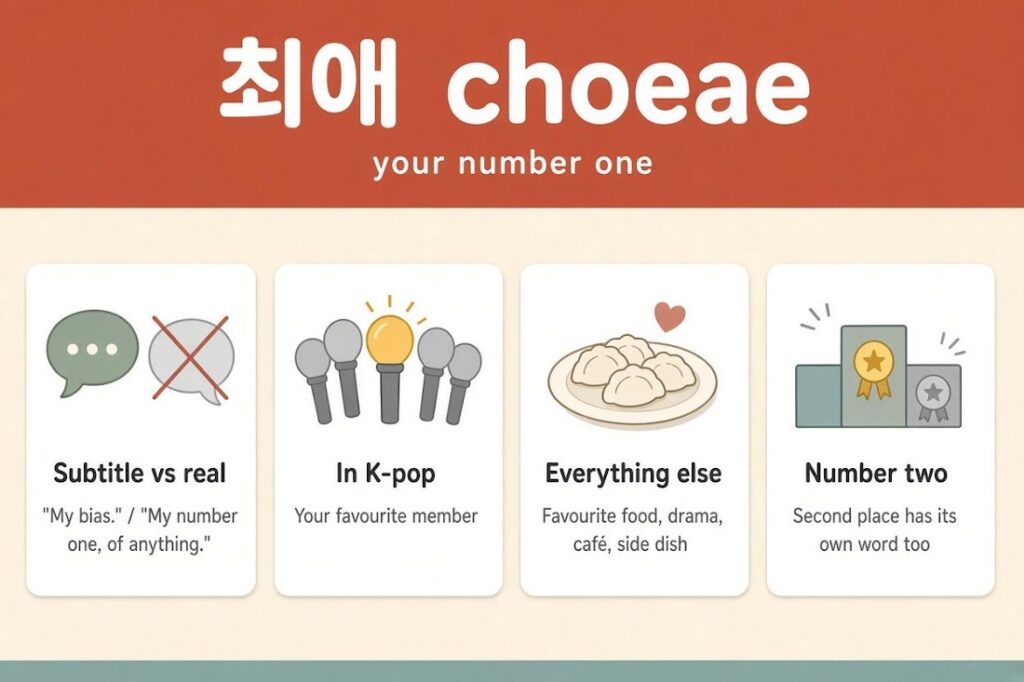
Short version: 최애 means “most loved,” your absolute favourite. In K-pop fandom it’s your favourite member, close to what English-speaking fans call a “bias.” But Koreans use it for everything: 최애 음식 (favourite food), 최애 드라마, 최애 카페, even 최애 반찬, the side dish you always reach for. Second place has its own word: 차애.
The ranking
| Word | Built from | Means |
|---|---|---|
| 최애 | 最 “most” + 愛 “love” | Number one |
| 차애 | 次 “next” + 愛 | Number two |
| 최애캐 | 최애 + 캐릭터 | Favourite character |
| 최애곡 | 최애 + 曲 “song” | Favourite song |
| 본진 | “home base” | The group you’re mainly a fan of |
As a noun it slots in anywhere: 이거 내 최애야 — “this is my favourite.” It’s casual and a little playful, because it carries the fandom flavour even when the subject is tteokbokki.
The fan-life vocabulary
- 덕질 — being a fan as an activity: buying albums, streaming, going to concerts.
- 입덕 — “entering” fandom, the moment you became a fan. An 입덕 영상 is the clip that got you.
- 탈덕 — leaving a fandom.
- 휴덕 — taking a break from it.
The 덕 in all of these comes from 덕후, a fan or enthusiast, which is usually traced to 오덕후, a Koreanised form of the Japanese otaku. In Korean it has lost most of its sting. Saying you’re a 덕후 of something today is closer to “I’m a huge nerd about it” than to an insult.
Where 최애 comes from
The parts are plain Sino-Korean, 最 and 愛, and 최애 sits in Korea’s standard dictionary as a plain, formal word for “loving most” — Chinese and Japanese have the same word. Fandom gave it a new, everyday life. How it became the standard fan word isn’t documented in any reliable way. What is clear is that it had become everyday fan vocabulary by the late 2010s, and that it has since escaped fandom completely. Your parents may use it about a television presenter.
최애 vs bias
“Bias” in English K-pop fandom is used almost only for idols. 최애 works for anything you love most. The second-place words also differ. 차애 is simply your steady number two. The English “bias wrecker” is a member who threatens to replace your bias, which is a different, more dramatic idea.
It’s casual. In a job interview, asked about your favourite book, say 가장 좋아하는 책 rather than 최애 책. Among friends, 최애 is perfectly natural at any age.
What subtitles do
A character calls a dumpling shop 내 최애 — and she’s talking about lunch in the language of fandom. Korean viewers hear the joke. The subtitle can’t use “bias” for a dumpling shop, so it says “my favourite,” which is correct and flat. With idols the problem doesn’t arise: “bias” is a good fit, and fans reading the subtitles already know it.
Read next
- “Maknae” (막내) — the youngest is a job, not a fact
- “Simkung” (심쿵) — heart, thud
- Why she calls him “Oppa” (오빠) — and why the subtitle just uses his name
Last reviewed: October 4, 2026