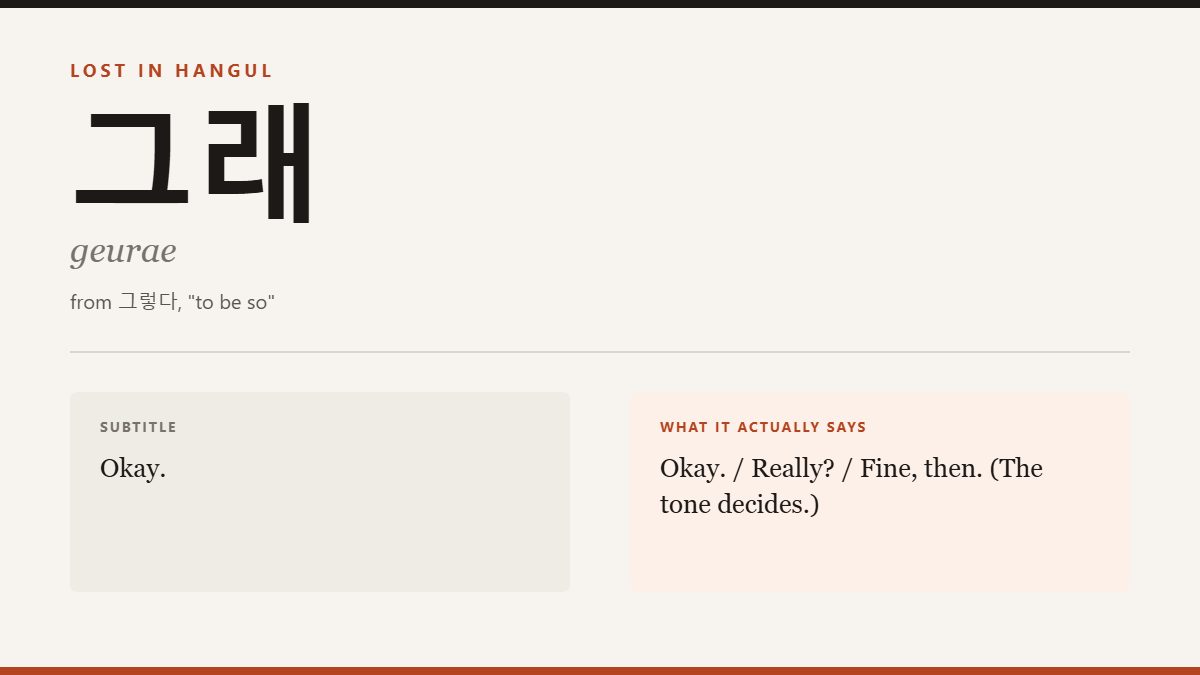
Short version: 그래 comes from 그렇다, “to be like that.” Its core meaning is “that’s so,” and from there it agrees, accepts, encourages, asks “really?”, comforts, and — with the right tone — gives up in anger. It’s casual 반말. The polite forms are 그래요 and 그렇습니다.
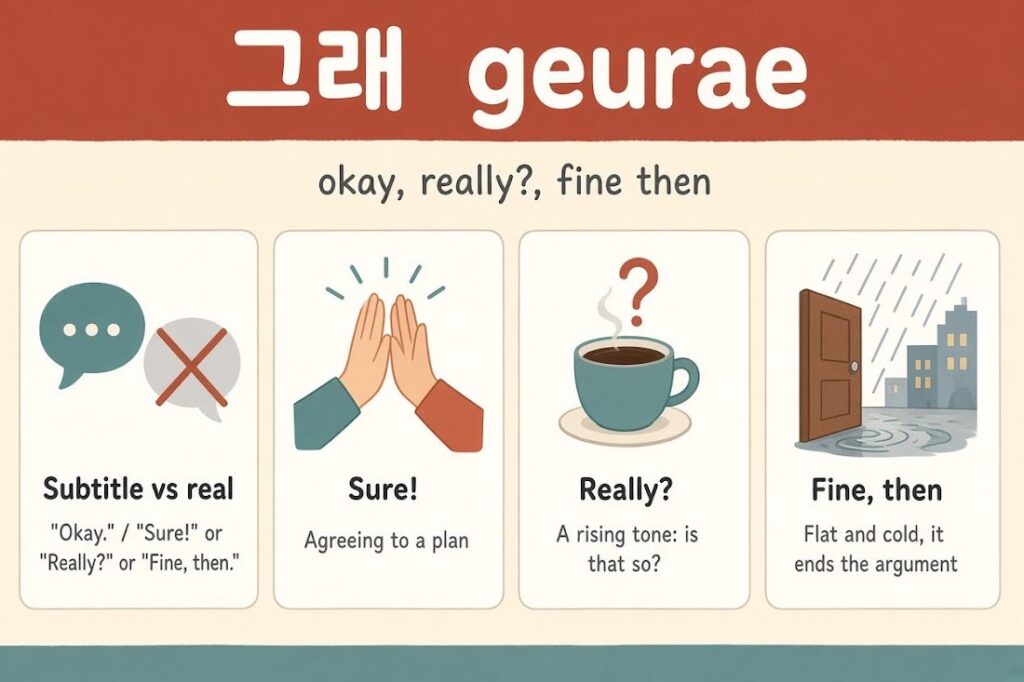
From “sure” to “fine, then”
| How it sounds | What it means |
|---|---|
| 그래. (calm) | Okay / sure / agreed |
| 그래? (rising) | Really? / Is that so? |
| 그래! (bright) | Yes! / Let’s do it! |
| 그래, 그래 (soft, repeated) | There, there / sure, sure |
| 그래… (falling) | Right… I see (sad acceptance) |
| 그래, 너 잘났다 | Fine, aren’t you great (sarcastic) |
Agreeing, and agreeing to
그래 can say “you’re right” about a statement, or “okay, let’s” to a proposal. 밥 먹을래? — 그래! is “Want to eat?” — “Sure!” 그래, 가자 is “Okay, let’s go.” It’s the most ordinary casual “okay” — agreeing to a plan or to a point. For a plain yes to a question, casual Korean uses 응 or 어: asked 밥 먹었어?, you answer 응, not 그래.
Asking “really?”
그래? with a rising tone is “Is that so?” It’s milder than 진짜?, which carries surprise or doubt. 그래? can be real interest — or polite lack of it. A flat 아, 그래? in reply to a long story is the Korean “Oh, okay,” and the storyteller knows exactly what it means.
The angry 그래
In an argument, 그래 is how someone stops arguing without agreeing. 그래, 알았어 — “Fine. Got it.” 그래, 헤어지자 — “Fine. Let’s break up.” The word is still “that’s so,” but the meaning is “I’m done.”
The comforting 그래
그래, 그래 — soft and repeated — is what you say to a crying child or a friend who needs to vent: “There, there. I know.” Older people also use 그래 as a warm, dignified reply to younger ones. A grandparent answering a grandchild’s 안녕히 주무세요 with 그래, 잘 자라 is the classic picture.
Where the word comes from
그래 is native Korean, the casual form of 그렇다, which is itself a contraction of 그러하다, “to be like that,” built on 그, “that.” The same root runs through a whole family of everyday words:
- 그래서 — “and so”
- 그래도 — “even so”
- 그러게 — “I know, right” (or “that’s what I said”)
- 그렇지 — “That’s it!” / “Right?”
- 그럼 — “then,” and also “of course”
그러게 deserves a note. It agrees by echoing: someone says “This queue is so long,” and you answer 그러게, “Tell me about it.” With a different tone — 그러게 내가 뭐랬어 — it becomes “See, what did I tell you?”
Don’t say 그래 to someone you’d speak politely to. To a teacher or a boss, use 네 or 네, 알겠습니다. 그래요 is polite but casual; it’s fine with a colleague, a little too relaxed for a senior manager.
What subtitles do
Episode one: “Want to go out with me?” — 그래! Episode sixteen, in the rain: 그래, 헤어지자. A Korean audience hears the same word bookend the relationship, bright at the start and flat at the end. The subtitles say “Sure!” and then “Fine. Let’s break up.” Both are good translations, and the echo between them is gone.
Read next
- “Ne” (네) — the Korean “yes” that often isn’t one
- “Jinjja” (진짜) — “really,” “real,” and “seriously?”
- “Injeong” (인정) — the one-word agreement that took over Korean variety
Last reviewed: October 4, 2026