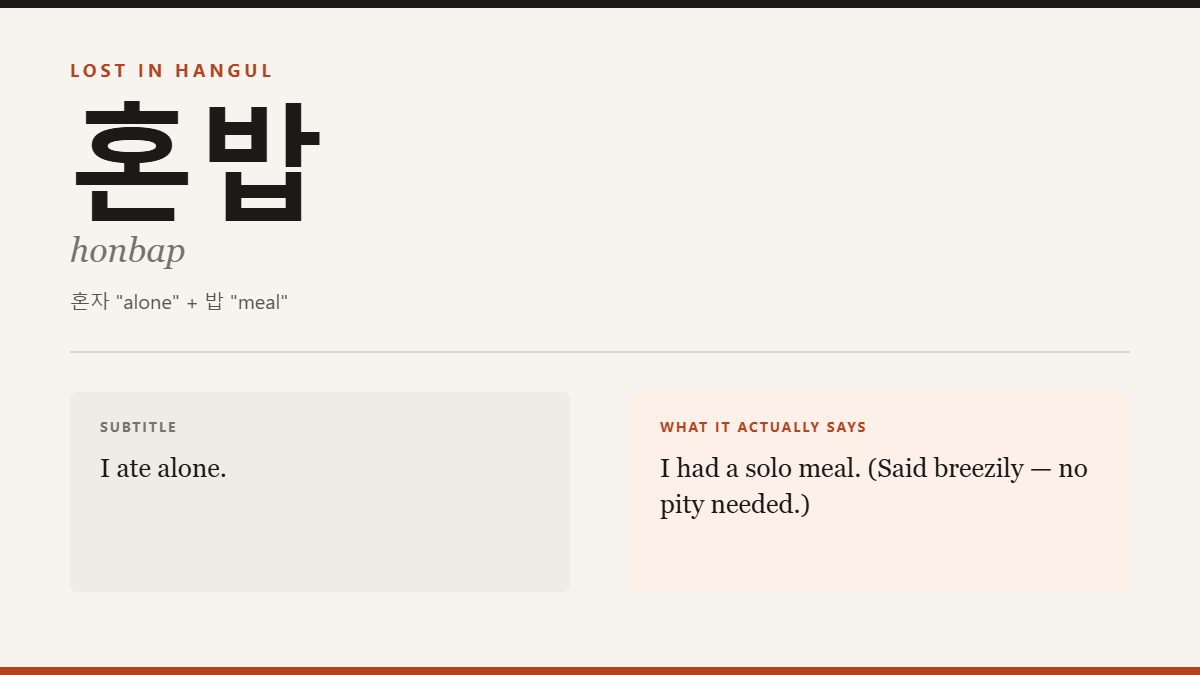
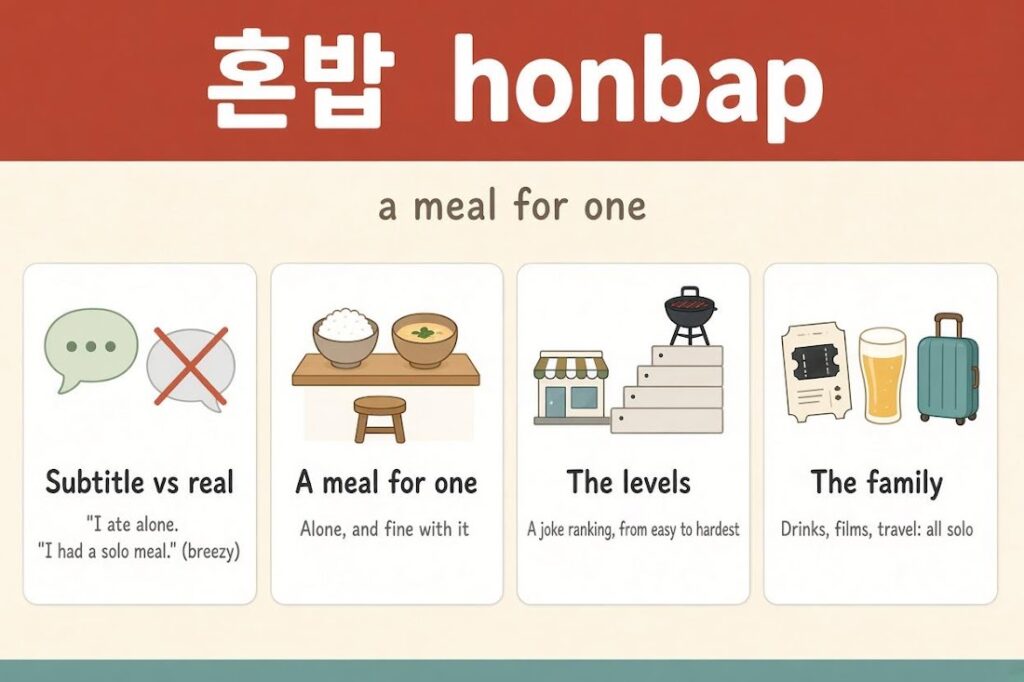
Short version: 혼밥 is a clipped form of 혼자 먹는 밥, “a meal eaten alone,” and it works as a verb too: 혼밥하다. The word exists because in Korea, eating alone used to feel conspicuous. Meals are built for sharing, and some restaurants — barbecue places especially — expect at least two portions. 혼밥 gave the act a neutral, even slightly cool, name.
The family
| Word | Built from | Means |
|---|---|---|
| 혼밥 | 혼자 + 밥 | Eating alone |
| 혼술 | 혼자 + 술 | Drinking alone |
| 혼영 | 혼자 + 영화 | Going to the cinema alone |
| 혼행 | 혼자 + 여행 | Travelling alone |
| 혼코노 | 혼자 + 코인 노래방 | Solo coin karaoke |
| 혼밥족 | 혼밥 + 族 “tribe” | People who regularly eat alone |
The pattern became so productive that 혼– now works almost like a prefix: put it in front of an activity and everyone understands you did it alone.
Why it needed a word
Korean meal culture is communal. Stews arrive in one pot, side dishes are shared, meat is grilled at the table for the group. Asking 밥 먹었어? is a way of caring for someone, and eating together is how colleagues and friends bond. Against that background, a person eating alone in a restaurant used to draw looks, and in school cafeterias it could signal that someone had no friends.
Giving it a short, slightly jokey name changed the feel. 혼밥 sounds like a choice, a small lifestyle, rather than a sad fact. tvN’s 2016 drama 혼술남녀 — known in English as Drinking Solo — took its title from the same wave of words.
The 혼밥 levels
A popular online joke ranks 혼밥 by difficulty. The versions differ, but they usually start with a convenience-store meal at level 1, climb through fast food and noodle shops, and put grilling meat alone at a barbecue restaurant and drinking alone in a busy pub at the top. People still share it to rate themselves.
Where the word comes from
Both parts are native Korean: 혼자, “alone,” and 밥, cooked rice and, by extension, a meal. The clipping takes the first syllable of each, the same way 남자 친구 becomes 남친. It spread in the mid-2010s, during a wider public conversation about the growing number of people living on their own.
Practical tip: many restaurants now have counter seats or menus labelled 1인분 or 1인 메뉴 (single portion). If a sign says 2인분 이상, it means “minimum two portions” — common at barbecue places, and the main obstacle to 혼밥 there.
What subtitles do
Here the subtitle’s problem is mood, not meaning. 혼밥했어 is breezy, even a little proud. “I ate alone,” the natural English, sounds lonelier, so a character who says it cheerfully can seem to be putting a brave face on things — the opposite of what the word was coined to do. “Had a solo lunch” gets closer, when the translator has room for it.
Read next
- “Bap meogeosseo?” (밥 먹었어?) — not really a question about food
- “Jal meokgetseumnida” (잘 먹겠습니다) — not “bon appétit”
- “Assa” and “Inssa” (아싸·인싸) — outsider, insider, and a cheer that sounds the same
Last reviewed: October 4, 2026