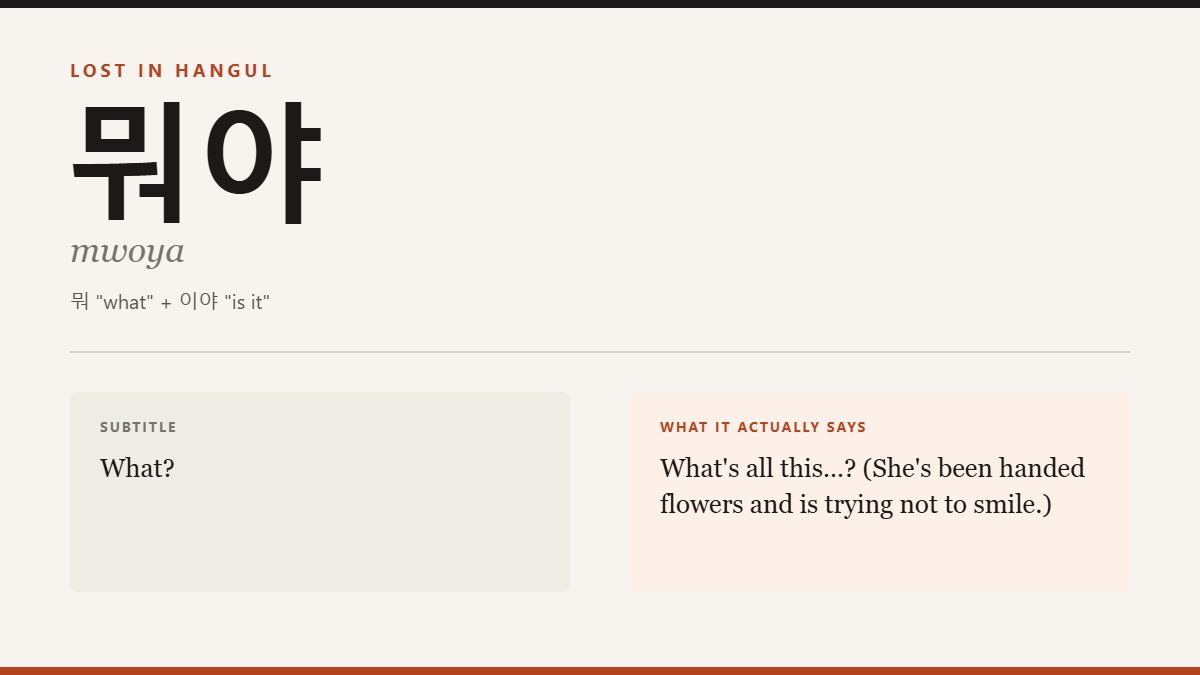
Short version: 뭐야 is 뭐 (“what”) plus 이야 (“is it”), so literally “What is it?” Sometimes it asks exactly that. More often it’s a reaction: confused (“what?”), irritated (“what the—”), flustered and pleased (“what’s all this?”), or disbelieving (“you’re kidding”). It’s casual 반말; the polite form is 뭐예요.
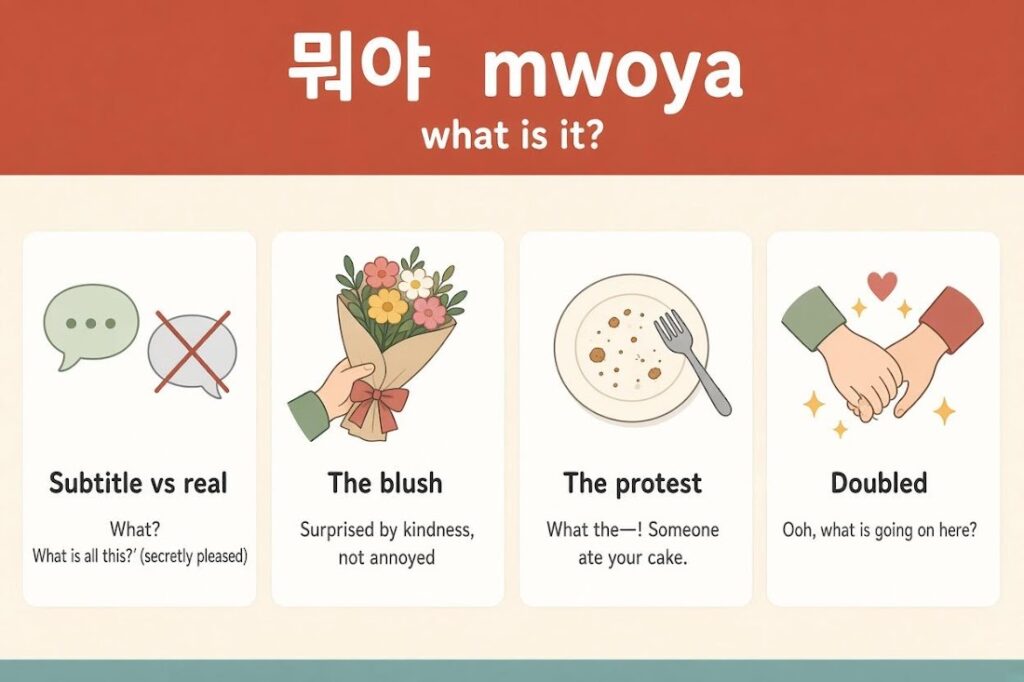
Question, protest, blush, disbelief
| How it sounds | What it means |
|---|---|
| 뭐야? (plain question) | What is it? / What’s that? |
| 뭐야! (sharp) | What the—! / What’s your problem? |
| 뭐야… (soft, smiling) | What’s this…? (pleased, embarrassed) |
| 뭐야, 진짜? | Are you serious? / No way. |
| 뭐야 뭐야 | Ooh, what’s going on here? |
The irritated one
Someone shoves past you, or your friend admits they ate your dessert: 아, 뭐야! Point it at a person — 뭐야, 너? — and it becomes “What’s with you?” To a stranger, that is how fights start. 이게 뭐야 about food or service is a complaint: “What is this supposed to be?”
The flustered one
This is the one learners miss. In romance scenes, 뭐야 is what a character says when caught off guard by affection — a confession, a gift, a compliment out of nowhere. 뭐야, 갑자기 means “What’s this, all of a sudden?” It isn’t a rejection. It’s embarrassment, and it’s usually followed by a smile the character tries to hide.
The curious one
Doubled, it turns into excited curiosity. Friends spot two people from the group holding hands: 뭐야 뭐야, 둘이 사귀어? — “Ooh, what’s this, are you two dating?” Said like that, 뭐야 뭐야 is practically a cheer.
Where it comes from
뭐 is a contracted form of 무엇, “what,” via 무어. 이야 is the casual form of 이다, “to be,” and shortens to 야 after a vowel. So 뭐야 is a complete sentence in two syllables. Polite: 뭐예요. Very formal: 무엇입니까.
Close relatives
- 뭐지? — “What is this? / Huh?” Usually muttered to yourself, puzzled.
- 뭐라고? — “What did you say?”
- 왜? — “Why?”, and also “What?” when someone calls your name.
- 뭐 — on its own, often “well,” “whatever,” “I suppose.”
The difference between 뭐야 and 뭐지 is direction. 뭐야 is aimed at someone or at the situation. 뭐지 is said to yourself — a character staring at a strange message on their phone says 뭐지?
With strangers, teachers or anyone older, use 뭐예요? or 이게 뭐예요? A bare 뭐야 to someone you should be polite to can sound like you’re picking a fight, even if you were only curious.
What subtitles do
English “what” is flexible too, so the irritated and the puzzled 뭐야 translate almost by themselves. The one that breaks is the blush. A woman handed flowers says 뭐야… and the subtitle reads “What?” — a word that, on the page, sounds puzzled or even annoyed. Korean viewers know she’s delighted and hiding it. English viewers have only the actor’s face to go on, and a quick reader may never look up from the text.
Read next
- “Heol” (헐) — the one-syllable jaw drop
- “Ani” (아니) — the word that usually is not “no”
- "Eomeo" (어머) — the K-drama "omo!", and who usually says it
Last reviewed: October 4, 2026