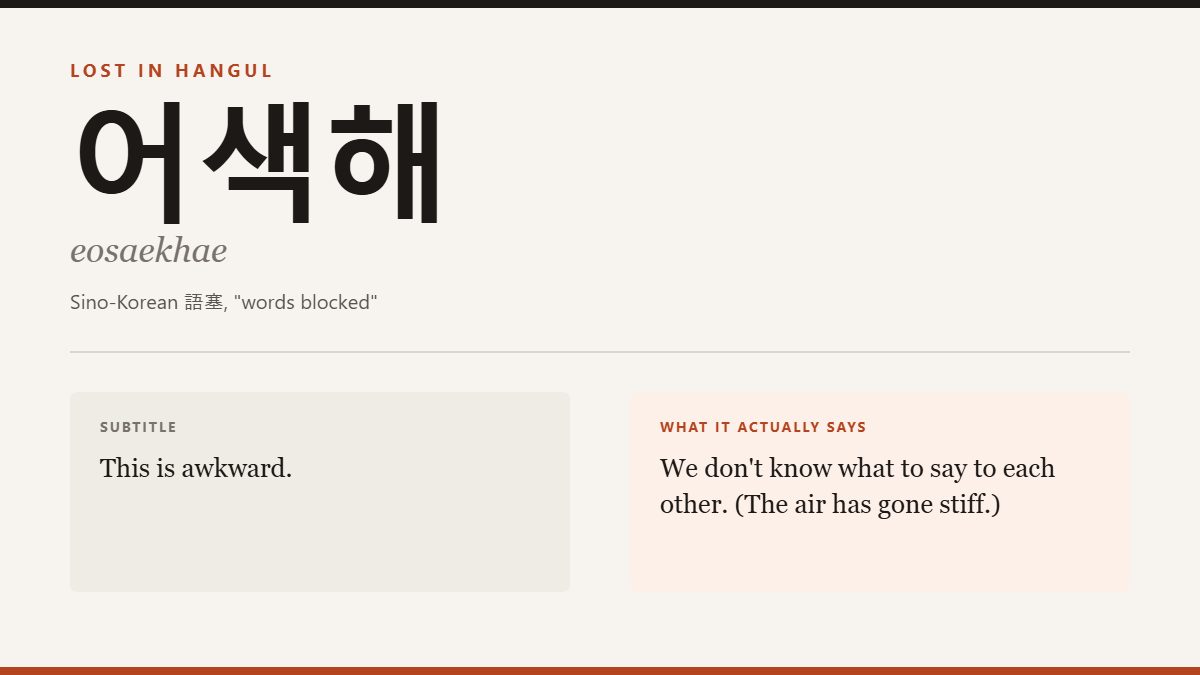
Short version: 어색하다 means awkward, stiff, unnatural. Two people who don’t know what to say to each other are 어색해. A sentence that sounds off is 어색해. A new haircut you aren’t used to is 어색해. What links them is that something doesn’t sit naturally yet. Its hanja are a small poem: 語塞, “words blocked.”
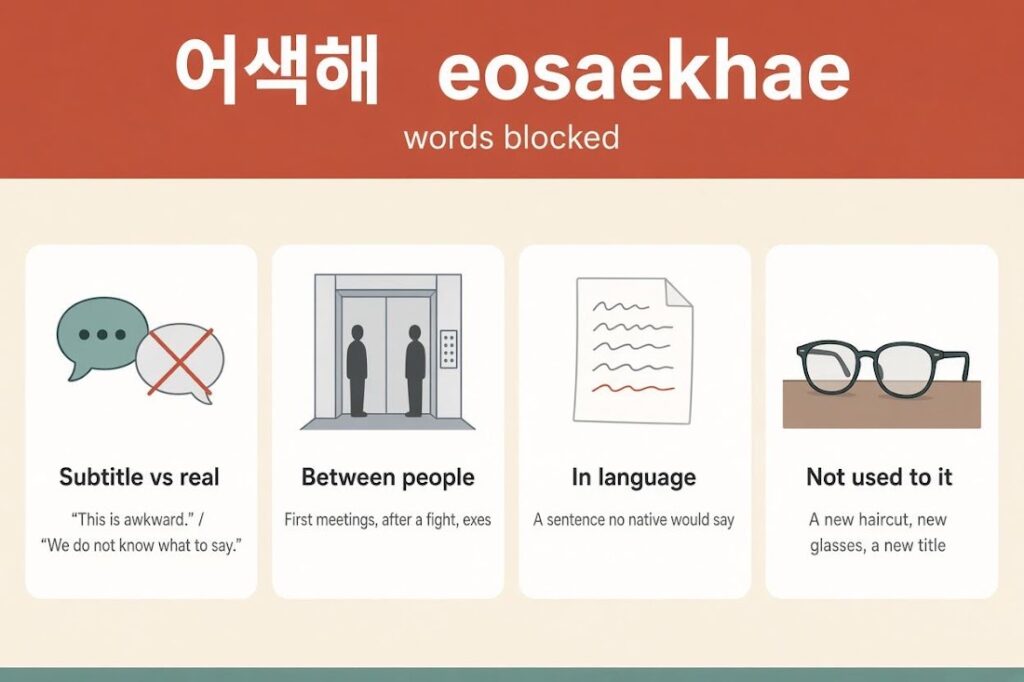
Three kinds of 어색
- Between people. First meetings, a blind date, two friends after a fight, exes in the same lift. 어색한 사이 is “an awkward relationship,” and 어색한 침묵 is the awkward silence.
- In language. 이 문장 좀 어색해 means “this sentence sounds unnatural.” Korean teachers say it about learners’ sentences constantly; it doesn’t mean wrong, it means no native would put it that way.
- With yourself. New glasses, a new suit, a new job title: 아직 어색해, “I’m not used to it yet.”
Korean has more than one “awkward”
| Word | What kind of awkward |
|---|---|
| 어색하다 | Stiff, unnatural, not yet at ease |
| 민망하다 | Embarrassing to be in or to watch; a bit shameful |
| 쑥스럽다 | Bashful, shy — when praised or put on the spot |
| 뻘쭘하다 | Left standing there; nobody responded (slang) |
| 오글거리다 | Cringe — toes curling at something cheesy |
Each fits a different moment. Two strangers in a lift: 어색해. Your friend sings badly and loudly at a wedding: 민망해. Your boss praises you in front of everyone: 쑥스러워. You wave at someone who was waving at the person behind you: 뻘쭘해. Your partner reads you a love poem they wrote: 오글거려.
Why first meetings run long
Korean first meetings can stay 어색 for a while for a structural reason. Before people relax, they usually need to settle who is older and what speech level to use. Until someone asks how old the other is, or suggests 말 놓을까요? — “shall we drop the formal speech?” — both sides stay in careful polite mode. That moment of switching is often what breaks the 어색함.
Where the word comes from
어색하다 is Sino-Korean: 語 “words” plus 塞 “blocked.” Dictionaries still list a sense close to the hanja — being stuck for an answer. It isn’t hard to see how “the words won’t come” spread into everything that feels unnatural, from a silence to a sentence.
To break the ice is 어색함을 깨다, and Koreans also borrow the English: 아이스브레이킹, a word you’ll hear at the start of group trips, orientation days and company workshops.
What subtitles do
어색해 itself is the easy one; “awkward” fits it well. The trouble is its neighbours. A character who is 민망해 (ashamed to be watching), one who is 쑥스러워 (shyly pleased) and one who is 뻘쭘해 (left hanging) can all end up saying “This is embarrassing” or “So awkward.” Korean viewers know which of the three it was, and it often changes how they read the scene. English viewers have to guess from faces.
Read next
- “Nunchi” (눈치) — subtitles say “reading the room,” and still miss it
- The moment they switch to 반말 — what just happened between them
- “Sseom” (썸) — the “something” before dating
Last reviewed: October 4, 2026