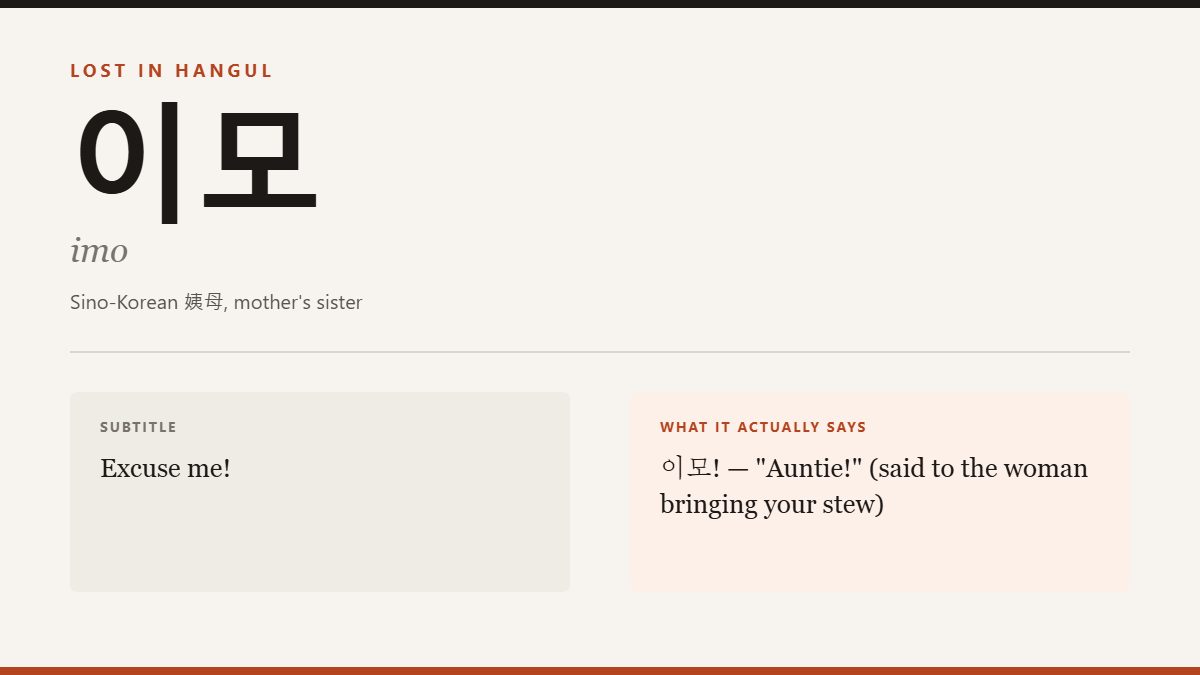
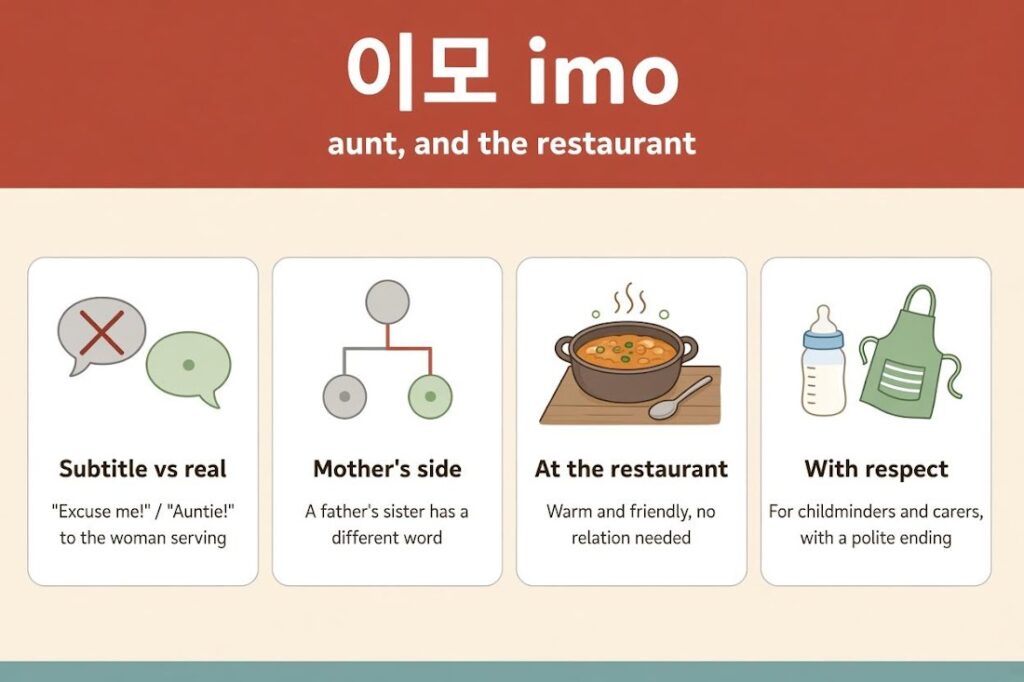
Short version: 이모 is your aunt on your mother’s side — your mother’s sister. Your father’s sister is a different word, 고모. Beyond the family, 이모 is the warm, everyday way to call a middle-aged woman working in a casual restaurant, and 이모님 is used for women who help in the home: childminders, housekeepers, carers. Children also call their mother’s close friends 이모.
The family version
English has “aunt” and “uncle” for everyone. Korean splits them by which parent they belong to.
| Relation | Korean |
|---|---|
| Mother’s sister | 이모 (her husband: 이모부) |
| Mother’s brother | 외삼촌 (his wife: 외숙모) |
| Father’s sister | 고모 (her husband: 고모부) |
| Father’s older brother | 큰아버지 (his wife: 큰어머니) |
| Father’s younger brother | 작은아버지, or 삼촌 if unmarried |
Where the word comes from
이모 is Sino-Korean, 姨母: 姨, a mother’s sister, and 母, mother. 고모 is 姑母, the father’s sister. The uncle words show Korea’s kinship arithmetic. 삼촌 is 三寸, “three degrees”: you are one step from your parent, and your parent’s brother is two more steps away. Your cousin, a step further still, is 사촌, “four degrees.” The 외 in 외삼촌 means “outside” and marks the mother’s side.
The restaurant 이모
In casual restaurants — barbecue, stew, noodle and snack places — customers call the woman serving or running the place 이모: 이모, 여기 반찬 좀 더 주세요. It is friendly and a little familial, and for many people it has replaced 아줌마, which can sound dismissive. A male server is more likely to get 사장님, 저기요, or occasionally 삼촌.
이모님
Add 님 and it becomes respectful. Families commonly call a childminder, a housekeeper or a postnatal carer 이모님. Using a family word for someone who works in the home is a very Korean solution: it makes the relationship personal and warm rather than purely professional.
Mum’s friends, and fans
Children call their mother’s close friends 이모, and their father’s friends 삼촌 or 아저씨. There is also 이모팬, “auntie fan”: an older woman who is a fan of a much younger idol or actor, and says so with a wink. The male equivalent is 삼촌팬.
이모 fits a woman around your parents’ age. For a server who looks your own age, it can land oddly — 저기요 (“excuse me”) is the safe choice. And if you’re a woman calling a slightly older woman, 언니 is the friendlier word.
What subtitles do
The biggest loss is in the family, not the restaurant. When a drama’s plot turns on which side of the family someone belongs to — a 고모 who never accepted the mother, a 이모 who took the children in — both women arrive in English as “aunt,” and the viewer has to work out the rest. In restaurant scenes, subtitles choose between “Auntie,” which leaves English viewers wondering if they’re related, and “Ma’am” or “Excuse me,” which keep the politeness and drop the warmth.
Read next
- “Ajumma” and “Ajusshi” (아줌마·아저씨) — the words for everyone’s aunt and uncle
- "Sajangnim" (사장님) — boss, shop owner, and anyone behind a counter
- "Appa" and "Eomma" (아빠·엄마) — and when they become 아버지 and 어머니
Last reviewed: October 4, 2026