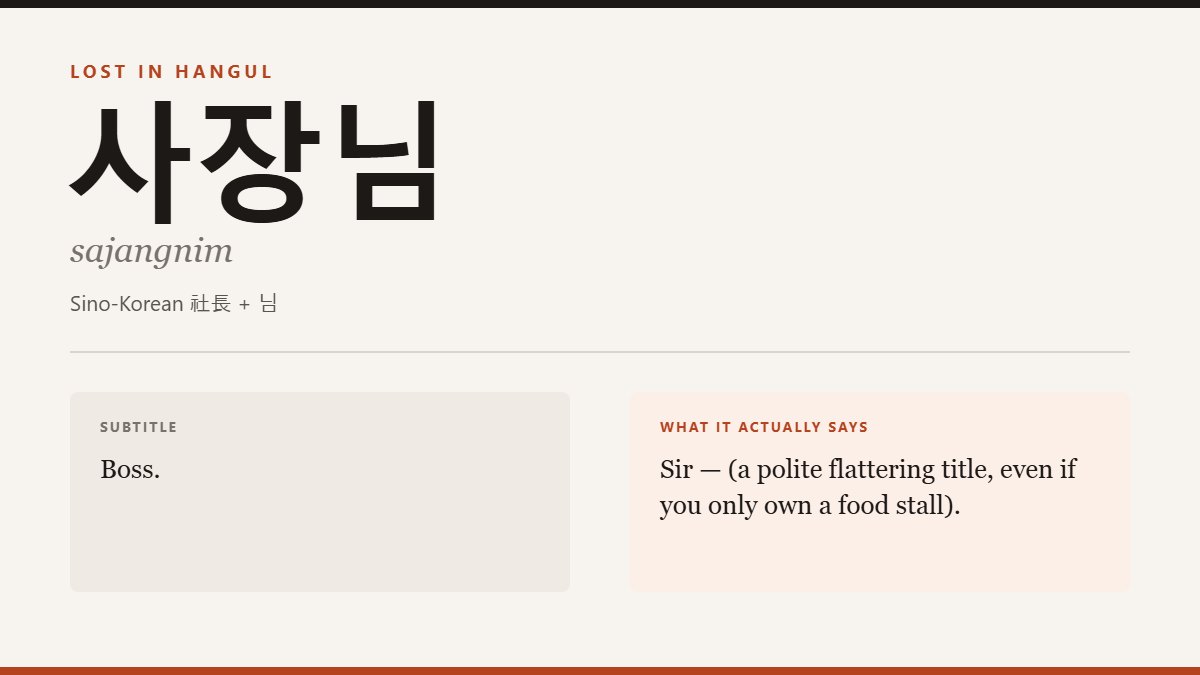
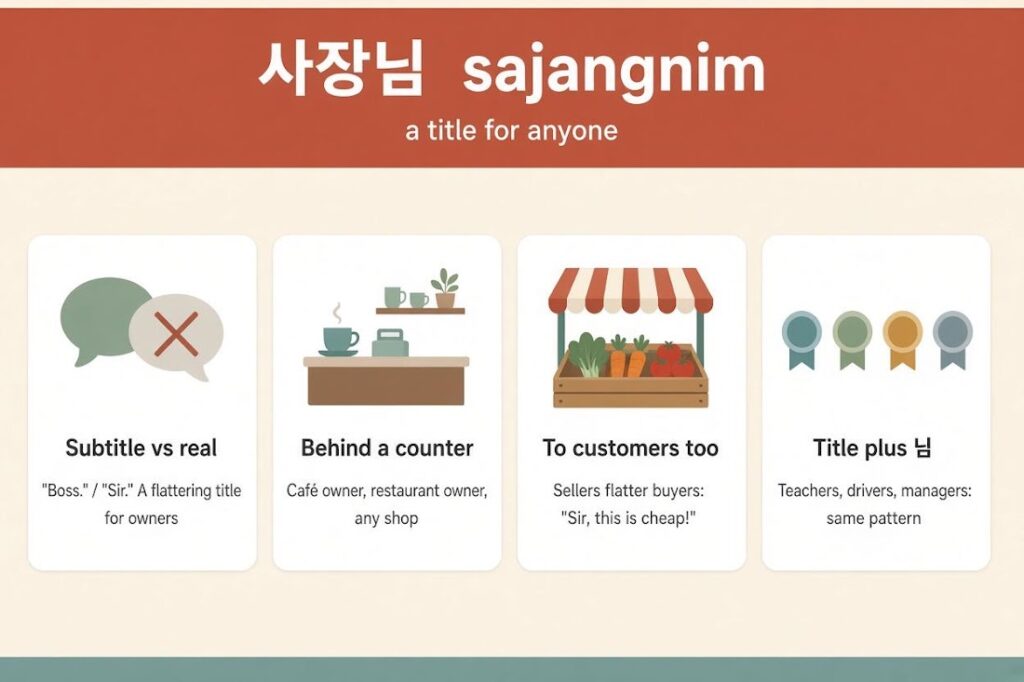
Short version: 사장님 officially means a company president. In daily life it is a polite title for almost anyone who might run a business — the owner of a café, a restaurant, a small shop — and a handy way to address a middle-aged man without calling him 아저씨. In markets, sellers even call their customers 사장님.
Where the word comes from
사장 is Sino-Korean, 社長: 社 “company” and 長 “head.” Add the honorific 님 and you have “respected head of the company.” In a large company the 사장님 is the president or CEO, and staff use the title rather than a name.
The everyday title
The word spread far beyond boardrooms because it solves a real problem. Korean needs a way to address adults without using “you” or a personal name, and kinship terms like 아저씨 can sound too casual. 사장님 is respectful, flattering, and safe:
- Café owner: 사장님, 아메리카노 하나 주세요
- Restaurant owner: 사장님, 여기 계산이요
- Delivery rider, taxi driver: often 기사님 instead, but 사장님 also works
- A woman running a shop: also 사장님 — the title isn’t gendered
Even if the person is only an employee, calling them 사장님 won’t offend. At worst it’s a small compliment they’ll correct with a laugh.
Customers as 사장님
In traditional markets and some shops, sellers call customers 사장님 or 사모님 (the boss’s wife). It’s pure flattery: treat the customer as important and they may buy more. You’ll hear it shouted across stalls: 사장님, 이거 싸요! — “Sir, this is cheap!”
The family of –님 titles
| Title | For |
|---|---|
| 사장님 | Owners, business people, “sir” |
| 선생님 | Teachers, doctors, professionals, respected strangers |
| 기사님 | Drivers, technicians |
| 부장님, 과장님 | Managers, by rank at work |
| 고객님 | Customers, in call centres and formal service |
The pattern is the same: job title plus 님. Korean prefers to call people by what they do rather than by name, and 님 makes it polite.
At work, using someone’s rank instead of their name is standard, and getting their rank wrong is a real mistake. Some Korean companies have tried switching everyone to “name + 님” or English first names to flatten the hierarchy, with mixed results.
What subtitles do
“Boss,” “sir,” “ma’am,” “Mr. Kim,” or the title is dropped. “Boss” is often the choice when a character calls a shop owner 사장님, and it gives English viewers the wrong idea — it sounds as if the character works for them. And when a market seller calls a young customer 사장님, the joke of the flattery is gone entirely.
Read next
- “Seonsaengnim” (선생님) — teacher, doctor, lawyer, stranger
- “-ssi” and “-nim” (씨 · 님) — the suffix that sets your rank
- "Ajumma" and "Ajusshi" (아줌마·아저씨) — the words for everyone's aunt and uncle
Last reviewed: September 26, 2026