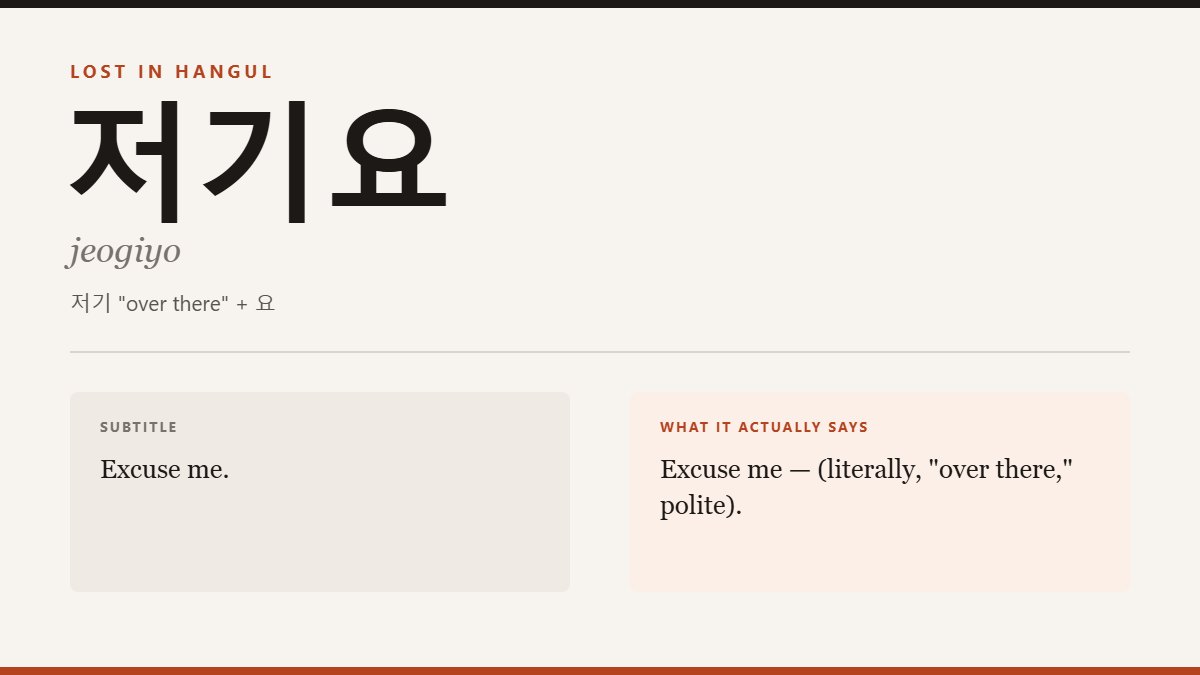
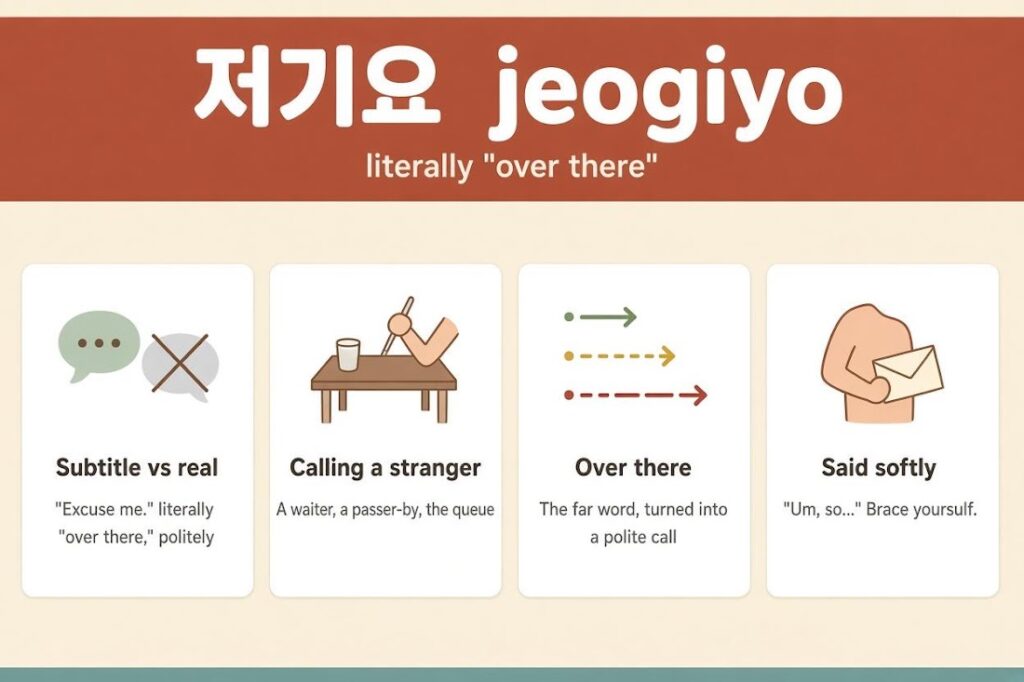
Short version: 저기요 is the standard way to get the attention of someone you don’t know — a waiter, a passer-by, the person in front of you in a queue. It literally means “over there,” with the polite ending 요. Said softly and trailing off, 저기… is also how people start a difficult sentence: “Um, so…”
Calling a stranger
English has “excuse me,” “sir,” “ma’am,” “hey.” Korean avoids most direct forms of address for strangers, so it uses a pointing word instead:
- 저기요 — “over there,” to someone at a distance or whose attention you need
- 여기요 — “over here,” to call a waiter to your table
- 실례합니다 — “excuse me” in the sense of “sorry to intrude”
At a restaurant, 여기요! and 저기요! are both normal, said clearly and not rudely. Many Korean restaurants also have a call button on the table, which removes the need altogether.
Where the word comes from
저기 is native Korean and part of a three-way set of place words:
| Word | Meaning |
|---|---|
| 여기 | Here (near me) |
| 거기 | There (near you) |
| 저기 | Over there (away from us both) |
Adding 요 turns the place word into a polite call. You are not really saying “over there”; you are pointing at the person with your voice, politely.
The hesitant 저기
The same word has a second life. Said slowly, without 요, 저기… is a filler that opens something awkward:
- 저기… 할 말 있어 — “Um… there’s something I need to tell you.”
- 저기, 혹시… — “So, by any chance…”
- 저기 있잖아 — “You know what…”
In dramas, this 저기 often comes right before a confession, an apology, or bad news. Korean viewers hear it as “brace yourself.”
Other ways to get attention
- 이모! / 사장님! — at a small restaurant, warmer than 저기요
- 학생! — “student!”, how older people call a young stranger
- 아저씨! / 아가씨! — possible, but can be risky or old-fashioned
아가씨, “young lady,” was once standard for calling a young woman. It has fallen out of favour because it’s also been used in contexts many women find demeaning. 저기요 is the safe choice.
What subtitles do
“Excuse me” for the call and “Um” or “So” for the hesitant version. Both are good. The loss is in how often Korean relies on it. A character who can’t bring themselves to say someone’s name and keeps saying 저기요 instead — to a person they are getting close to — is holding back, and the English “Excuse me” just sounds oddly formal rather than shy.
Read next
- "Ajumma" and "Ajusshi" (아줌마·아저씨) — the words for everyone's aunt and uncle
- “Seonsaengnim” (선생님) — teacher, doctor, lawyer, stranger
- “Eotteokhae” (어떡해) — not a question, despite appearances
Last reviewed: September 26, 2026