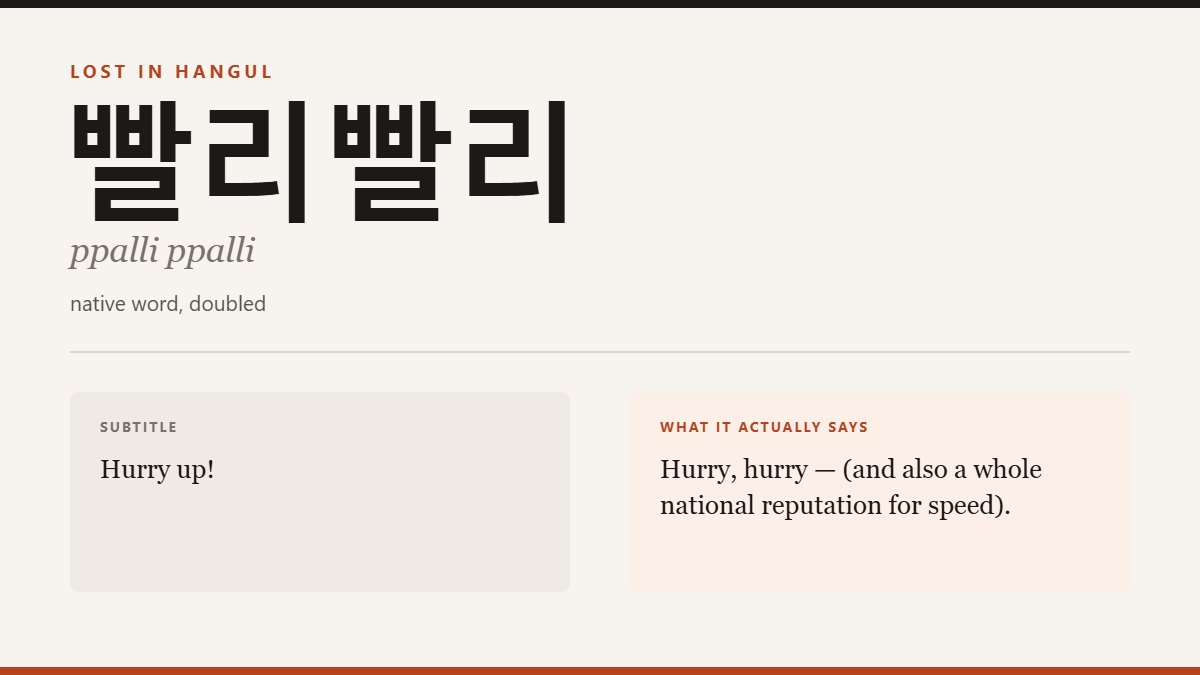
Short version: 빨리 means “quickly.” Doubled, 빨리빨리 means “hurry, hurry!” — and it has become a nickname for Korea’s famously fast pace of life, from same-day delivery to the elevator “close door” button that gets pressed before anyone has finished stepping in.
The everyday word
- 빨리 와 — come quickly
- 빨리빨리 해 — hurry up and do it
- 빨리 좀! — come on, faster!
- 빨리요 — polite, “quickly, please”
Doubling adds urgency and a little impatience. It’s what parents say to children in the morning and what managers say near a deadline.
Where the word comes from
빨리 is native Korean, the adverb form of 빠르다, “to be fast.” Repeating a word for emphasis is common in Korean — 천천히 천천히 (“slowly, slowly”), 조심조심 (“carefully, carefully”) — so 빨리빨리 is ordinary grammar. What makes it special is that it became a label for a culture.
빨리빨리 문화
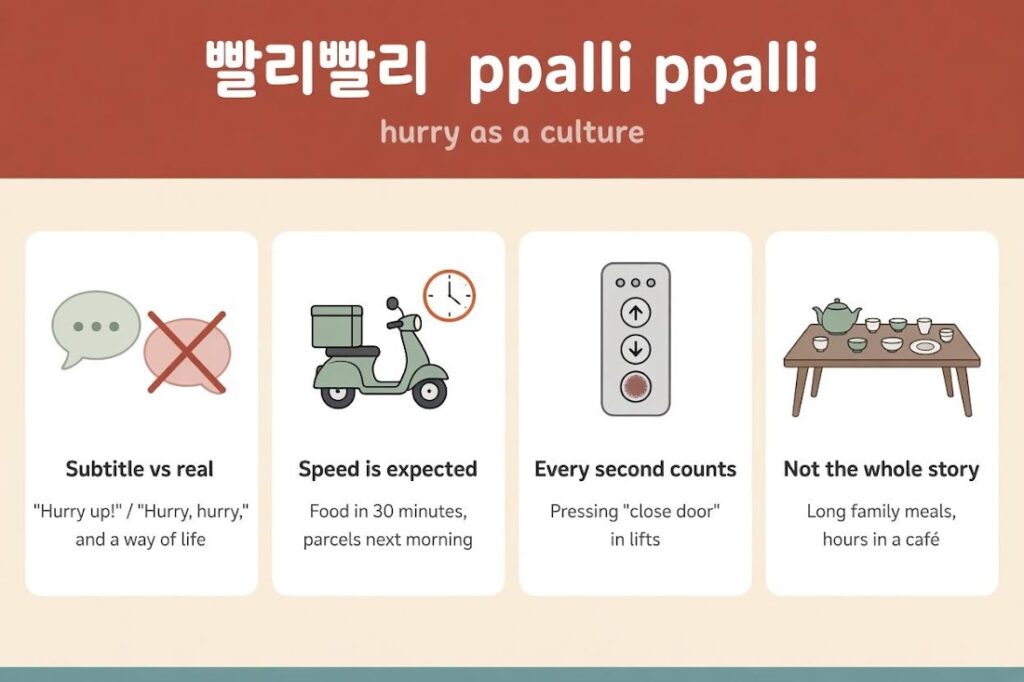
“빨리빨리 culture” is how Koreans themselves describe the national love of speed. Commonly cited examples:
| Example | What people mean |
|---|---|
| Food delivery in 30 minutes, or less | Speed is expected, not a bonus |
| Next-morning or same-day parcels | Waiting feels unnecessary |
| Pressing “close door” in lifts | Every second counts |
| Fast internet, fast paperwork | Slowness feels like failure |
It’s said with both pride and complaint. Speed is a point of national pride when compared to slower systems abroad, and a source of stress when it means long hours and no patience.
Where the culture comes from
The usual explanation ties it to the extraordinarily rapid industrialisation of South Korea in the second half of the twentieth century, when the country changed faster than almost anywhere else. That’s a reasonable story, and many Koreans tell it. But it’s an explanation after the fact; nobody can prove that one caused the other, and national-character stories always simplify.
Foreigners who work in Korea often say 빨리빨리 is one of the first Korean phrases they learned, because they heard it constantly. It’s also, somewhat less kindly, one of the first phrases some foreign workers were shouted at with.
The limits of the stereotype
Plenty of Korean life is slow: long family meals, hours in a café, the patience of traditional crafts. And younger Koreans increasingly push back against the pace — the rise of words like 워라밸 (work–life balance) is partly a reaction. So treat 빨리빨리 as a real habit and a real word, but not a full description of a people.
What subtitles do
“Hurry up,” “Quick,” “Come on, faster.” These are correct. What’s lost is the cultural shorthand. When a character complains about 빨리빨리 문화, or a foreign character sighs 빨리빨리 back at a Korean one, the line is about a whole society. “Hurry, hurry” in English doesn’t carry that weight.
Read next
- “Gukrul” (국룰) — the national rule nobody voted on
- “Gatsaeng” (갓생) — the “god life”, meant sincerely and as a joke
- “Dapdaphae” (답답해) — not frustrated. Something tighter than that.
Last reviewed: September 26, 2026