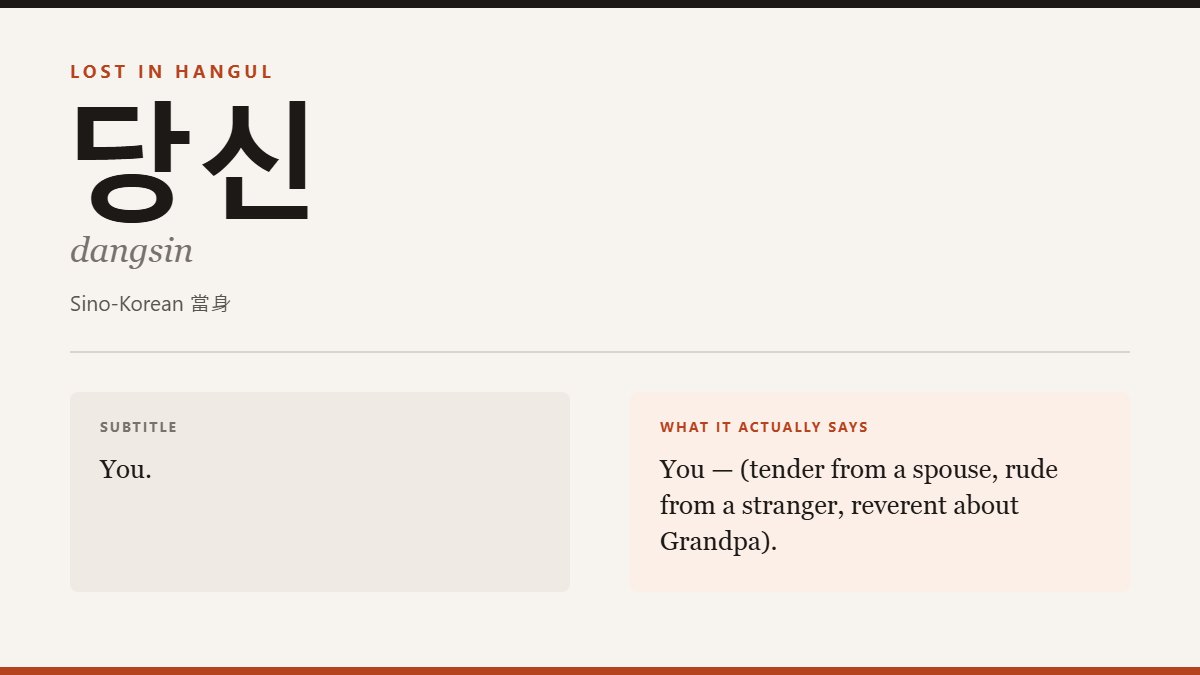
Short version: 당신 is listed in textbooks as the polite word for “you.” In practice, Korean speakers rarely use it that way. It’s what long-married couples call each other, what strangers spit at each other in an argument, a common word in songs and ads, and — in a completely different use — a respectful pronoun for an absent elder.
Why Korean avoids “you”
Korean prefers not to address people with a pronoun at all. Instead, it uses names, titles, or kinship terms: 선생님, 사장님, 언니, 민수 씨. Pronouns like 너 (casual “you”) are only for close friends and people younger than you. That leaves 당신 in an odd place — a polite-looking “you” with nowhere comfortable to go.
The four uses
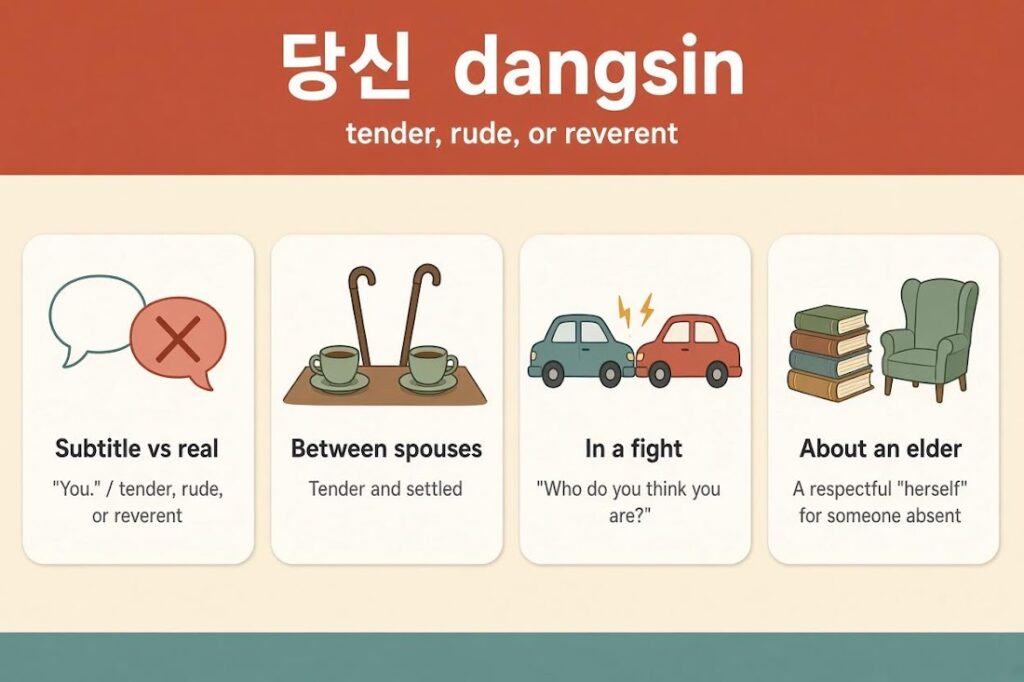
| Use | Example | Feel |
|---|---|---|
| Between spouses | 당신 밥 먹었어? | Tender, settled |
| In an argument | 당신이 뭔데? | Hostile, “who do you think you are?” |
| Songs, ads, poems | 당신을 위한… | Addressing an idealised “you” |
| About an absent elder | 할아버지는 당신의 책을… | Deeply respectful “his own” |
The fighting 당신
If a stranger calls you 당신 in person, something is wrong. It’s the pronoun of arguments between adults who don’t know each other: drivers after a crash, neighbours over noise. 당신이 뭔데? — “Who do you think you are?” — is a classic line. Using it to someone you’d normally address with a title strips away the respect and treats them as an opponent.
The respectful 당신
This use surprises even intermediate learners. When talking about a respected elder who isn’t present, 당신 can serve as a reflexive “himself” or “herself,” showing deep respect: 할머니는 당신보다 자식들을 먼저 생각하셨다 — “Grandmother always thought of her children before herself.” It’s formal and a little literary, and it’s the opposite of the fighting 당신.
Where the word comes from
당신 is Sino-Korean, 當身: roughly “the very person.” Its range of meaning — from reverent to hostile — developed over time as Korean moved away from using second-person pronouns in polite speech. When there’s no neutral polite “you,” any word that tries to fill the slot ends up coloured by the situations it survives in.
Advertising uses 당신 because it needs to address an unknown reader. “당신을 위한 선택” — “a choice for you” — sounds fine on a poster, even though the same sentence said face to face to a stranger might sound strange.
What subtitles do
“You.” There is simply nothing else. When an old couple say 당신, English viewers see the neutral pronoun and miss the tenderness. When a stranger says 당신 in a confrontation, the line might get “Who the hell are you?” — which captures the heat, correctly, by adding words. The reverent use is usually rewritten as “herself,” and the respect is quietly lost.
Read next
- The moment they switch to 반말 — what just happened between them
- “Uri” (우리) — why she says “our mom” about her own mother
- Hyung, Nuna, Sunbae — three words your subtitle turned into “you”
Last reviewed: September 26, 2026