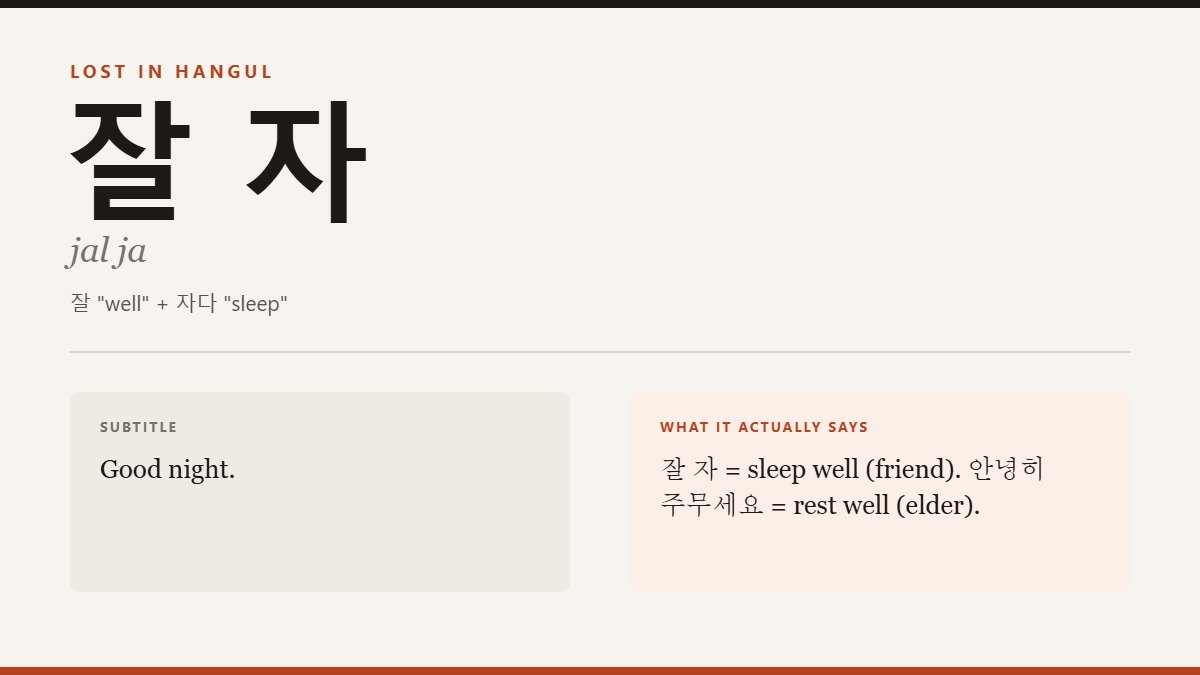
Short version: 잘 자 means “sleep well” and is what you say to friends, partners and children. To parents and older people you say 안녕히 주무세요, which uses the honorific verb for sleep. There are also sweeter and slangier versions. Subtitles turn all of them into “Good night.”
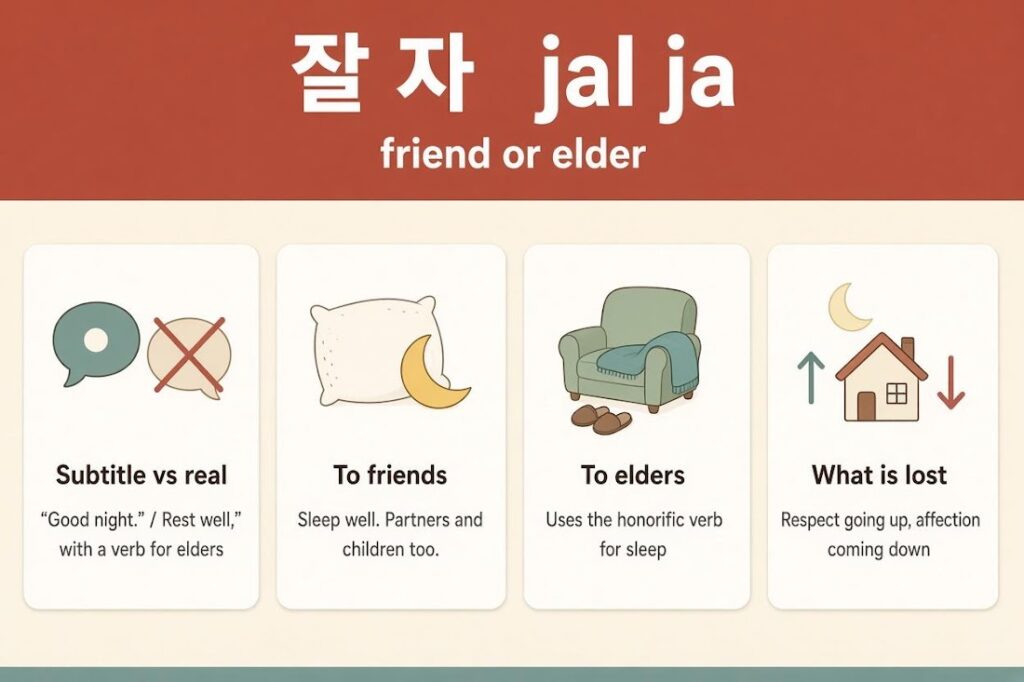
The goodnights
| Phrase | Literally | To whom |
|---|---|---|
| 잘 자 | Sleep well | Friends, partner, children |
| 잘 자요 | Sleep well (polite) | Near-equals you’re polite with |
| 안녕히 주무세요 | Sleep peacefully (honorific verb) | Parents, grandparents, elders |
| 좋은 꿈 꿔 | Have good dreams | Partner, children |
| 굿밤 | “Good night” in Konglish | Casual, playful, texting |
Families with children often have a bedtime routine: the child bows or hugs and says 안녕히 주무세요 to the grandparents, then gets 잘 자 back. The two sides of the exchange use different words for the same sleep.
Where the phrases come from
잘 means “well” and 자다 means “to sleep”; both are native Korean. 주무시다 is the honorific verb for sleeping, used only about people you respect. 안녕히 is “in peace,” the same 안녕 as in hello and goodbye. So 안녕히 주무세요 is a respectful wish that the elder sleeps peacefully.
In the morning, the matching question is 안녕히 주무셨어요? — “Did you sleep well?” — asked of older family members. Friends just say 잘 잤어?
The couples’ version
Couples add a lot: 잘 자, 좋은 꿈 꿔, 사랑해, sometimes all three, sometimes with a string of hearts in text. 꿈에서 만나 — “see you in my dreams” — is a sweet, slightly corny sign-off. Friends who hear someone ending a phone call like that will tease them.
Getting this wrong has a small comic effect. A grown man saying 잘 자 to his father-in-law sounds startlingly casual. A young woman saying 안녕히 주무세요 to her boyfriend sounds oddly formal — or as if she’s being sarcastic after a fight.
Other bedtime phrases
- 푹 자 — sleep deeply, get some real rest
- 얼른 자 — go to sleep already (to a child, or a friend up too late)
- 잘 자라, 우리 아가 — sleep well, my baby (the opening of a well-known lullaby)
What subtitles do
“Good night” for all of them, or occasionally “Sleep well.” That’s the only practical choice. What gets lost is the family structure the phrases carry. A drama scene where a grandchild says 안녕히 주무세요 and the grandmother answers 그래, 잘 자라 is a small, complete picture of Korean family politeness — respect going up, affection coming down. In English, it’s two people saying “Good night.”
Read next
- The verbs that change for your grandmother — and why subtitles can't show it
- The moment they switch to 반말 — what just happened between them
- “Bap meogeosseo?” (밥 먹었어?) — not really a question about food
Last reviewed: September 26, 2026