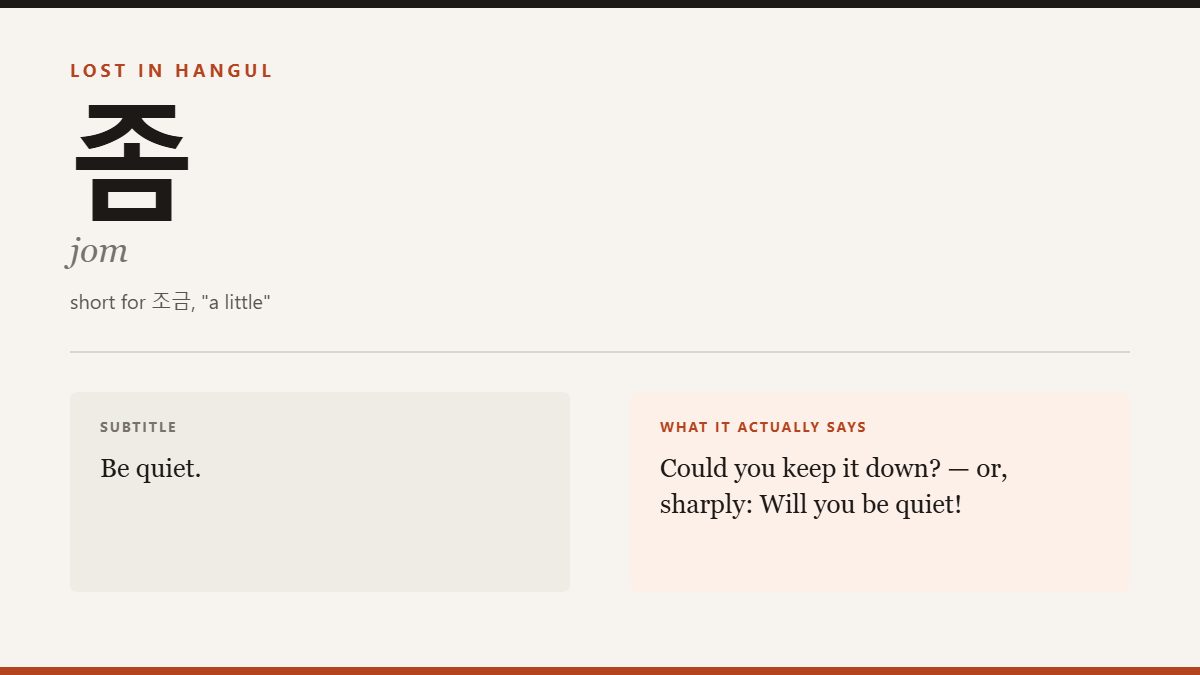
Short version: 좀 is the shortened form of 조금, “a little,” and sometimes it means exactly that. More often it isn’t measuring anything. In a request it works like “please” or “just.” In a complaint it works like “will you.” And in 노래 좀 하네, it means the opposite of a little: “you can actually sing.”
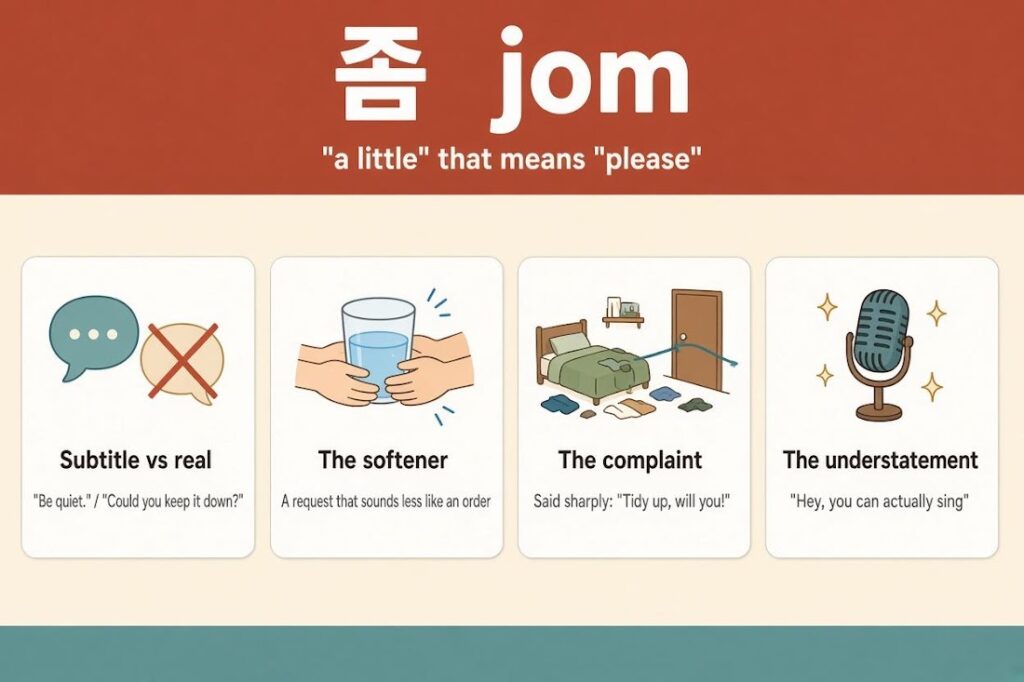
Amount, softener, complaint, understatement
| Use | Example | Roughly |
|---|---|---|
| Amount | 좀 더 주세요 | A little more, please |
| Softener | 이것 좀 봐 줄래? | Could you take a look at this? |
| Irritation | 아, 좀! | Oh, come on! / Stop it! |
| Understatement | 너 노래 좀 하네? | Hey, you can really sing |
The softener
Korean speakers put 좀 into requests almost without thinking: 물 좀 주세요, 문 좀 열어 줘, 사진 좀 찍어 주실 수 있어요? In 물 좀 주세요, nobody is asking for a small amount of water. The 좀 lowers the pressure of the request, the way “just” or “could you” does in English. Without it, the sentence is still correct, but it sounds more like an instruction.
This is why 좀 is one of the most common words in spoken Korean, and why subtitles drop it so often. It carries no facts. It carries manners.
The irritated 좀
Change the voice and the same word turns sharp. 좀 가만히 있어 — “Can you just sit still?” — is what a parent says to a fidgeting child for the third time. 제발 좀 is “for once, please.” And 아, 좀! on its own is pure exasperation: “Oh, come on!”
The logic is the same as English “will you” in “Be quiet, will you.” A polite softener, repeated with impatience, becomes a complaint. Online and in casual speech you’ll also see it written 쫌, which adds emphasis.
The understatement
- 노래 좀 하네 — “you can actually sing” (grudging, impressed)
- 좀 치는데? — said about someone’s tennis, pool or piano: “not bad at all”
- 좀 사는 집 — a family that is fairly well-off (literally “lives a little”)
- 좀 많이 늦었어 — “I’m quite late,” literally “a little a lot”
And there is the polite refusal. Asked what you think of something, 음, 그건 좀… — “Hmm, that’s a bit…” — trailing off is a clear no. Nobody needs the rest of the sentence.
Where the word comes from
좀 is native Korean, a contraction of 조금, “a little.” 조금 is still used in full, especially in writing and careful speech. 쪼금 is a dictionary word too, the stronger form of 조금. 쫌 is just an informal spelling of 좀.
Similar but different
| Word | Means | Note |
|---|---|---|
| 조금 | A little | The full form; neutral, fine in writing |
| 약간 | Slightly | Sino-Korean 若干; mostly about amount, but in casual talk also a hedge, “kind of” |
| 살짝 | Lightly, a touch | Casual; also “secretly” |
| 제발 | Please, I beg you | Emotional; often paired with 좀 |
If you are learning, put 좀 in your requests when you ask someone to do something for you. It makes you sound far less blunt. Just watch your tone: a bright 좀 asks a favour, a flat one sounds annoyed.
What subtitles do
Picture a mother asking her son to tidy his room. First it’s 방 좀 치워 줄래? — “Could you tidy your room?” Ten minutes later it’s 방 좀 치워! — “Tidy your room, will you!” Korean viewers hear her patience run out through the same little word. In the subtitles, the first 좀 usually vanishes and the second becomes “will you,” if it survives at all. The understatement fares no better: 노래 좀 하네 tends to become “You’re a good singer,” and the teasing, half-reluctant admiration goes with it.
Read next
- The Korean words subtitles always delete (and why translators do it)
- "Jeogiyo" (저기요) — "excuse me," literally "over there"
- “Gwaenchanayo” (괜찮아요) — it also means “no thank you”
Last reviewed: October 4, 2026