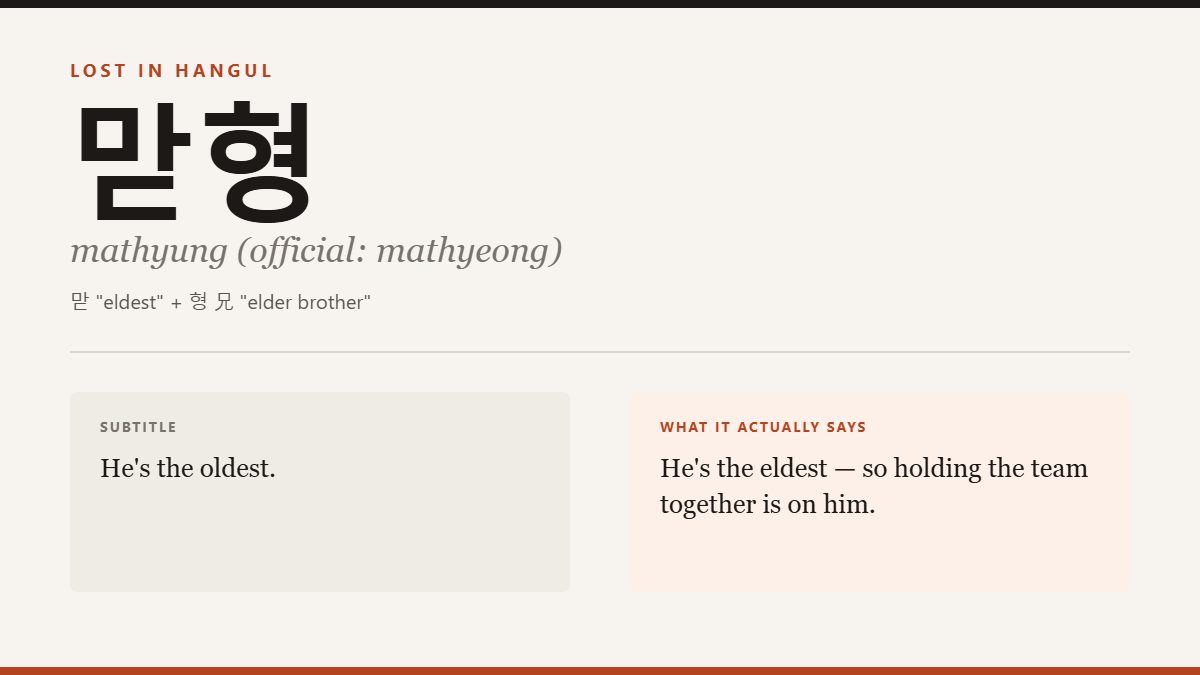
Short version: 맏형 means “eldest brother.” In a family, it’s the first-born of the brothers. Outside the family, it’s the oldest man in a group — an idol group, a national team, a team at work — and the title comes with a job: steady everyone, take responsibility, set the example. It’s pronounced “ma-tyeong,” because the ㄷ and ㅎ merge into a ㅌ sound. But the official romanization keeps the h in nouns, so it’s written mathyeong — which means the fans’ usual spelling, mathyung, is closer to the rule than it looks.
Where the word comes from
맏 is a native Korean prefix meaning “first-born, eldest.” It shows up across family vocabulary: 맏이 (the eldest child), 맏아들 (eldest son), 맏딸 (eldest daughter), 맏며느리 (the eldest son’s wife, a role that traditionally came with heavy duties). 형 is Sino-Korean, 兄, elder brother. So 맏형 is half native and half Sino-Korean: the first of the elder brothers.
The women’s version is 맏언니, the eldest sister — or the oldest woman in a group.
At home, people mostly say 큰형
Inside a family, younger brothers usually call the eldest 큰형 (“big brother”) or simply 형. 맏형 sounds more like a description than something you shout down the hall. That is why you meet it most in news reports and fandom, where someone is being described as the eldest rather than addressed.
In a group, it’s a role
- Idol groups: the oldest member is the 맏형 (or 맏언니), and he is not necessarily the leader. In BTS, for example, the leader is RM, while the 맏형 is Jin, the oldest member.
- Sports: Korean sports reporting routinely calls the oldest player on a national team “대표팀 맏형,” usually when he is the one speaking for the team or keeping morale up.
- Work: the oldest man on a team may be called the team’s 맏형, half jokingly, when he takes charge of the dinner or calms an argument.
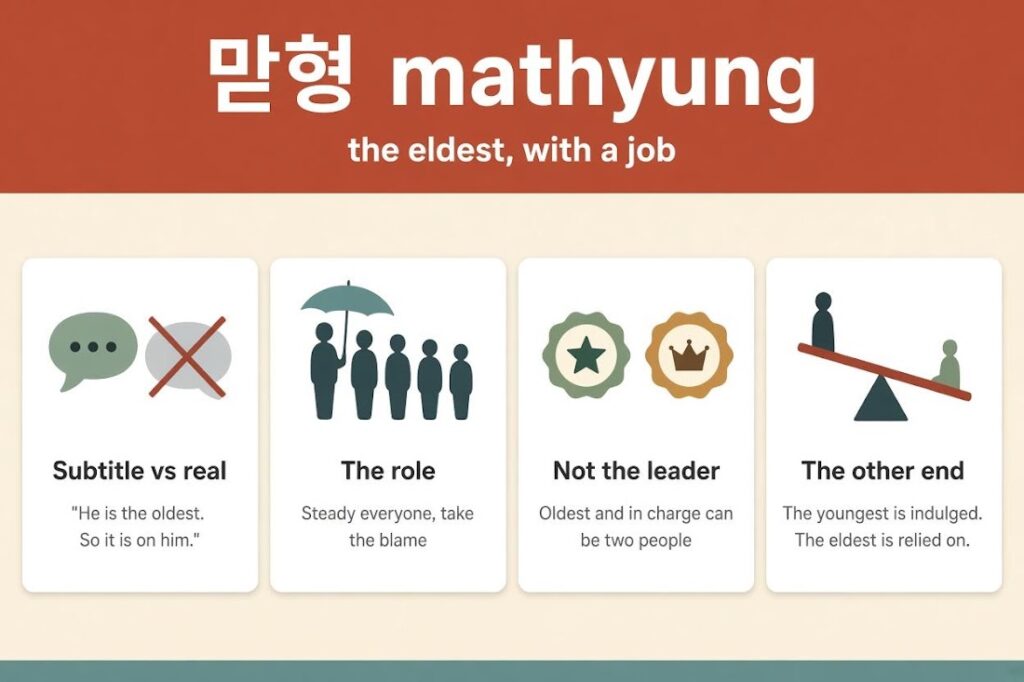
The expectations mirror the ones for the 막내 at the other end. The youngest is indulged and runs errands; the eldest is relied on. He is supposed to be the calm one, smooth over fights between the younger members, and be the last to fall apart.
The words around it
| Word | Means | Where you hear it |
|---|---|---|
| 맏형 | Eldest brother; oldest man in a group | News, fandom, descriptions |
| 큰형 | Eldest brother | Family, everyday |
| 맏언니 | Eldest sister; oldest woman in a group | Girl groups, women’s teams |
| 맏이 | The first-born child | Family |
| 장남 | Eldest son (長男) | Formal, documents |
| 막내 | The youngest | Everywhere |
Being 맏형 is about age, nothing else. He doesn’t have to be anyone’s actual brother, and he doesn’t have to be in charge. That separation — eldest on one side, leader on the other — is normal in Korean groups and often a running joke when the eldest is the least organised person in the room.
What subtitles do
The team is falling apart, and a younger member turns to the oldest one: 형이 맏형이잖아. The subtitle reads “You’re the eldest, aren’t you?” — which sounds like a remark about birth years. In Korean it’s a summons: you’re the 맏형, so step up and fix this. “The oldest” and “the eldest member” are accurate translations of the word and silent about the job that comes with it.
Read next
- “Maknae” (막내) — the youngest is a job, not a fact
- Hyung, Nuna, Sunbae — three words your subtitle turned into “you”
- “Dongsaeng” (동생) — younger sibling, and anyone you’ve adopted as one
Last reviewed: October 4, 2026