Short version: 한 is the ache that builds when something was taken from you, or never given, and there was nothing you could do about it. It is not quite grief, not quite resentment, and not quite regret. It is what those three leave behind when they are held in for a long time.
What it describes
The shape of 한 is specific. Something unfair happened. The person could not fight it, fix it, or even say it out loud. Years pass, and the feeling does not fade. It hardens.
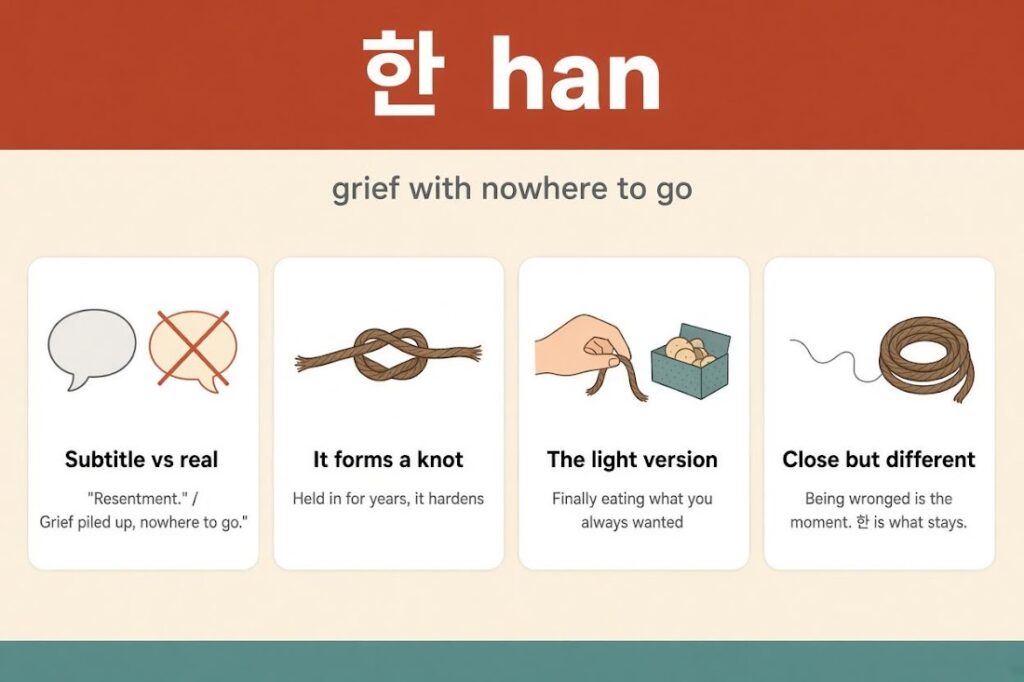
That is why Korean describes 한 with verbs of knotting and binding. 한이 맺히다 means han “forms a knot.” A person who died with an unfulfilled wish is said to have died with 한 in them. The opposite verb is 풀다, to untie: 한을 풀다 is to finally release it.
- A mother who could not go to school because her brothers were sent instead, still bringing it up at seventy.
- A family separated by the division of the peninsula, waiting decades for a reunion list.
- A man who worked for a company for thirty years and was let go with a phone call.
In each case, the injustice is only half of it. The other half is that it had nowhere to go.
Where the word comes from
한 is Sino-Korean, 恨. The same character appears in Chinese and Japanese with a meaning closer to “resentment” or “regret.” The Korean word has drifted toward something broader and heavier, and it combines into compounds such as 원한 (怨恨, a grudge against someone) and 통한 (痛恨, bitter regret).
The idea of han as a national emotion is a separate question, and it is debated. Several scholars have argued that the picture of Koreans as a people defined by han took shape in the twentieth century, partly through colonial-era writing that described Korean art as sorrowful, and was then taken up and reshaped by Korean writers after liberation. Others see it as older. The word itself is old. The claim that it is uniquely Korean is the part to treat with care.
The everyday, lighter version
Here is the part that surprises learners. 한풀이, “untying han,” is also used jokingly about ordinary things.
- Someone who was never allowed junk food as a kid buys a whole box of snacks at thirty: 어릴 때 한풀이.
- A student who failed an exam three times finally passes and throws a party: that is 한풀이 too.
- After a diet, eating fried chicken at midnight is, half seriously, 한풀이.
The joke works because everyone knows the heavy meaning. Using it for snacks is the same move as calling a missed bus “a tragedy” in English.
How it differs from nearby words
| Word | What it is | Time scale |
|---|---|---|
| 억울하다 | Being wronged and unable to prove it | Now, this situation |
| 서운하다 | Hurt that someone close fell short | Recent, personal |
| 원한 | A grudge aimed at a specific person | Long, with a target |
| 한 | Accumulated grief with no outlet | Years, sometimes a lifetime |
억울함 that is never resolved can become 한. That is a reasonable way to think about the relationship: 억울하다 is the moment, 한 is what the moment turns into when it stays.
You will read that “there is no English word for han.” That is true of a single word, but English speakers know the feeling perfectly well. What English lacks is a common, everyday noun that people use about their own families at the dinner table. Korean has one.
What subtitles do
Subtitles usually pick “resentment,” “grief,” or “bitterness,” and sometimes drop the word and let the actor’s face carry it. When a character says 한이 맺혔다, you may see “It still hurts” or “I never got over it.” Both are fair. What is lost is the sense that this has been sitting in someone for years, and that everyone else in the scene recognises it at once.
When a character says 한풀이 about a plate of food, the subtitle almost always goes flat: “I’ve been dying to eat this.” The joke about the heavy word disappears.
Read next
- “Eogulhada” (억울하다) — wronged, and unable to prove it
- “Seounhada” (서운하다) — the hurt you feel slightly embarrassed about
- “Jeong” (정) — the bond English never got a word for
Last reviewed: September 26, 2026