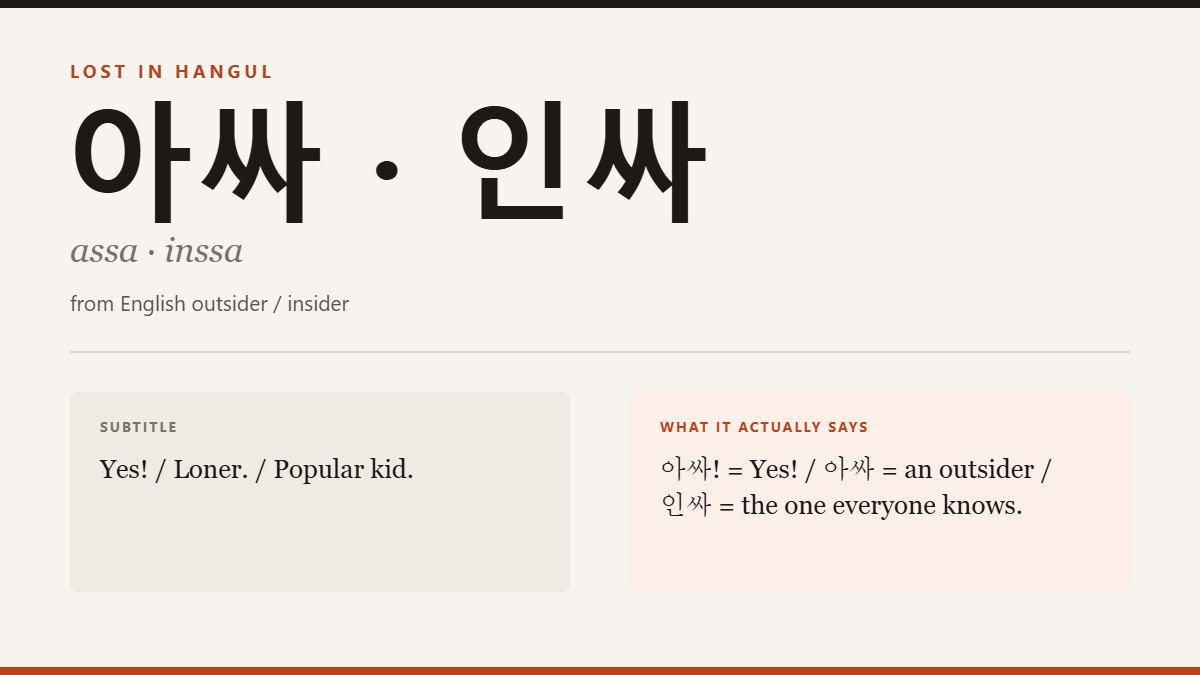
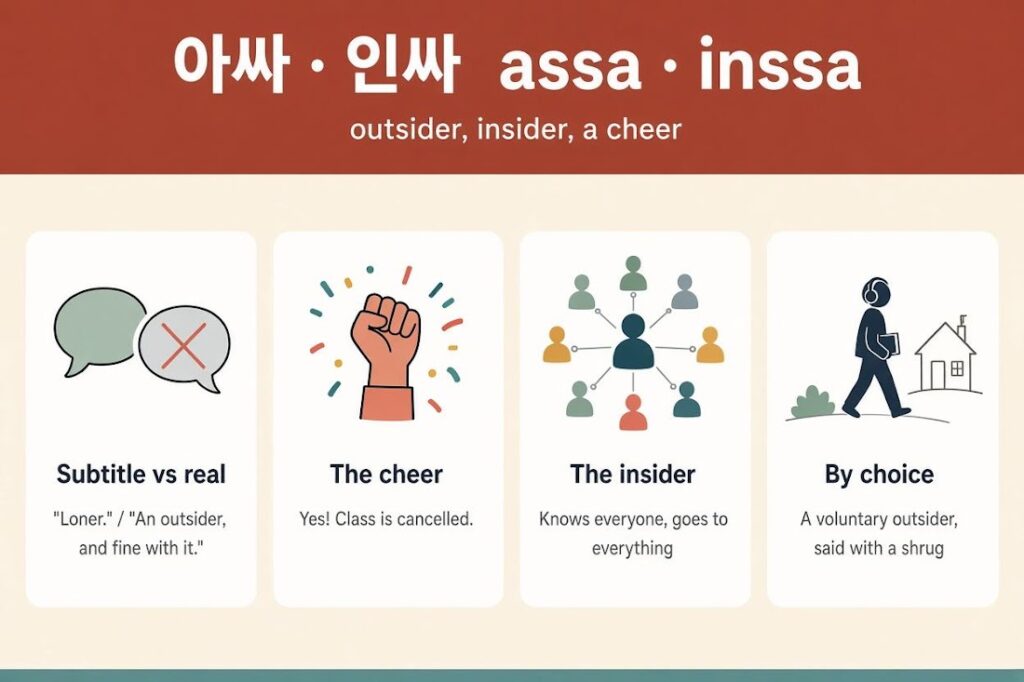
Short version: 아싸 has two meanings that sound identical. As an exclamation, it is “Yes!” — the cheer when something goes your way. As a noun, it is short for 아웃사이더, “outsider,” the person who isn’t part of the crowd. Its opposite is 인싸, from 인사이더, “insider,” the socially connected one.
The cheer
아싸! is an old exclamation of delight: winning a game, getting the last piece of cake, hearing that class is cancelled. It is casual and a little childish. A playful extended version, 아싸 가오리, adds the word for stingray purely because it sounds fun — there’s no deeper meaning.
The outsider
The noun 아싸 comes from clipping 아웃사이더, the Korean spelling of “outsider.” It became common among university students in the 2010s to describe people who did not take part in the social life of their department — no drinking parties, no clubs, eating alone.
Its opposite, 인싸, comes from 인사이더, “insider.” An 인싸 knows everyone, goes to everything, and is always up on the latest trend.
| Word | Meaning |
|---|---|
| 인싸 | The socially connected, popular one |
| 핵인싸 | “Nuclear insider” — extremely popular |
| 인싸템 | An “insider item,” something trendy everyone has |
| 아싸 | An outsider |
| 자발적 아싸 | A voluntary outsider — by choice |
The attitude shift
At first, 아싸 was mildly pitying. Over time it has been claimed with pride. 자발적 아싸, “voluntary outsider,” describes someone who opts out of forced group activities on purpose: they would rather study, work, or go home. The phrase reflects a broader shift among younger Koreans toward valuing privacy and personal time over group obligation.
People now call themselves 아싸 cheerfully. It can mean “I don’t do group drinking,” “I’m an introvert,” or simply “I didn’t know about that trend.”
인싸 has a slightly teasing edge too. Calling someone a 핵인싸 can be admiring or can hint that they are trying hard. Tone does the work.
Where these come from
Both 아싸 and 인싸 are Korean clippings of English loanwords, a very common pattern: take the first syllable of each part and join them. The same process gives 셀카 (self camera, selfie) and 에어컨 (air conditioner). The exclamation 아싸 is older and unrelated — it just happens to sound the same.
What subtitles do
The cheer becomes “Yes!” or “Score!”, which is fine. The noun becomes “loner” or “outsider,” and 인싸 becomes “popular kid” or “social butterfly.” These are close but tilt negative: “loner” in English suggests sadness or isolation, while 아싸 is often said with a shrug. And when a character plays on both meanings — cheering 아싸! and then admitting they’re an 아싸 — the pun has no chance.
Read next
- “Gatsaeng” (갓생) — the “god life”, meant sincerely and as a joke
- “Gukrul” (국룰) — the national rule nobody voted on
- “TMI” in Korean means the opposite of TMI in English
Last reviewed: September 26, 2026