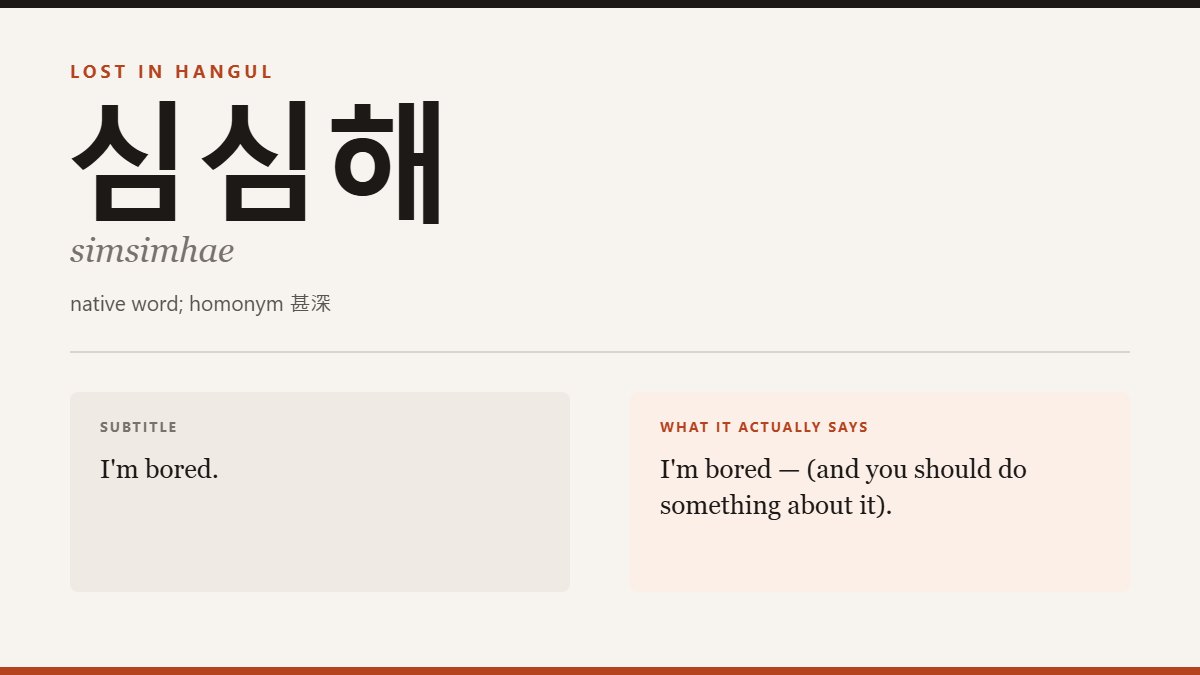
Short version: 심심해 means “I’m bored,” and a child whining 심심해 is really saying “play with me.” The same word also describes food that is lightly seasoned. And there is a completely different, formal 심심하다 that means “profound,” which once caused a nationwide argument over an apology.
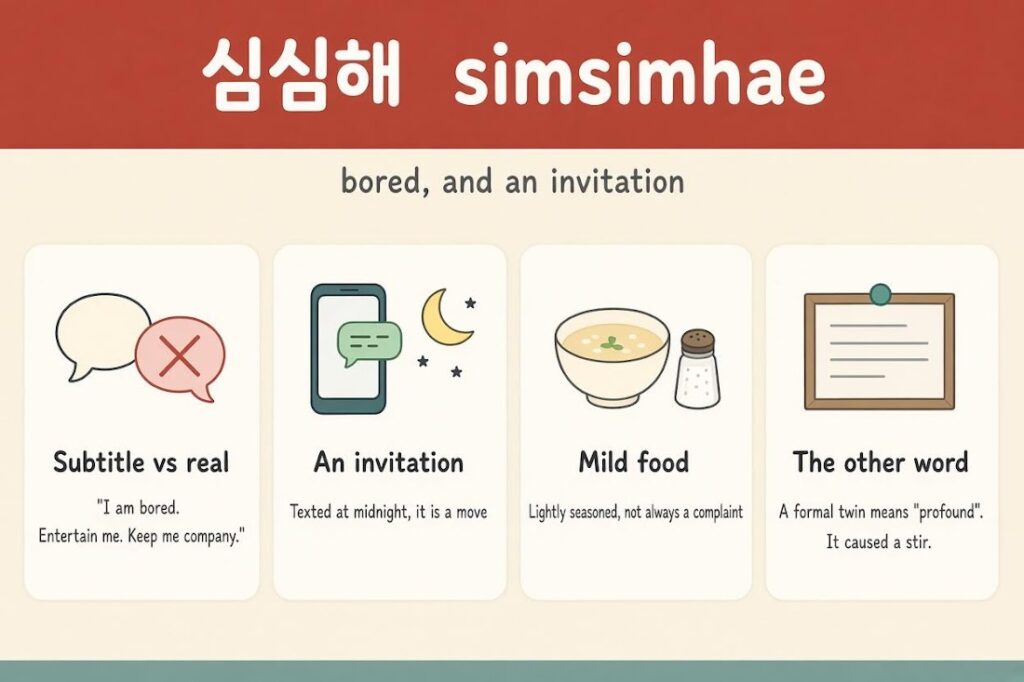
Bored — and asking for company
심심하다 describes having nothing to do and nothing to hold your attention. Said aloud to someone, it is often a hint:
- A child to a parent: 엄마, 심심해 — “Mum, play with me.”
- A friend over text on a Sunday: 심심해 — “Want to hang out?”
- A partner at home: 나 심심해 — “Pay attention to me.”
English “I’m bored” can do the same, but 심심해 does it more openly and more often. It’s a gentle way of saying “I want your company.”
Bland, in a good way
The same native word describes mildly seasoned food. 좀 심심하다 means “a bit light on salt.” It’s not necessarily a complaint — some dishes are meant to be 심심하게, lightly flavoured, and healthy eating is often described that way.
| Word | About food |
|---|---|
| 심심하다 | Lightly seasoned, mild (often neutral) |
| 싱겁다 | Underseasoned, bland (usually a complaint) |
| 짜다 | Too salty |
| 간이 딱 맞다 | Seasoned just right |
The other 심심하다
Here is the twist. There is a second, unrelated word spelled exactly the same: 甚深하다, a formal Sino-Korean word meaning “very deep, profound.” It appears mostly in formal apologies and condolences: 심심한 사과, “a profound apology,” or 심심한 위로, “deep condolences.”
In 2022, an organisation posted a notice offering its 심심한 사과. Many readers online took it to mean a “boring apology” and were outraged. A national argument followed about vocabulary, literacy and whether formal Sino-Korean words still belong in public notices. It was widely covered in the Korean press as a sign of a generation gap in vocabulary.
Both sides had a point. The formal word is correct and standard. But a notice meant for the public that many readers can’t parse isn’t doing its job. The plain alternative, 깊은 사과 (“a deep apology”), avoids the problem entirely.
Where the words come from
The everyday 심심하다 (“bored,” “mild”) is native Korean. The formal 심심하다 is Sino-Korean, from 甚 “very” and 深 “deep.” They are homonyms — same sound, same spelling, no relation. Korean has many pairs like this, because native and Sino-Korean vocabulary sit side by side.
What subtitles do
“I’m bored” — right in almost every case. What gets lost is the invitation. When a character texts 심심해 at midnight to someone they like, Korean viewers read it as a move. “I’m bored” in English reads more like a complaint. The 2022 misunderstanding, meanwhile, is untranslatable by design: in English, “deep” and “boring” don’t share a spelling.
Read next
- “Dapdaphae” (답답해) — not frustrated. Something tighter than that.
- “Hyeonta” (현타) — the moment the frame widens and it is bleak
- “Gatsaeng” (갓생) — the “god life”, meant sincerely and as a joke
Last reviewed: September 26, 2026