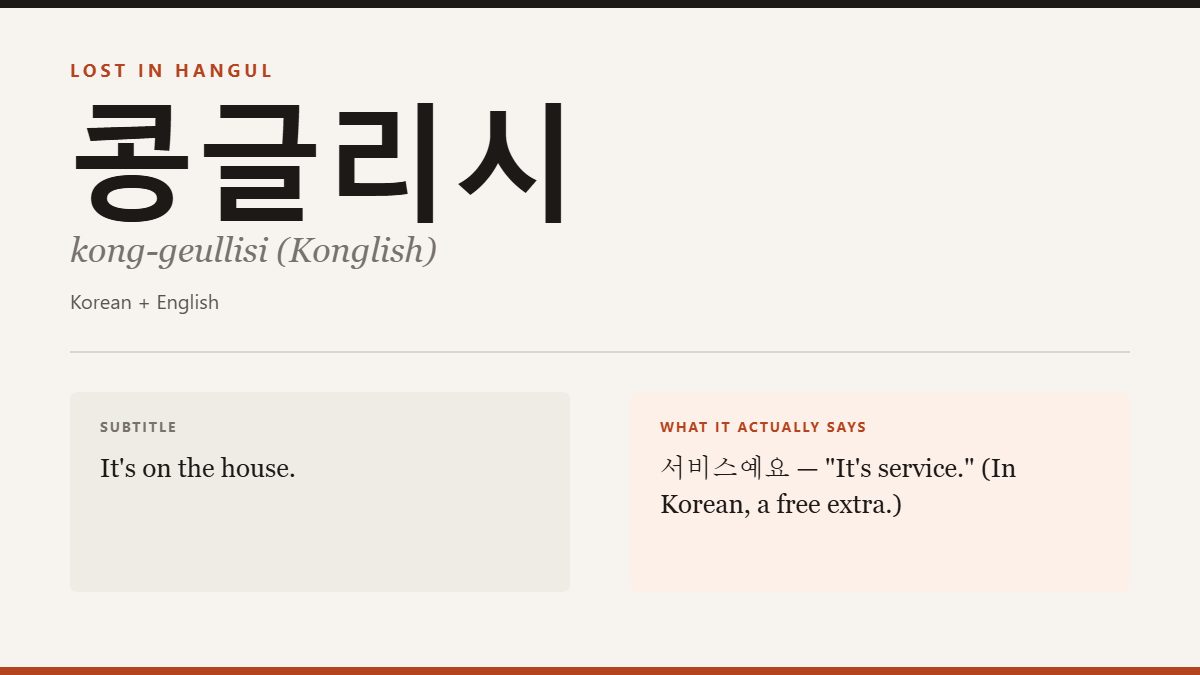
Short version: 콩글리시, Konglish, is English-derived vocabulary used in Korean with a meaning, shape or combination that English speakers wouldn’t recognise. Some words were probably assembled in Korea from English parts; some arrived through Japanese; some are English words cut short. They are normal Korean. A Korean who says 핸드폰 isn’t making an English mistake — they’re speaking Korean.
Common ones
| Konglish | Looks like | Means |
|---|---|---|
| 핸드폰 | hand phone | Mobile phone |
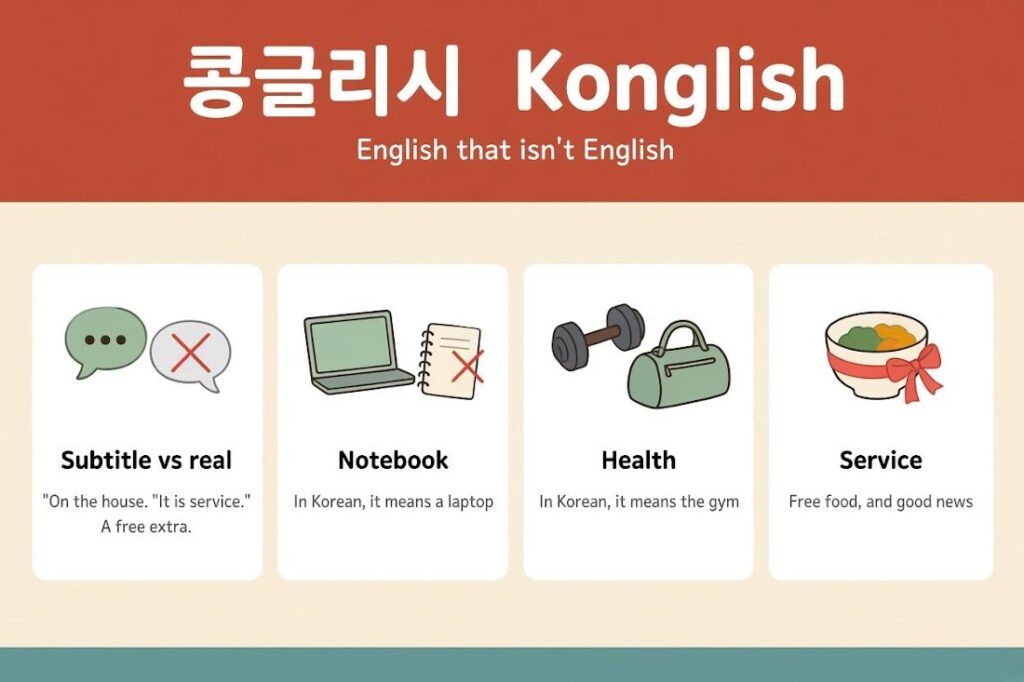
| 노트북 | notebook | Laptop |
| 서비스 | service | Something free, on the house |
| 아이쇼핑 | eye shopping | Window shopping |
| 셀카 | self camera | Selfie |
| 원샷 | one shot | Down your drink in one |
| 스킨십 | skinship | Affectionate touching |
| 헬스 | health | Working out at the gym |
| 미팅 | meeting | A group blind date (among students) |
| 사인 | sign | Autograph, signature |
| 파이팅 (usually written 화이팅) | fighting | “You can do it!” |
미팅 deserves a note. In an office it can mean a business meeting, as in English. Among university students it means a group date where friends from two sides meet. The context usually makes it obvious — and when it doesn’t, that’s a sitcom plot.
Where they come from
- Through Japanese. Many English-based words were coined or popularised in Japan in the twentieth century, and some reached Korean that way. 스킨십 is one: “skinship” spread in Japan from the 1950s before it became everyday Korean, though who first coined it is disputed. 에어컨 (air conditioner) and 리모컨 (remote control) are usually explained as clipped forms that came the same way; Japanese has the same short words.
- Probably assembled in Korea. 셀카 is 셀프 + 카메라 cut down. 핸드폰 joins “hand” and “phone” — though Singapore and Malaysia say “handphone” too, so it isn’t uniquely Korean.
- Reshaped English. 썸, from “something,” is a newer example: an English word turned into a Korean noun for the stage before dating.
The confusions for learners
The trap runs both ways. English speakers learning Korean hear 서비스 and think of customer service; at a Korean restaurant, it means an extra dish you didn’t pay for, which is good news. 헬스 doesn’t mean health in general — 헬스 다녀 means “I go to the gym.” And 노트북 is never a paper notebook; for that, adults usually say 노트, and 공책 sounds more like school.
Pronunciation is the other half. In a Korean sentence, loanwords are said the Korean way: 커피, 버스, 피자. Switching to a perfect native-English pronunciation mid-sentence can sound like showing off. Koreans even have a word for an over-polished English accent: 버터 발음, “butter pronunciation.”
Konglish isn’t a set of errors to be corrected. Koreans who speak excellent English still say 핸드폰 in Korean, the same way English speakers say “déjà vu” without speaking French. Inside Korean, these are simply the words.
What subtitles do
Most of the time, the right move is invisible: 핸드폰 becomes “phone,” 서비스 becomes “on the house,” and nobody needs to know. The trouble starts when Konglish is the point of the scene — a character proudly showing off “English” that no English speaker would recognise, or a visitor in a drama baffled by 아이쇼핑. To make that land, a subtitle would have to put wrong English on screen on purpose, and very few will.
Read next
- “Hwaiting” (화이팅) — not “fighting”, and not quite “you got this”
- “Sseom” (썸) — the “something” before dating
- "Menbung" (멘붕) — "mental collapse," said about losing your keys
Last reviewed: October 4, 2026