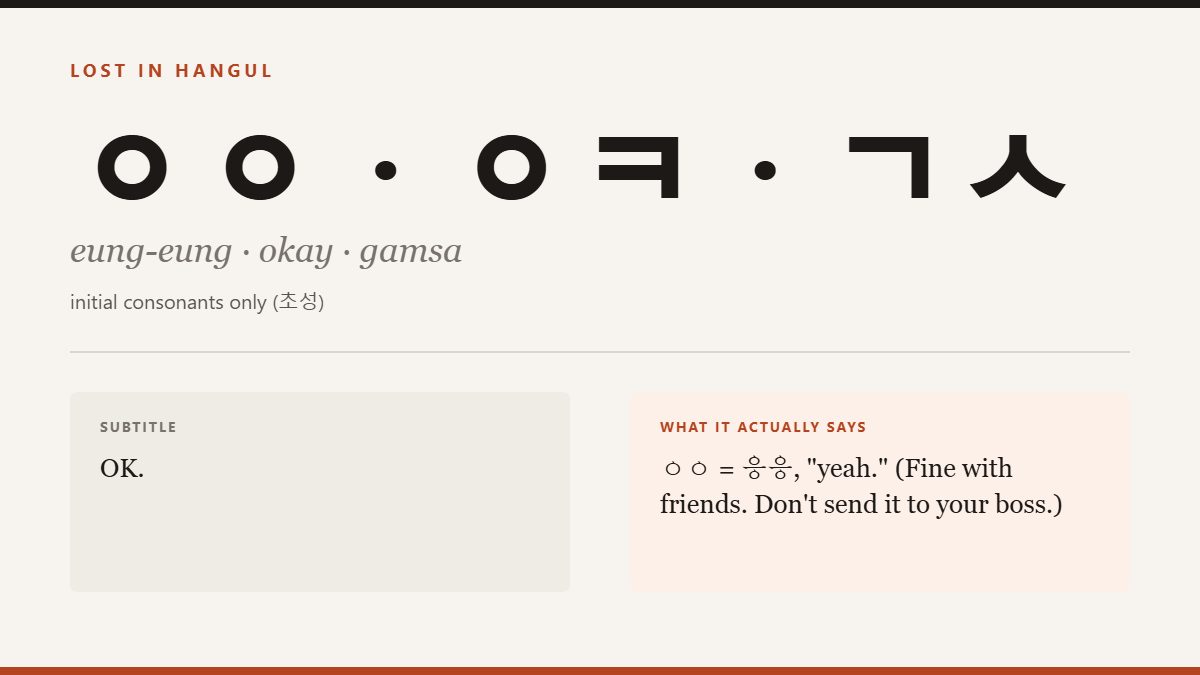
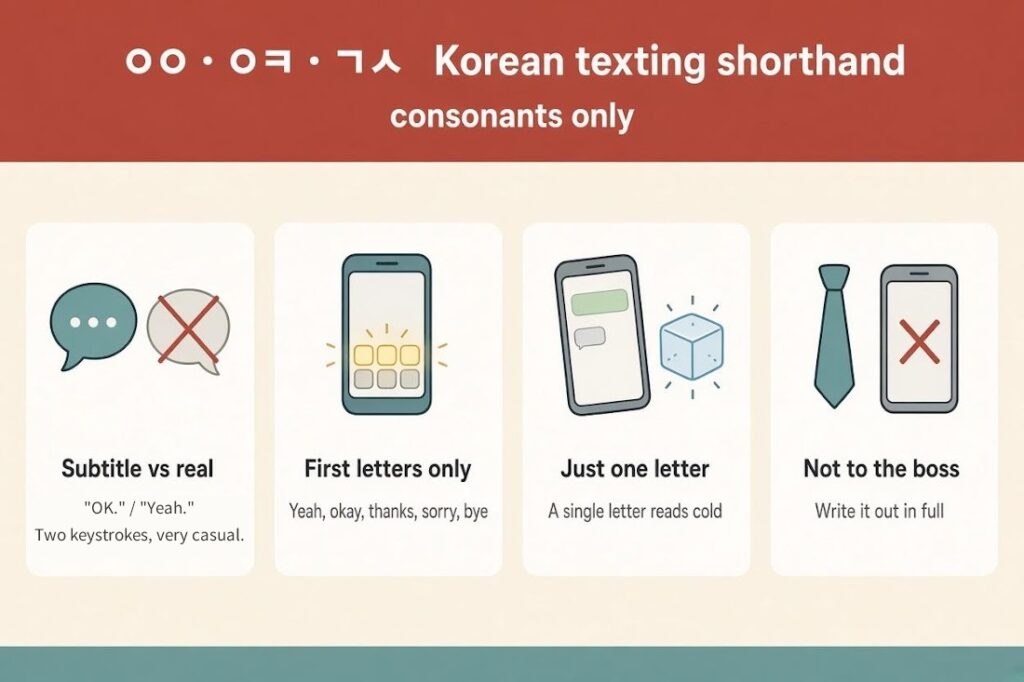
Short version: Koreans abbreviate text messages by typing only the first consonant of each syllable, the 초성 or “initial sound.” ㅇㅇ is 응응, “yeah.” ㅇㅋ is 오케이, “okay.” ㄱㅅ is 감사, “thanks.” It’s fast and very casual. And like ㅋㅋㅋ, how many you type and who you send them to changes how they land.
The common ones
| Shorthand | Stands for | Means |
|---|---|---|
| ㅇㅇ | 응응 | Yeah, yep |
| ㅇㅋ | 오케이 | Okay |
| ㄴㄴ | 노노 | No, nope |
| ㄱㅅ | 감사 | Thanks |
| ㅈㅅ | 죄송 | Sorry |
| ㅊㅋ | 축하 | Congrats |
| ㅎㅇ | 하이 | Hi |
| ㅂㅂ / ㅂㅇ | 바이바이 / 바이 | Bye |
| ㄱㄱ | 고고 | Let’s go |
| ㄷㄷ | 덜덜 | Shaking — “that’s scary” or “that’s insane” |
Two vowel-only ones belong with them: ㅠㅠ and ㅜㅜ, which aren’t abbreviations at all. They’re crying eyes, tears running down. And ㅇㅈ, short for 인정 (“fair enough, agreed”), is common enough to have its own post on this site.
How they land
- ㅇㅇ to a friend is neutral. A single ㅇ is the Korean “k.” — technically a yes, emotionally a shrug.
- Doubling or decorating warms things up: ㅇㅋㅇㅋ, ㅇㅇㅇ, ㅇㅋ~, ㅇㅋㅋㅋ.
- ㄱㅅ and ㅈㅅ are fine between friends for small things. For a real favour or a real apology, write it out: 고마워, 미안해.
- To anyone you’d speak politely to — a teacher, a boss, your partner’s parents — don’t use them. Write 네, 알겠습니다 in full.
Why it works
Hangul is built from letters. Every syllable block starts with a consonant, so a word’s skeleton of initial consonants is often enough to recognise it, especially in a familiar context. 초성 abbreviations grew with online chat and mobile texting, where every keystroke counted, and they’ve stayed because they’re quick and carry a casual tone.
The same idea powers 초성 퀴즈, a game where you guess a word or a title from its initial consonants alone. It’s a staple of variety shows and classroom ice-breakers, and it’s harder than it sounds: ㄱㅅ could be 감사, 가수, 고생, or a dozen other words.
Where it comes from
ㅋㅋㅋ (from 크크, a laugh) and ㅎㅎ (from 하하, 히히) were the early, famous examples. The rest followed the same logic. Some are abbreviations of English loanwords — ㅇㅋ is “OK” spelled in Hangul, then cut down again — which is why they look stranger to learners than they are.
One warning: some consonant pairs are swear words in disguise. ㅅㅂ is the most common, and it is exactly as rude as the word it stands for. If you see it in a comment, the writer is cursing; don’t copy it into your own messages.
What subtitles do
A girlfriend sends three paragraphs. The reply on his phone screen is a single ㅇ. In Korean, that’s the scene: he has made a point, and the audience winces. A good subtitle renders it “k,” an English reply with much the same chill, and the moment survives. A careless one writes “OK,” which could just as easily be the cheerful ㅇㅋㅇㅋㅋㅋ, and the point is lost.
Read next
- ㅋㅋㅋ vs ㅎㅎ — how Koreans laugh in text, and which one is cold
- “Injeong” (인정) — the one-word agreement that took over Korean variety
- “TMI” in Korean means the opposite of TMI in English
Last reviewed: October 4, 2026