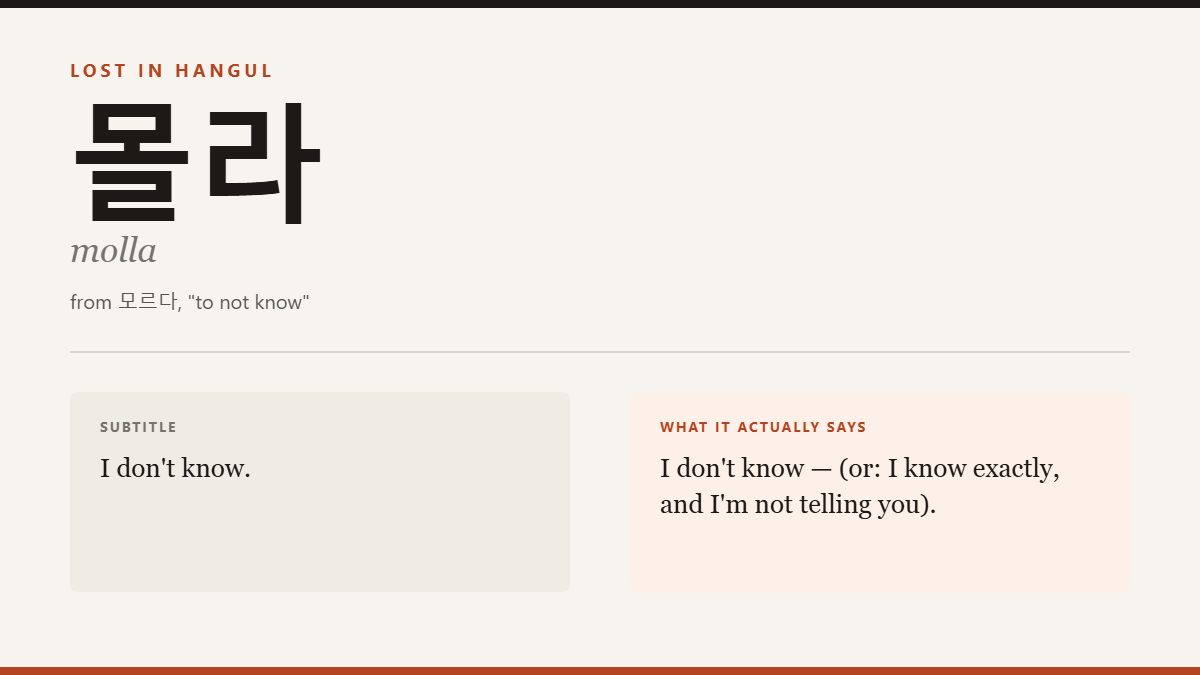
Short version: 몰라 is the casual “I don’t know,” from 모르다. But tone changes it completely. Said flatly, it’s information. Said with a pout, it’s “Figure it out yourself.” Thrown over the shoulder, it’s “I’m done with this conversation.” And there’s a real difference between 몰라 and 모르겠어: one states a fact, the other admits you can’t tell.
The forms
| Form | Level | Feel |
|---|---|---|
| 몰라 | Casual | I don’t know / dunno |
| 몰라요 | Polite | I don’t know (can sound blunt) |
| 모르겠어 / 모르겠어요 | Casual / polite | I’m not sure, I can’t tell |
| 잘 모르겠습니다 | Formal | I’m afraid I don’t know |
| 나도 몰라 | Casual | Don’t ask me / no idea |
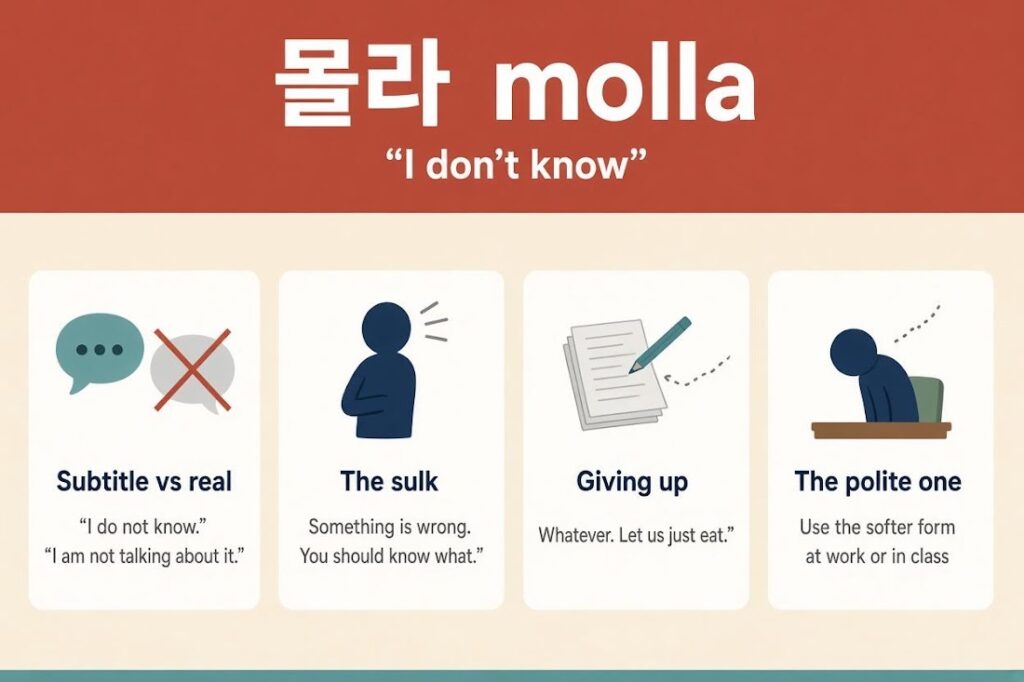
The –겠– in 모르겠어요 softens things. It frames the answer as “I can’t tell” rather than a flat “I don’t know.” That’s why 잘 모르겠습니다 is the standard answer at work, in class or in customer service, and why a bare 몰라요 to a teacher can sound like a sulky teenager.
The sulky 몰라
A partner asks “What’s wrong?” The answer is 몰라. That means: something is wrong, you should know what it is, and I’m not going to spell it out. Romance dramas run on this exchange. Sometimes it’s 몰라 몰라, with a turned back, which adds “and stop asking.”
The giving-up 몰라
- 몰라, 몰라 — “Whatever. I give up.” Pushing the homework away at midnight.
- 몰라, 그냥 먹자 — “Who cares, let’s just eat.”
- 나도 몰라 — “Your guess is as good as mine.”
Here 몰라 means you’ve stopped trying to know. It’s surrender, often cheerful.
The teasing 몰라
Drawn out with a smile — 몰라~ — it’s playful: “Wouldn’t you like to know?” Said by someone hiding a surprise, it’s practically a confession that there is one.
Where the word comes from
모르다 is native Korean, “to not know,” and it’s worth noticing that it exists at all. Korean has a separate verb for not knowing instead of putting “not” in front of “know.” The opposite of 알다 (“to know”) is 모르다, and you can’t say 안 알아. In the same way, 없다 (“to not exist, not have”) is the opposite of 있다.
The spelling follows a predictable pattern that textbooks call the 르-irregular: verbs whose stem ends in 르 double the ㄹ before –아/-어. So 모르 + 아 becomes 몰라, just as 빠르다 (“fast”) gives 빨라.
For learners: in class, at work, or with anyone older, say 잘 모르겠어요 or 잘 모르겠습니다. Save 몰라 for friends — and remember that, said the wrong way, even a friend will hear “leave me alone.”
What subtitles do
“I don’t know.” The words are right; the sulk isn’t always. English “I don’t know” can be sulky too, but it reads as genuine confusion unless the actor sells it hard. And the difference between a polite 모르겠어요 and a blunt 몰라요 — the difference between a careful employee and a defiant one — becomes the same three words.
Read next
- “Ne” (네) — the Korean “yes” that often isn’t one
- “Gwaenchanayo” (괜찮아요) — it also means “no thank you”
- "Geurae" (그래) — yes, okay, really?, and "fine, then"
Last reviewed: October 4, 2026