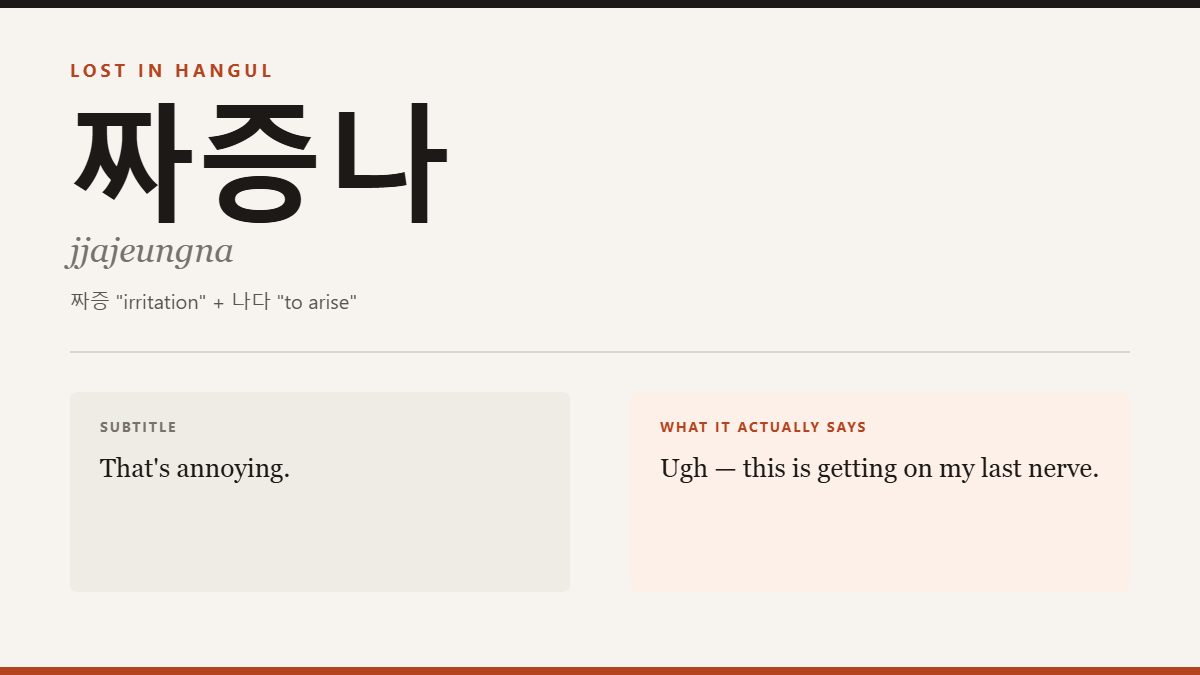
Short version: 짜증 is irritation — a scratchy, fed-up feeling. 짜증 나 (“irritation comes up”) means “this is so annoying” or “I’m so irritated.” It’s for small, grating things: a slow phone, sticky summer heat, a friend who’s late again. It’s lower and more constant than anger. And aimed at a person, it’s harsh.
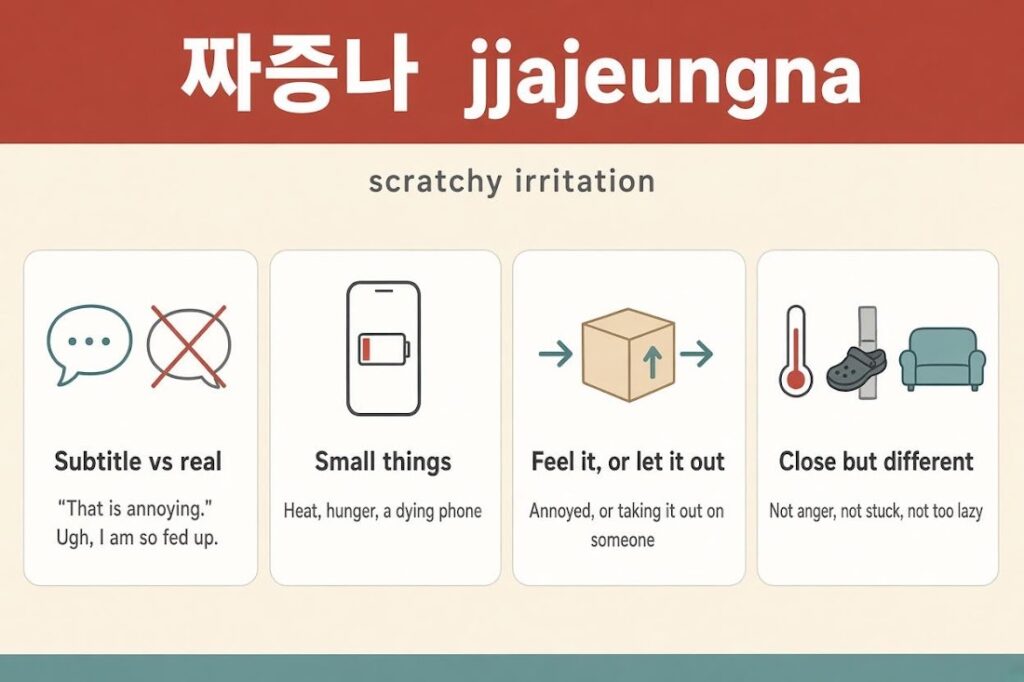
Feeling it vs. letting it out
짜증 is a noun, and the verb you pair it with changes the meaning:
- 짜증(이) 나다 — irritation comes up in you: “I’m annoyed.”
- 짜증(을) 내다 — you let it out on someone: “to snap, to be grumpy at.”
- 짜증스럽다 — irritating (a little more written).
나다 is “to arise,” 내다 is “to put out.” 화나다 (to be angry) and 화내다 (to get angry at someone) work the same way. So 나 짜증 나 is “I’m annoyed,” while 나한테 짜증 내지 마 is “Don’t take it out on me.”
A note on spelling. 화나다 is one word, but standard spelling treats 짜증 나다 as two, with a space. Most people type 짜증나 anyway, which is why you’ll see it that way in titles, comments and on this page’s heading.
Classic triggers
- 장마 — the rainy weeks of early summer, when everything is damp and sticky.
- A phone on 1% battery with no charger in sight.
- Someone chewing loudly on the bus.
- Being told 짜증 내지 마 when you weren’t, until that moment.
Physical discomfort — heat, hunger, tiredness — is the classic background. A hungry, overheated person is primed for 짜증, and Korean speakers will often explain someone’s mood that way: 배고파서 짜증 났나 봐, “I think they’re cranky because they’re hungry.”
Similar but different
| Word | Feeling | Shape |
|---|---|---|
| 짜증 나 | Irritated, fed up | Scratchy, low-level, repeated |
| 화나 | Angry | Hot, aimed at a cause |
| 열받아 | Angry (“heat rising”) | Casual, sudden |
| 답답해 | Blocked, stifled | Something won’t move |
| 귀찮아 | Can’t be bothered | Effort, not irritation |
Aimed at a person
너 진짜 짜증 나 — “You’re so annoying” — is much harsher than it looks. It is close to “I can’t stand you.” Between siblings or very close friends it’s an everyday insult that nobody takes to heart. Between colleagues, it’s a confrontation.
Where the word comes from
Korea’s standard dictionary treats 짜증 as a native word. According to the National Institute of Korean Language, an older form, 자증, appears in an 1880 Korean–French dictionary — 자증 내다, glossed as looking displeased — and its first sound hardened into 짜 in the twentieth century, a common change in Korean. Before that, the trail goes cold. 나다 is the everyday verb for something arising — 소리가 나다 (a sound comes), 생각이 나다 (a thought comes).
짜증 나 is casual and blunt. In a polite setting, Koreans say 좀 신경 쓰이네요, “it’s bothering me a bit,” or 좀 불편하네요, “it’s a little uncomfortable” — usually with a 좀 to soften it.
What subtitles do
Two lines that differ by one syllable — 나 짜증 나 and 나한테 짜증 내지 마 — are two different complaints: “I’m annoyed” and “Stop taking it out on me.” Subtitles usually keep them apart, but in a quick exchange both can collapse into “You’re so annoying,” and the argument changes shape. Frequency is the other loss. A character who says 짜증 나 in every scene is being drawn as moody and young; in English, the repetition just reads as complaining.
Read next
- “Dapdaphae” (답답해) — not frustrated. Something tighter than that.
- “Aish” (아이씨) — the half-swear subtitles turn into “Dammit”
- "Gwichana" (귀찮아) — not lazy, just not worth the bother
Last reviewed: October 4, 2026