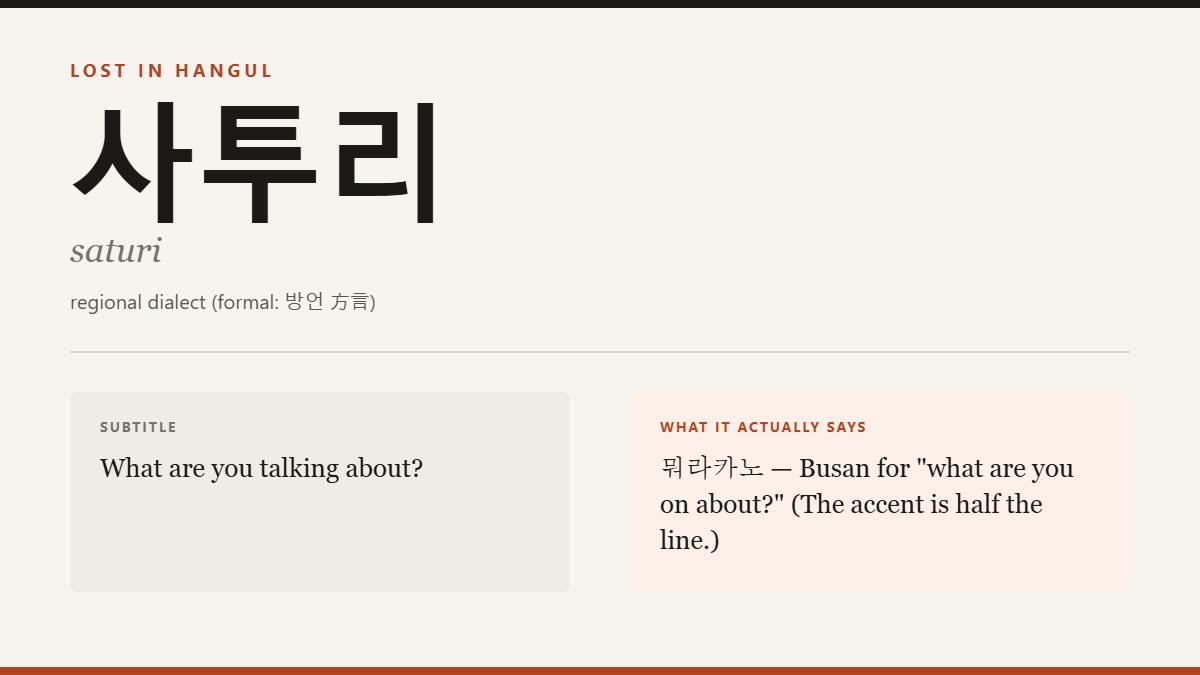
Short version: 사투리 means regional dialect — accent, vocabulary and verb endings together. Standard Korean is officially defined as the modern speech of Seoul used by educated people, and most dramas are written in it. So when a character speaks 사투리, the writer is telling you something: where they’re from, and often what kind of person they’re meant to be. English subtitles almost never show it.
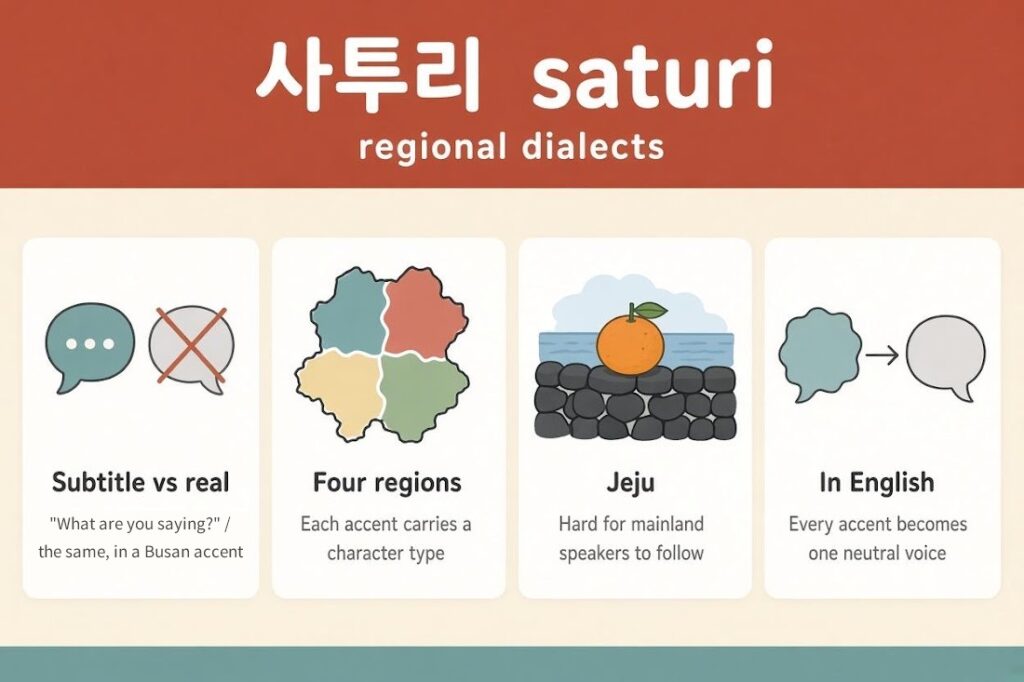
The main dialect regions
| Region | Sample | Standard Korean |
|---|---|---|
| Gyeongsang (Busan, Daegu) | 밥 뭇나? / 뭐라카노 / 아이다 | 밥 먹었어? / 뭐라고 하는 거야? / 아니야 |
| Jeolla (Gwangju) | 그랑께 / 허벌나게 | 그러니까 / 엄청나게 |
| Chungcheong (Daejeon) | 괜찮아유 / 그려 | 괜찮아요 / 그래 |
| Jeju | 혼저옵서예 / 폭싹 속았수다 | 어서 오세요 / 수고 많으셨습니다 |
These are only the most recognisable markers. Each region has its own intonation, and for many Koreans the melody gives a speaker away before any particular word does.
What a dialect tells Korean viewers
Dramas use dialect as shorthand — sometimes affectionately, sometimes as a stereotype.
- Gyeongsang men are cast as blunt and gruff, men of few words. A famous joke says a Gyeongsang husband speaks only three sentences at home: 아는? 밥 묵자. 자자. — “The kids? Let’s eat. Let’s sleep.”
- Jeolla speech is often played as warm, earthy and expressive. 거시기 — “whatsit,” a word that can stand in for almost anything — is in the standard dictionary, but the whole country thinks of it as Jeolla’s.
- Chungcheong speech is stereotyped as slow, easygoing and indirect.
- Seoul speech, by contrast, can be played as smooth and a little cold.
The 2013 tvN drama 응답하라 1994 (Reply 1994) built much of its comedy on this: students from different provinces share a boarding house in Seoul, and their dialects collide at every meal.
Jeju is a special case
Jeju speech is so different from the mainland that speakers of standard Korean often can’t follow it, and UNESCO listed it as critically endangered in 2010. The 2025 Netflix series 폭싹 속았수다 used a Jeju phrase as its title. It means roughly “you’ve worked so hard” — the 속았수다 is Jeju for having toiled, not the standard 속았다, “was fooled.” In English it was released as When Life Gives You Tangerines, a new title rather than a translation.
Where the word comes from
사투리 is native Korean. The formal, scholarly word is 방언, Sino-Korean 方言, “regional speech.” The dialects themselves are not corruptions of Seoul speech; they are sister varieties, some of which keep older sounds and words that standard Korean has lost.
Why it vanishes in English
A translator could, in theory, give a Busan fisherman a Texan drawl or a Glaswegian accent. They almost never do, because the associations would be wrong. So dialect becomes standard English, sometimes with rougher wording to hint at the character.
For learners: enjoy 사투리, and learn to recognise it, but don’t imitate it casually. A foreigner speaking Busan dialect is delightful on a variety show; in a Seoul office, picked up from one colleague, it can sound as if you’re imitating them.
What subtitles do
They erase it, nearly every time. A scene where a Seoul character can’t understand her new Gyeongsang colleague, and the whole joke is the accent, plays in English as two people talking normally. The best a subtitle can do is let the confusion show: “What did he just say?”
Read next
- “Gosaenghaesseo” (고생했어) — why “good job” isn’t what he said
- The Korean words subtitles always delete (and why translators do it)
- 합니다 vs 해요 — the two polite Koreans, and why subtitles merge them
Last reviewed: October 4, 2026