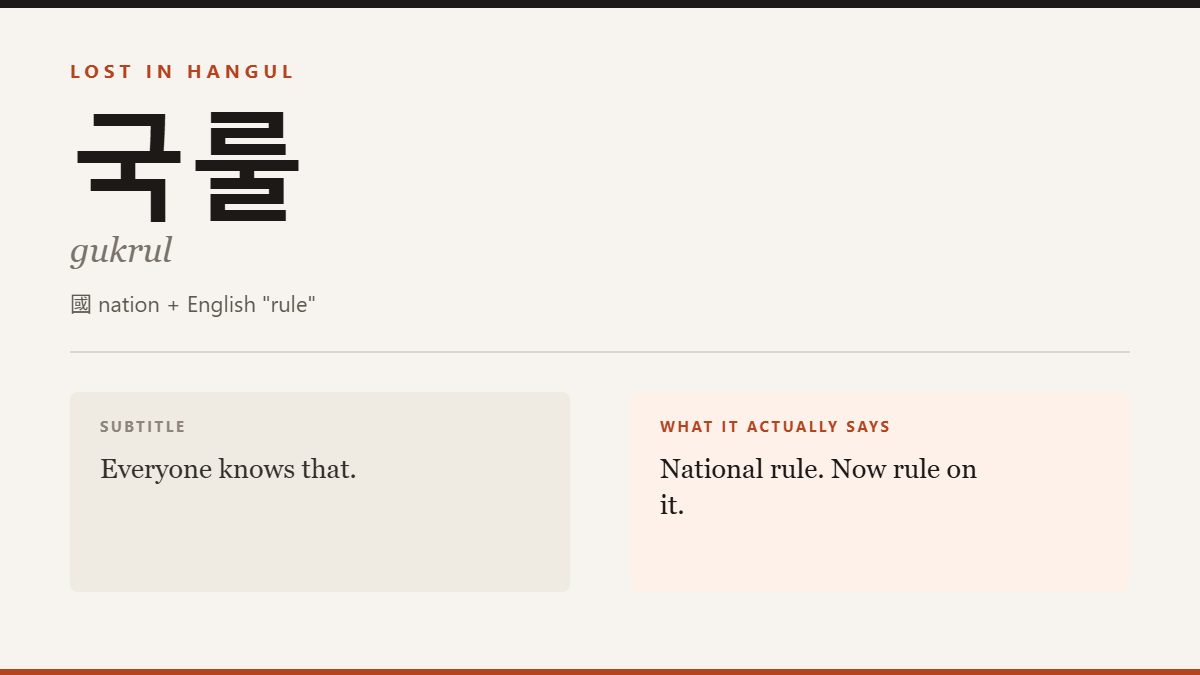
Short version: 국룰 (gukrul) means “national rule” — the unwritten default that everybody follows and nobody voted on. It is not law and it is not even tradition. It is consensus, claimed out loud.
Where the word comes from
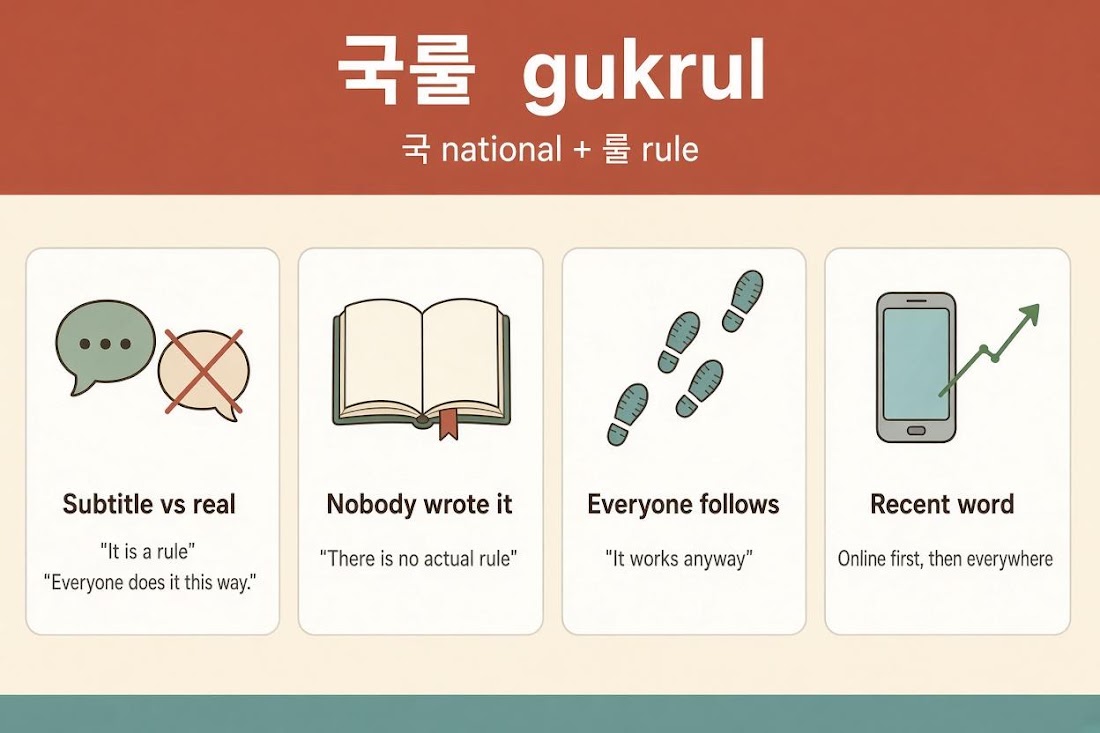
A hybrid, and a recent one. 국 is 國, the hanja for country or nation, the same character in 국민 (citizens) and 국가 (state). 룰 is the English word “rule”, transcribed.
So the construction is Sino-Korean plus English, glued together by internet Korean in the last decade or so. That mixture is completely normal in modern slang and it is part of why the word sounds light: nobody could mistake it for an official term.
What gets called a 국룰
- 치킨엔 맥주가 국룰 — fried chicken goes with beer. The canonical example.
- 이사하면 짜장면 — you eat jjajangmyeon on moving day.
- Taking your shoes off, obviously, but nobody bothers saying it because it is not debatable.
- Which member of a group pays. Which side of the escalator to stand on. How long to wait before texting back.
The pattern: small, shared, unenforceable, and strongly felt. Nobody is fined for drinking soju with fried chicken. Several people will tell you that you are wrong.
It is a claim, not a statement
This is the part that does not survive translation. Saying something is 국룰 is an assertion of consensus, and it invites a ruling. The natural response is 인정 — granted — or a flat refusal.
So it usually appears in the same move as the other one-word verdict words. Someone declares the national rule, the table grants it or fights about it, and the whole exchange takes four seconds.
English “everyone knows that” is the closest, and it is a statement of fact rather than a bid. That is the missing half.
The family it belongs to
| Word | Literally | Use |
|---|---|---|
| 국룰 | national rule | The unwritten default |
| 정석 | the orthodox method | The proper way to do something |
| 국민 간식 | national snack | Something everyone eats |
| 기본 | basics | The minimum, non-negotiable |
정석 is the older, more serious cousin — it means the textbook method, and it carries no joke. 국룰 always carries a small one, because calling a snack pairing a national rule is deliberately oversized.
Register and shelf life
Young, casual, internet-born, and very common in variety captions. It would be strange in writing at work and completely normal in a group chat.
It has lasted long enough now to be safe vocabulary rather than a passing coinage, which is more than can be said for most words built this way.
What subtitles do
“It’s a rule”, “everyone knows”, “classic”, “obviously”. All fine, all flat. The lost piece is that the speaker is making a bid for agreement and expecting an answer.
Read next
- “Injeong” (인정) — the one-word agreement that took over Korean variety
- “Hyeonta” (현타) — the moment the frame widens and it is bleak
- “Daebak” (대박) — one word, four completely different meanings
Last reviewed: September 21, 2026