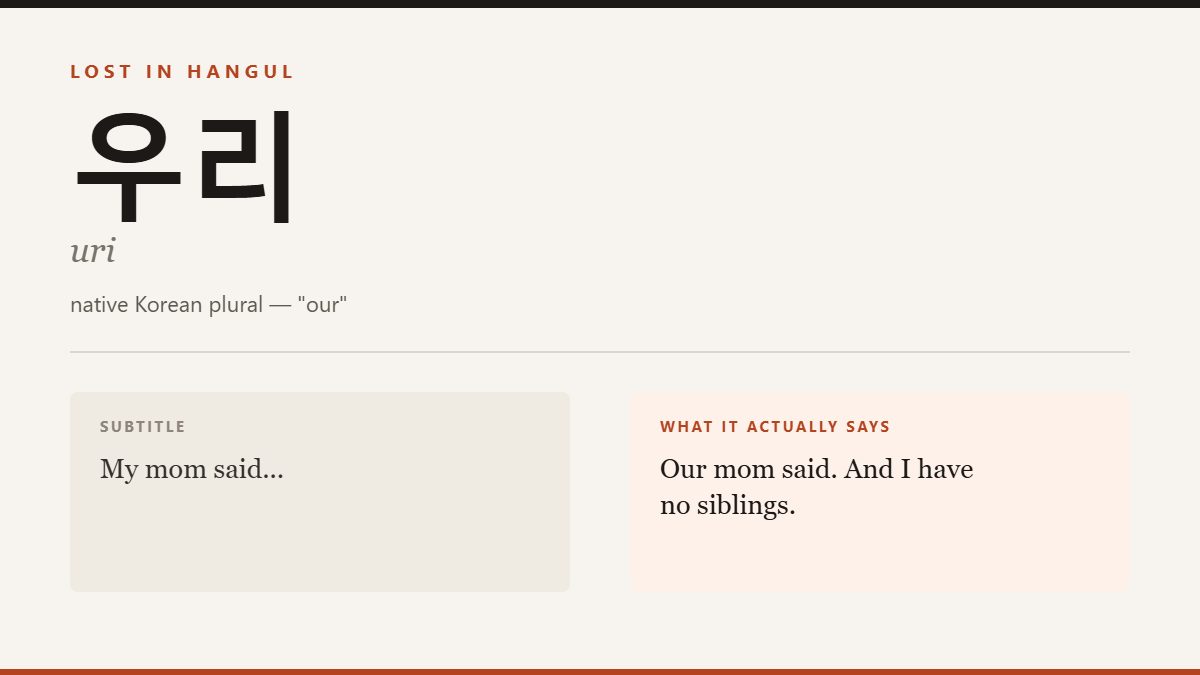
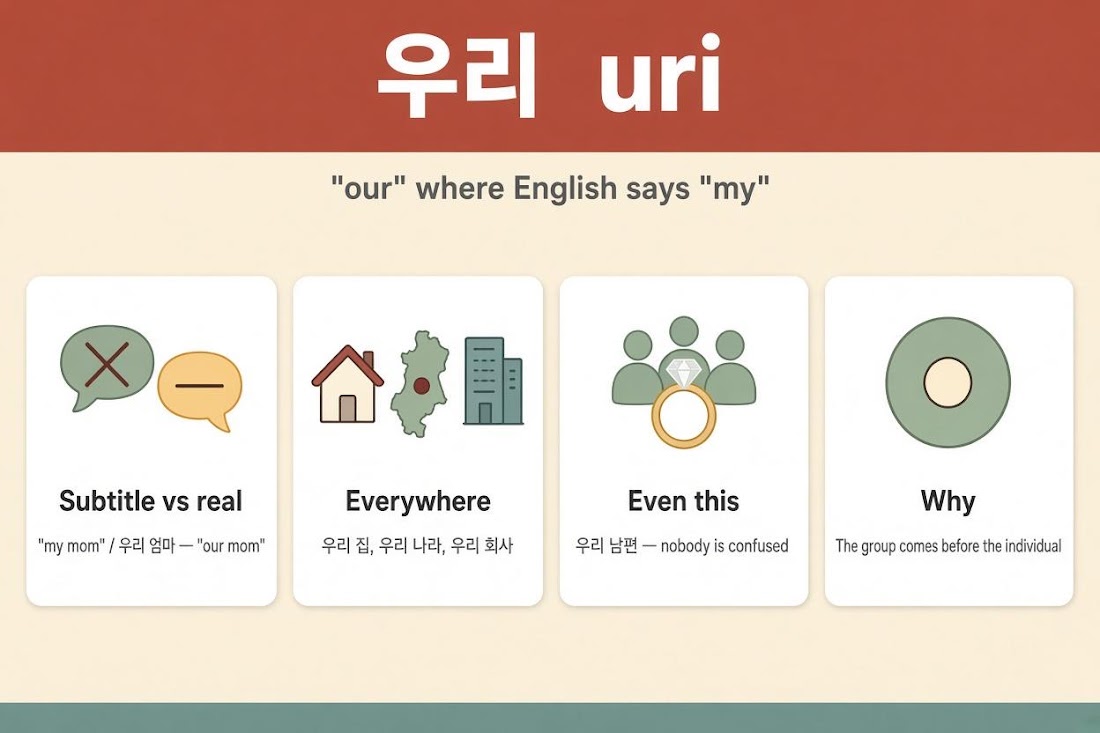
Short version: 우리 means “our”, and Korean uses it where English would say “my”. 우리 엄마 is our mother, said by an only child. 우리 집 is our house, said by someone who lives alone.
Where the word comes from
Native Korean, the ordinary first-person plural. There is no hanja and no trick to it. The interesting part is not the word’s origin but its territory, which is far larger than English “our”.
What it attaches to
Family first, and this is close to obligatory. Saying 내 엄마 — “my mother” — is grammatically fine and sounds cold enough that speakers avoid it. The same goes for 우리 아빠, 우리 형, 우리 누나.
Then it spreads outward:
- 우리 집 — our house, even for a person living alone
- 우리 학교, 우리 회사 — our school, our company
- 우리나라 — our country, written as one word. This one is a fixed noun.
- 우리 애기 — said about a pet, a younger member, anyone being looked after
- 우리 남편 — our husband, which reliably startles English speakers and means nothing of the kind
Why it is not really “our”
The plural is doing something other than counting. It marks the thing as belonging to a group the speaker is part of, and by saying it that way the speaker quietly includes the listener in that group, or at least invites them in.
So 우리 엄마 is not a claim that we share a mother. It is closer to “the mother in my family”, where the family is presented as a unit rather than as a possession of one person.
The flip side is that 내 — my — sounds possessive in a way Korean tends to avoid for people. Using it about a family member can read as either childish or pointedly distancing, depending on the sentence.
The one that breaks English hardest
우리 남편 and 우리 와이프. English hears “our husband” and stops working. Korean hears “the husband in our household” and moves on.
Subtitles always render these as “my husband”, which is correct in meaning and drops the fact that Korean does not really like assigning people to individuals.
Where it stops
It is not unlimited. 우리 works for things the speaker belongs to or is responsible for, not for objects.
| Natural | Odd |
|---|---|
| 우리 엄마 | 우리 핸드폰 (unless shared) |
| 우리 회사 | 우리 신발 |
| 우리 강아지 | 우리 컴퓨터 (unless shared) |
The rule of thumb: people and groups take 우리, possessions take 내.
What subtitles do
They write “my” every time, which is the only sensible choice. “Our mom” in an English subtitle would send a viewer hunting for a sibling who does not exist.
What disappears is a small, constant signal that Korean speakers put family and institutions in a shared frame rather than a personal one. It is invisible in translation precisely because it is in every other sentence.
If you want to use it
Use it for your family, your workplace, your school, your country and your pets. It will sound more natural than the “correct”-looking 내.
The exception worth knowing: when contrast matters — “that’s my bag, not yours” — 내 is right and 우리 would be strange.
Read next
- Hyung, Nuna, Sunbae — three words your subtitle turned into “you”
- “-ssi” and “-nim” (씨 · 님) — the suffix that sets your rank
- “Maknae” (막내) — the youngest is a job, not a fact
Last reviewed: September 21, 2026