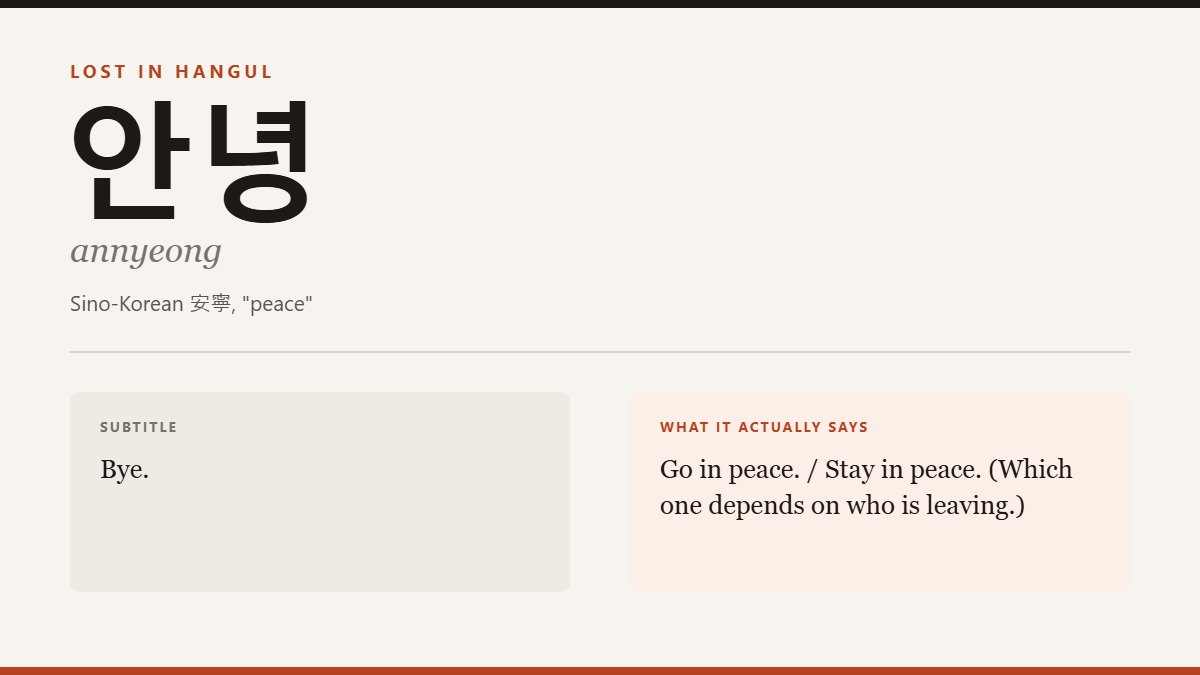
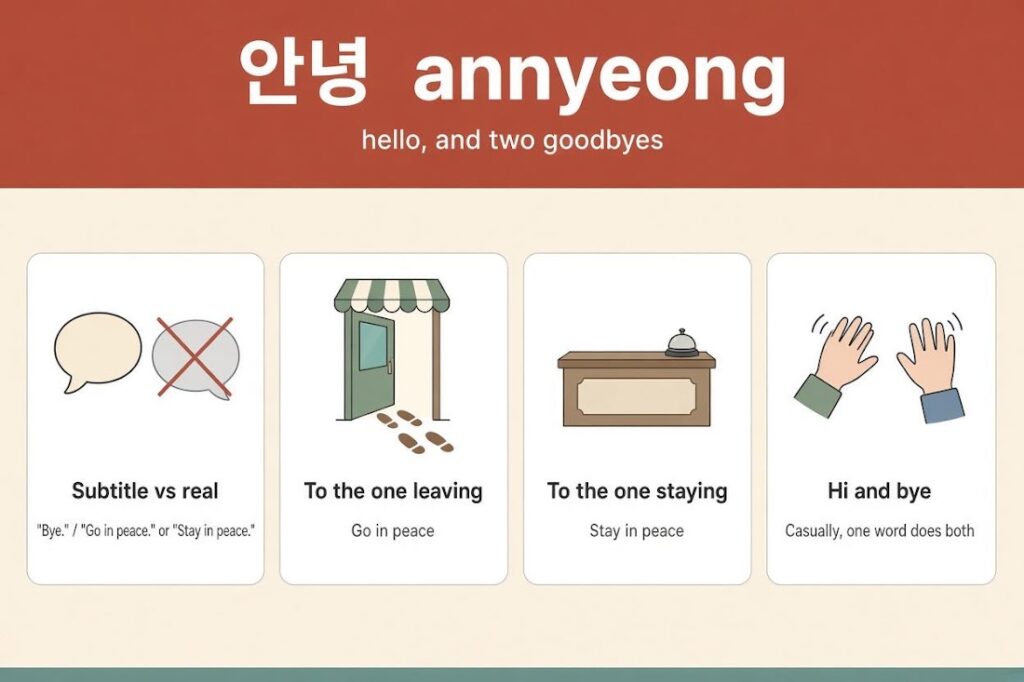
Short version: 안녕 is casual for both “hi” and “bye.” The polite versions split: 안녕하세요 is hello, and there are two different polite goodbyes, one for the person leaving and one for the person staying. Subtitles turn both into “Goodbye.”
Where the word comes from
안녕 is Sino-Korean, 安寧: peace, calm, being well. The greeting 안녕하세요 is literally a polite question — “Are you at peace?” — though nobody hears it as a question any more, any more than English speakers hear “How do you do” as one.
The same word appears in serious contexts. 안녕 in a news report can mean “public safety” or “wellbeing,” and a very formal letter might wish someone 안녕 in its old, full sense.
The two polite goodbyes
| You say | Literally | Said to |
|---|---|---|
| 안녕히 가세요 | Go in peace | The person leaving |
| 안녕히 계세요 | Stay in peace | The person staying |
So when you leave a shop, you say 안녕히 계세요 to the shopkeeper, who stays. The shopkeeper says 안녕히 가세요 to you, because you are the one going. If you both leave at the same time — at a bus stop, say — both of you say 안녕히 가세요.
Learners mix these up constantly, and Korean speakers forgive it instantly. But getting it right is a small, noticeable sign that you understand how the language thinks: the goodbye describes what the other person is about to do.
The casual forms
- 안녕 — hi, or bye. To friends, children, people younger than you.
- 안녕! 잘 가 — bye, get home safe (to someone leaving)
- 잘 있어 — take care (to someone staying)
- 들어가 / 들어가세요 — literally “go in,” said at the end of phone calls and at parting, meaning “get home safely”
That last one is a good example of a phrase with no English match. 들어가세요 at the end of a call is just “bye,” but it carries the picture of the other person going home, inside, somewhere safe.
Hello, in practice
안녕하세요 is the all-purpose polite hello. 안녕하십니까 is the more formal version, used in speeches, announcements and by staff greeting customers. Between friends, 안녕 works, but often people skip it entirely and say 어, 왔어? (“oh, you’re here?”) or ask whether you’ve eaten.
Children are taught to say 안녕하세요 to every adult they meet, loudly, with a bow. That is why a child’s 안녕하세요 in a drama is often a small comic beat: it is the most drilled sentence in the language.
What subtitles do
“Hi,” “Hello,” “Bye,” “Goodbye.” There is no way around it — English has no pair of goodbyes that depend on who leaves. What goes missing is small but constant. When a character says 안녕히 계세요 and leaves a room, Korean viewers already know who is walking out. And when a character says just 안녕 to someone older, the subtitle “Bye” can’t show that it was too casual — or, in a romance, that the switch to 안녕 was deliberate.
Read next
- “Bap meogeosseo?” (밥 먹었어?) — not really a question about food
- The moment they switch to 반말 — what just happened between them
- The Korean words subtitles always delete (and why translators do it)
Last reviewed: September 26, 2026