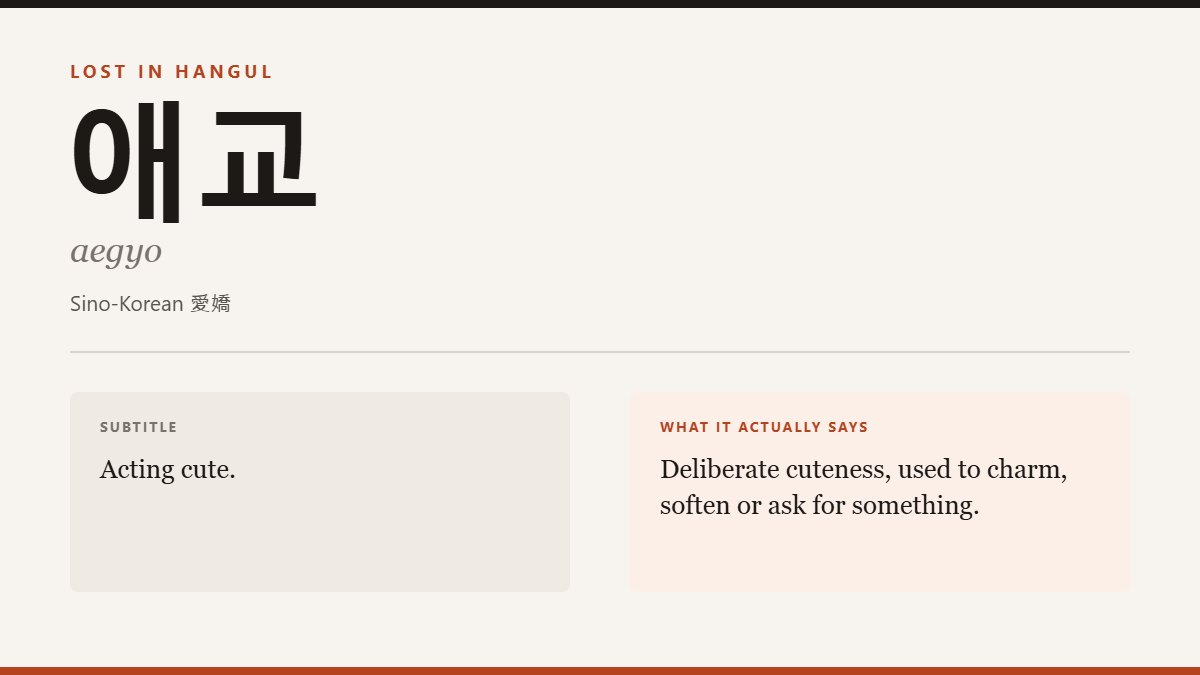
Short version: 애교 is deliberately cute behaviour — a sweeter voice, drawn-out vowels, a pout, small gestures. It is used to charm, to soften a request, or to smooth over a moment. English has “acting cute,” but that sounds more childish and less accepted than 애교 is in Korea.
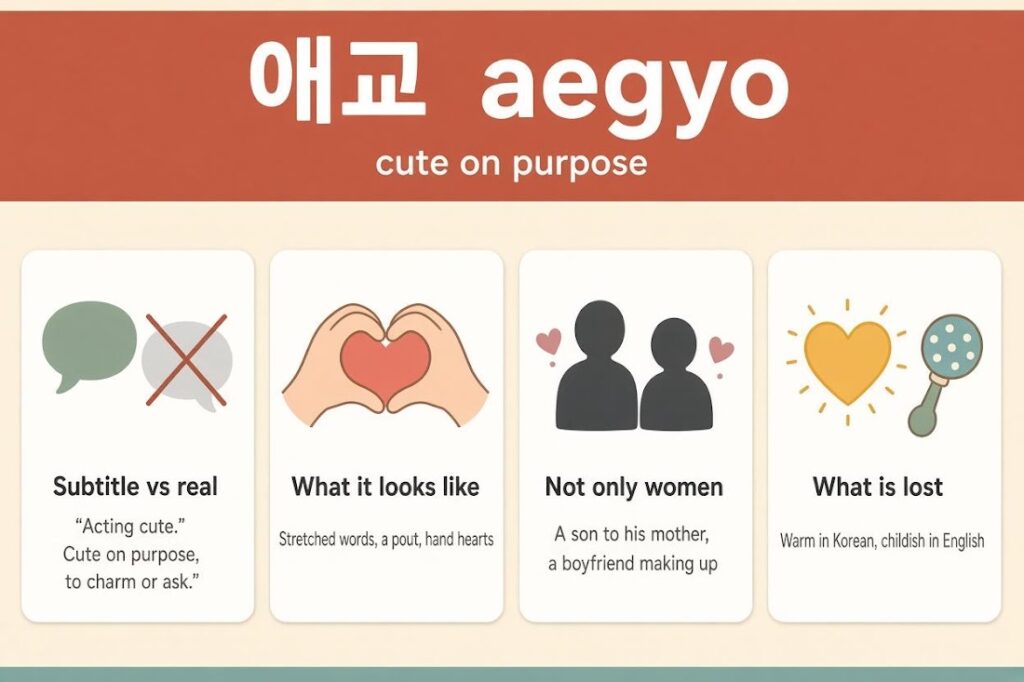
What it looks like
- Stretching words: 오빠~ becomes 오빠아앙~
- A higher, softer voice and baby-talk endings
- Small hand gestures: making hearts, pressing cheeks
- Pouting, stamping a foot, tilting the head
- Saying one’s own name in the third person
It can be very subtle — a slightly longer vowel in a request — or a full, knowing performance. Both count.
Where the word comes from
애교 is Sino-Korean, 愛嬌: 愛 “love” and 嬌 “charming, delicate.” The same characters appear in Japanese as aikyō, meaning charm or amiability. In Korean the word has narrowed toward the deliberate, cute kind of charm.
Who uses it, and when
The stereotype is a girlfriend to a boyfriend. In practice, 애교 is much wider:
| Situation | What 애교 does |
|---|---|
| A child to parents | Asks for a toy, gets out of trouble |
| Adult child to parents | Softens a request or an apology |
| Couples, any gender | Affection, making up after a fight |
| Youngest in a group (막내) | Expected charm, sometimes a duty |
| Idols on variety shows | A requested performance |
Men do 애교 too — a son to his mother, a boyfriend making up. “Men with good 애교” is a compliment, not a joke.
The performance side
On variety shows, idols are often asked to “show us some 애교,” and many find it awkward. Plenty of viewers find the constant requests uncomfortable as well. The visible embarrassment has become its own genre: the stiff, reluctant idol forced to do a cute gesture is a running joke.
This shows something important. 애교 is understood as a behaviour, not a trait. People say someone “has a lot of 애교” (애교가 많다) or “none at all” (애교가 없다), the way English might say someone is or isn’t a hugger.
애교살, literally “aegyo flesh,” is the small puffy area under the eyes that shows when someone smiles. It is considered attractive and youthful, and some people have it enhanced cosmetically. It’s the same word, attached to a face that looks as if it is smiling.
What subtitles do
“Acting cute,” “being cute,” “sweet-talking,” or, when the text is the 애교 itself, stretched English: “Pleeease.” The problem is the moral colour. English “acting cute” can sound mocking or infantilising. In Korean, 애교 between a couple is often simply affectionate, and a partner who never does it may be teased as cold. The subtitle can make an ordinary, warm moment look childish.
Read next
- Why she calls him “Oppa” (오빠) — and why the subtitle just uses his name
- “Maknae” (막내) — the youngest is a job, not a fact
- “Simkung” (심쿵) — heart, thud
Last reviewed: September 26, 2026