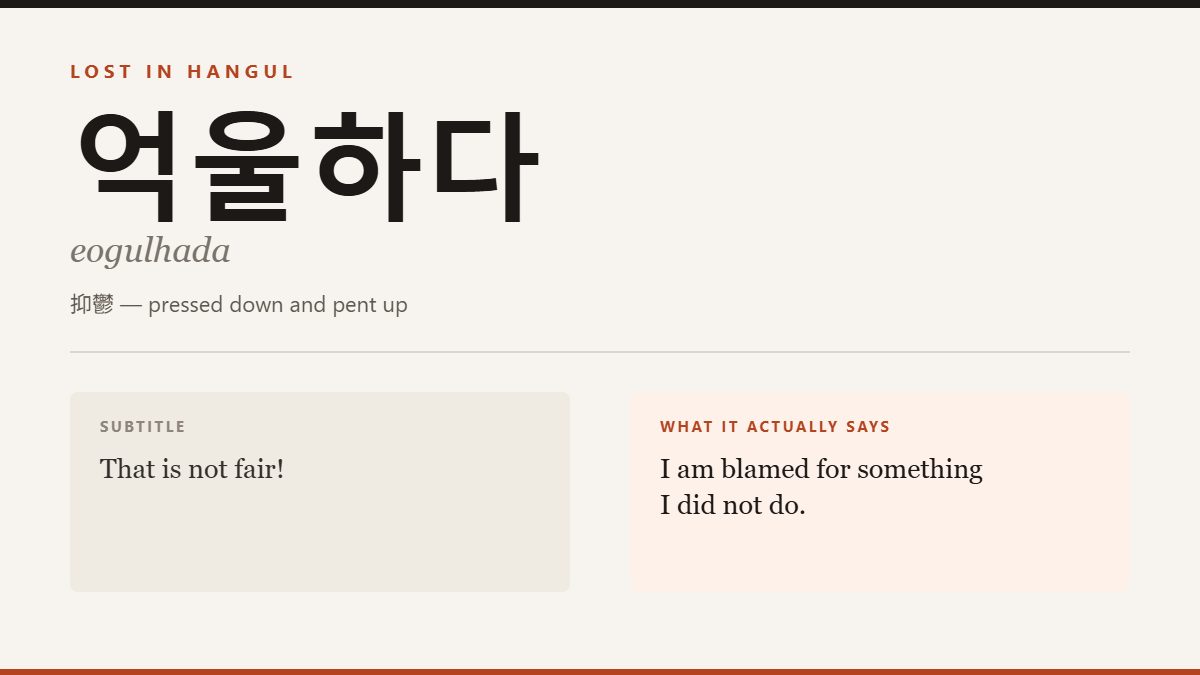
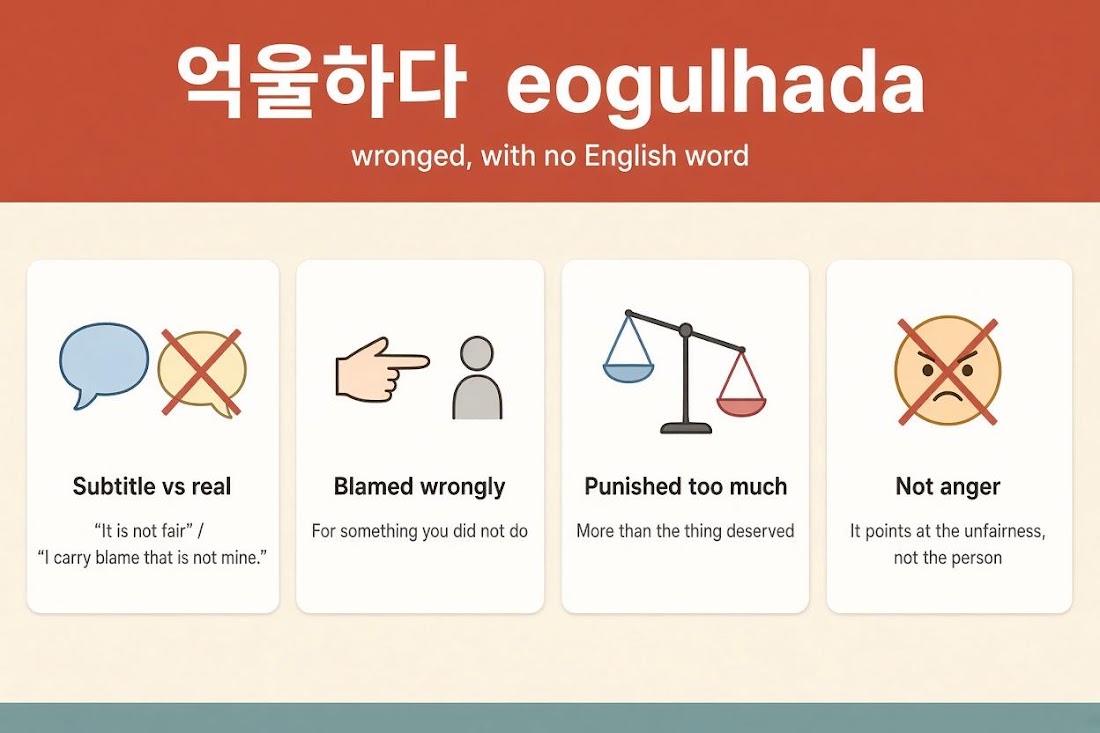
Short version: 억울하다 (eogulhada) is what you feel when you are blamed for something you did not do and cannot prove it. English “unfair” describes the situation from outside. 억울하다 describes what the situation is doing to the person inside it.
Where the word comes from
The hanja are 抑鬱: 抑, to press down or suppress, and 鬱, pent up or gloomy. Pressed-down and unable to get out — which is a remarkably good description of the feeling, given how rarely etymology is this on the nose.
There is a detail worth knowing here. The same two characters, in Chinese and Japanese, mean depression. Korean has 우울 (憂鬱) for that, and sent 억울 in a completely different direction: not sadness, but the specific pressure of being wronged and unheard. Same characters, two languages, two destinations.
The condition that has to be met
This is the part that makes it hard to translate. 억울하다 requires a gap between the truth and what other people believe. Remove the gap and the word stops applying.
If you are treated badly and everyone knows you were treated badly, you are angry, or wronged, and you are not 억울. The word needs an audience that has the story wrong. It is the feeling of standing there knowing the truth while the room decides otherwise.
Which is why it tends to come with a specific physical picture: chest, throat, something stuck. Korean speakers describing it reach for 가슴이 답답하다 constantly.
Where you will hear it
- A child blamed for something a sibling did. This is the training ground for the word and every Korean has the memory.
- Being scolded at work for a decision someone above you made.
- Losing a competition to something that felt rigged.
- 억울한 옥살이 — wrongful imprisonment. This is standard news vocabulary, not slang.
- Dying with something unresolved: 억울하게 죽다.
The phrase that does not exist in English
억울함을 풀다 — to release one’s eogul. The feeling is treated as a knot that can be untied, and untying it means the truth becoming publicly known.
This is the engine of an entire genre of Korean drama. A character is falsely accused in episode two and the remaining fourteen hours are spent on 억울함을 풀다. English would call that clearing your name, which sounds administrative. The Korean is about the pressure being let out of a person.
What it is not
| Word | What it covers |
|---|---|
| 억울하다 | Blamed wrongly, and unable to prove it |
| 화나다 | Angry, plainly |
| 분하다 | Bitter at losing, indignant. Closer, but about defeat rather than false blame. |
| 서운하다 | Quietly hurt by someone close to you |
| 한 | Accumulated, long-term, often collective |
한 is the one people bundle it with, and the difference is time. 억울 attaches to a specific incident with a specific accusation. 한 is what is left decades later if nobody ever untied it.
What subtitles do
Usually “That’s not fair” or “I’m innocent”. Both are reasonable and both point outward at the situation, when the Korean is pointing inward at the speaker.
The version that works best is usually the least literal: “Nobody believes me.” It is not what was said, and it is what was meant.
If you want to use it
억울해 on its own is complete, and it is one of the more useful words to have, because the situation it names comes up constantly and English makes you build a sentence for it.
The one thing to know is that it is a claim about your own innocence. Saying 억울해 about something you actually did will get you a flat look.
The phrase that has no English shape
Korean routinely uses 억울하다 as a modifier where English would need a whole clause. 억울한 사람 is not “an unfortunate person”; it is a person carrying a wrong that nobody has acknowledged. 억울한 죽음 is a death that was never accounted for.
You see this in headline Korean constantly, and it compresses in a way English cannot match. A newspaper can write 억울한 옥살이 20년 in five syllables. English needs “twenty years wrongly imprisoned” and still loses the part about the person’s interior.
In variety, it is mostly a joke
Because the word is so heavy, casual use is funny. A cast member loses a game on a technicality and wails 억울해! with his whole chest, and the caption blows it up in large type. The humour is the mismatch: a word built for wrongful imprisonment applied to losing at rock-paper-scissors.
English subtitles write “That’s not fair!” which is the correct meaning and a completely different joke, because English has no word grand enough to be funny when misapplied here.
Read next
- “Seounhada” (서운하다) — the hurt you feel slightly embarrassed about
- “Aswipda” (아쉽다) — a shame, and not the same as 서운하다
- “Dapdaphae” (답답해) — not frustrated. Something tighter than that.
Last reviewed: September 20, 2026