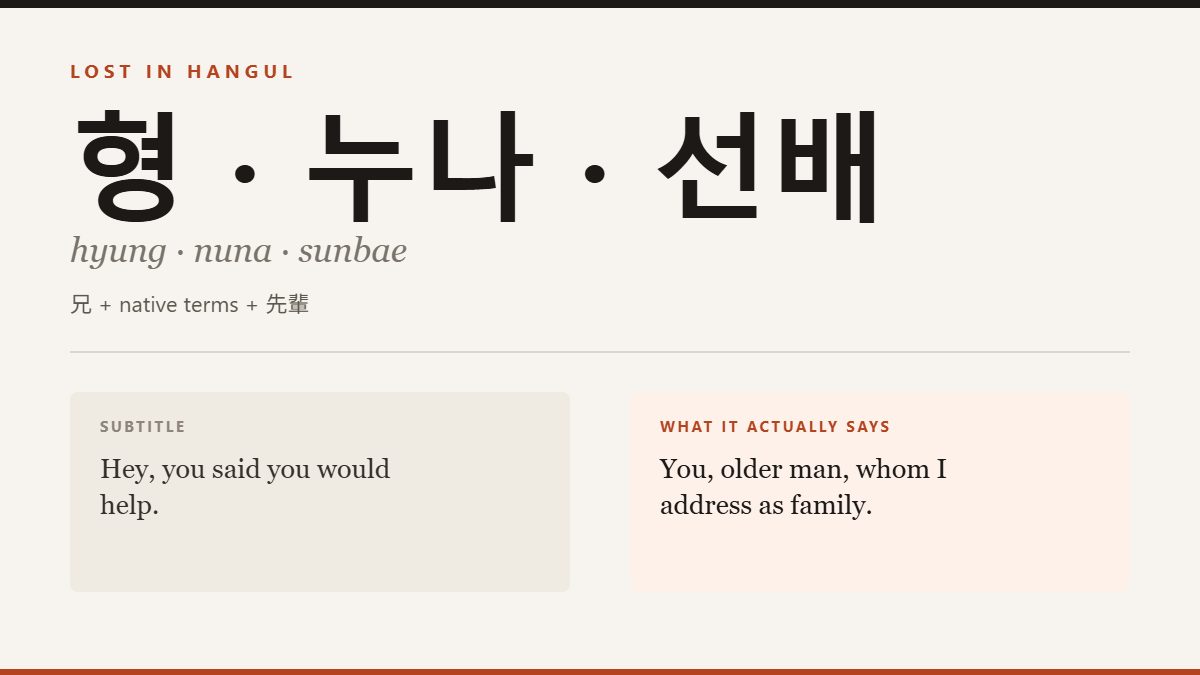
Short version: Korean mostly does not say “you”. It says what you are to the speaker. 형, 누나, 언니, 오빠, 선배 all sit in the slot where English puts a pronoun or a name, and every one of them states a relationship. English subtitles flatten the lot into “you”, and the flattening happens in almost every line of dialogue.
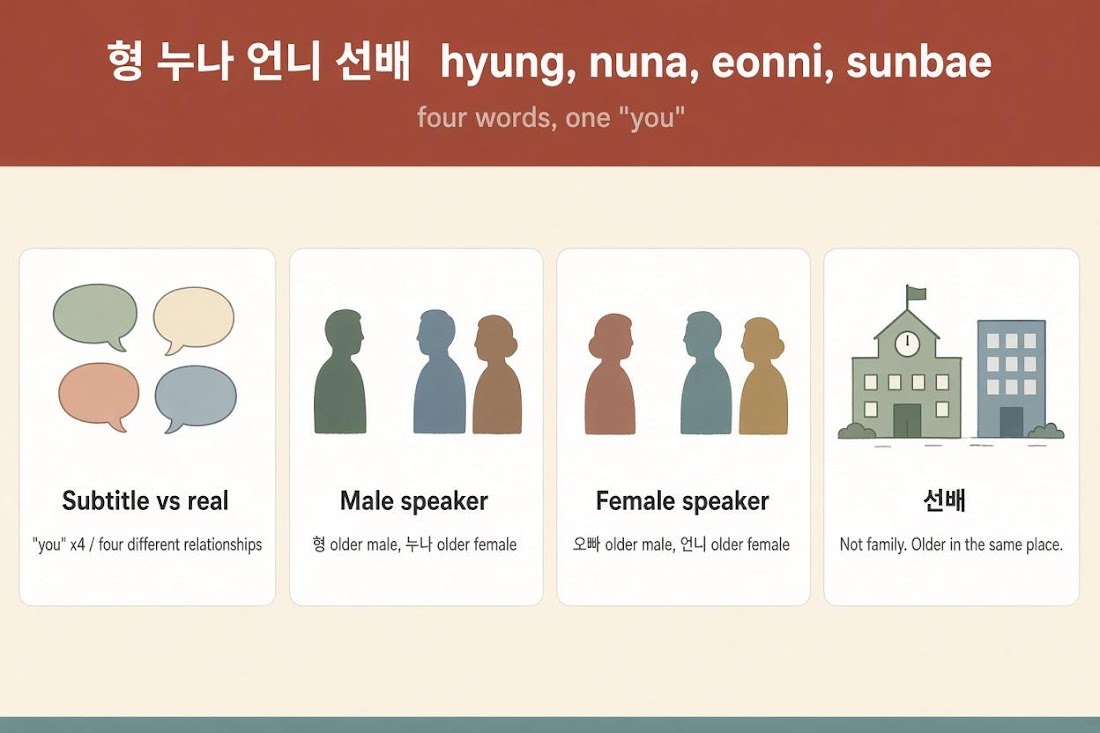
The grid
Which word you use depends on your gender as much as the listener’s. This is the part that surprises English speakers, because English titles do not care who is speaking.
| Male speaker | Female speaker | |
|---|---|---|
| To an older man | 형 (hyung) | 오빠 (oppa) |
| To an older woman | 누나 (nuna) | 언니 (eonni) |
Four words for one relationship type, sorted entirely by who is standing where. A man and a woman in the same room, addressing the same older man, will use different words, and neither can borrow the other’s.
Where they come from
Only one of the four is Sino-Korean. 형 is 兄, the character for elder brother, which is why it shows up inside formal compounds like 형제 (brothers, 兄弟). The other three — 누나, 언니, 오빠 — are native Korean words with no hanja behind them.
That split is worth noticing because it lines up with register. 형 can appear in stiff, formal contexts in a way the others cannot.
선배 and 후배 are a different system entirely: 先輩 and 後輩, senior and junior, borrowed from the same Sino-xenic stock that gave Japanese senpai and kōhai. These are about institutional seniority rather than age. Someone who entered your university or company before you is 선배 even if they are younger than you, which happens often enough to be awkward.
Why Korean avoids “you” in the first place
There is a second-person pronoun, 너, and it is perfectly normal — downward and sideways. To a close friend, a younger sibling, a junior you are comfortable with. Aimed upward at someone older or senior, it is rude in a way that is difficult to overstate.
So Korean has two escape routes. It drops the subject entirely, which it does constantly and grammatically, or it fills the slot with a relationship term. The second is where 형 and the rest come in. They are not affectionate flourishes added on top of a sentence. They are doing the grammatical work that English gives to a pronoun.
Which means that when an English subtitle says “you”, the Korean almost certainly said something more specific, and the more specific thing was about hierarchy.
They are not just for family
All four are used with people you are not related to, constantly, and the non-family use is by far the more common one.
- A woman calls a slightly older woman at work 언니 once they are friendly. Also used to shop assistants and restaurant staff of roughly her own age.
- A man calls an older male colleague 형 after hours, then switches back to his title in a meeting.
- 이모 — literally “maternal aunt” — is the standard warm address for a middle-aged woman running a restaurant.
- Idol groups run on this. The 형 line is the older members, 막내 is the youngest, 맏형 the eldest. Fandoms use these Korean words untranslated because there is nothing to translate them into.
The moment permission gets granted
You do not simply start calling someone 형. Someone older offers it, and the offer is a real event: 말 놓자, let’s drop the formal speech, or 형이라고 불러, call me hyung.
In variety shows this gets its own segment. Two cast members negotiate whether they are close enough yet, someone gets turned down, the edit adds a sound effect. In dramas it is a turning point. In an English subtitle it is: “Just call me Minsoo.”
If you are learning
Do not assign yourself these words. Wait to be offered. Using 형 or 언니 on someone who has not invited it reads as presumptuous, in the specific way that slapping someone on the back at a first meeting is presumptuous.
The safe default until then is their name plus 씨, or their job title plus 님. Neither is cold. Both are simply correct, which is the thing to be while you are still working out where you stand.
The word “friend” is not a free choice either
While we are here: 친구 does not simply mean friend. It means someone of the same age. Two people born in the same year are 친구; a person three years older is not, no matter how close you are or how long you have known them.
This catches English speakers out badly, because “we’re friends” is a statement about closeness in English and a statement about birth year in Korean. Introducing an older colleague you adore as 제 친구 will get a small correction. The word you want is 형 or 언니, which is warmer anyway.
The awkward case: a senior who is younger than you
Because 선배 is about when you entered an institution and 형 is about when you were born, the two can point in opposite directions. Someone who joined the company two years before you but is three years younger is your 선배 and not your 형.
Korean workplaces handle this in various uncomfortable ways, usually by both people retreating to job titles and polite speech and never resolving it. Military service, repeated university years and late career changes all produce this situation regularly. If a drama scene feels stiff for no visible reason, this is often what is happening underneath.
And when the terms stop
Because these words mark closeness, dropping them marks its loss. Two people who have called each other 형 and 동생 for years, suddenly using full names and polite endings, have had a falling out. Nothing needs to be said about it.
An English subtitle shows this as two characters using each other’s names, which is what they were doing the whole time.
Read next
- Why she calls him “Oppa” (오빠) — and why the subtitle just uses his name
- “Maknae” (막내) — the youngest is a job, not a fact
- “-ssi” and “-nim” (씨 · 님) — the suffix that sets your rank
Last reviewed: September 20, 2026