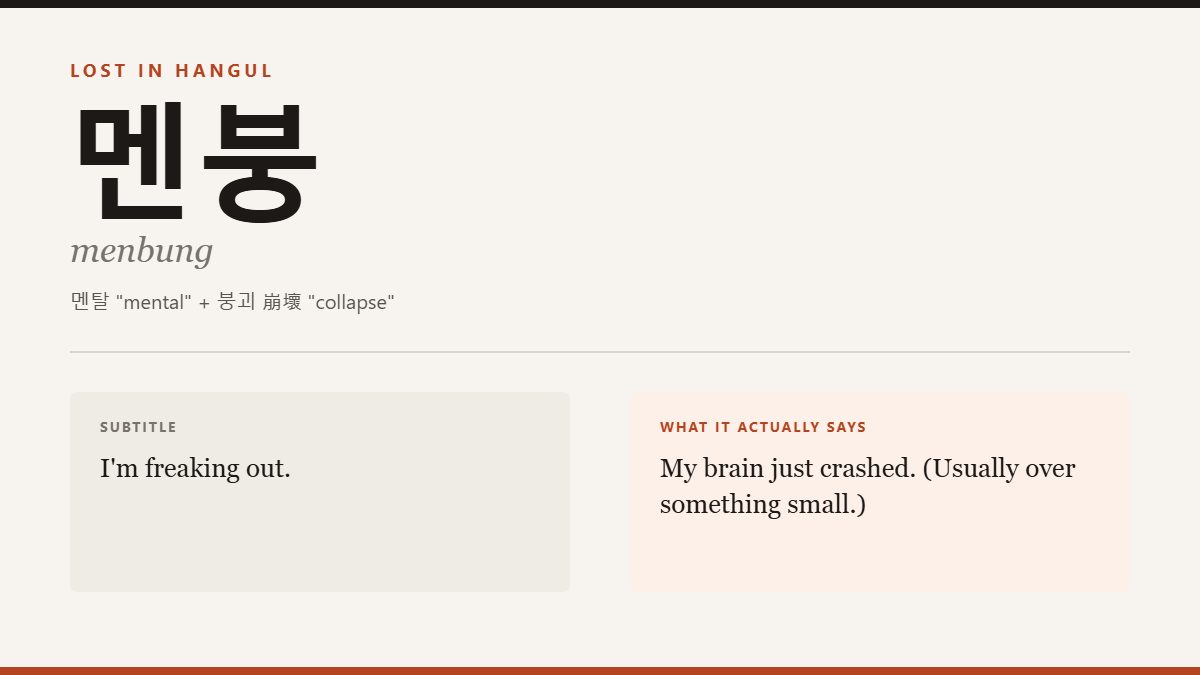
Short version: 멘붕 is a clipped form of 멘탈 붕괴 — English “mental” plus 붕괴, “collapse.” It names the moment your mind goes blank because something went wrong and you can’t process it. It’s casual slang, and it’s mostly used about everyday disasters: a deleted file, a missed train, an exam on the chapter you skipped.
How it’s used
- 멘붕 왔어 / 나 지금 멘붕이야 — “I’m losing it right now.”
- 완전 멘붕 — “total meltdown.”
- 멘붕에 빠지다 — to fall into 멘붕.
- 멘붕에 빠뜨리다 / 멘붕 오게 만들다 — to make someone’s brain crash.
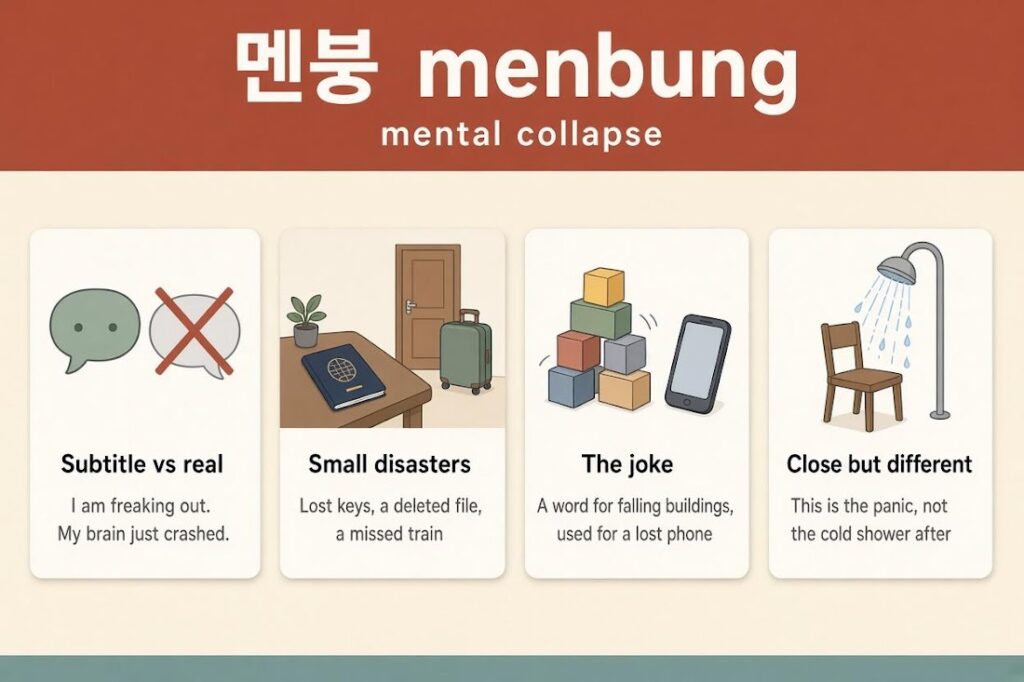
The typical situations are small and sudden. You reach the airport and your passport is on the kitchen table. Your laptop dies five minutes before a presentation. A friend tells you the person you’ve been texting is married. Each of those is 멘붕: panic plus blankness, the feeling of standing still while your mind spins.
It is usually said about yourself, and usually with a bit of a laugh. That’s part of its charm. Calling a lost phone a “mental collapse” is a joke about how big it feels in the moment.
Where the word comes from
멘탈 is borrowed from English “mental,” but in Korean it works as a noun meaning composure or mental state: 멘탈이 강하다 is “mentally tough,” 멘탈 관리 is “keeping your nerves in check.” 붕괴 is Sino-Korean, 崩壞, the word used when a building or a bridge collapses. Clipped to the first syllable of each part, in the usual Korean way, you get 멘붕.
The word is usually traced to online gaming communities around 2011. By 2012 it had spread to television and newspapers, and it has stayed in everyday speech since.
The 멘탈 family
| Expression | Means |
|---|---|
| 멘붕 | Mind goes blank in panic |
| 멘탈이 털리다 | To be badly shaken, mentally wrecked |
| 유리 멘탈 | “Glass mental” — easily rattled |
| 강철 멘탈 | “Steel mental” — unflappable |
| 멘탈 잡아 | “Get a grip,” “pull yourself together” |
Similar but different
- 현타 — a sudden, quiet, sobering realisation. 멘붕 is the panic; 현타 is the cold shower afterwards.
- 헐 — the reaction to news. 멘붕 is the state you’re left in.
- 어떡해 — “what do I do?”, the sentence people say while in 멘붕.
- 당황하다 — the standard word for being flustered. 멘붕 is the slang, and stronger.
Borrowing the word for a collapsing building to describe a lost phone is the joke — and that’s exactly why people avoid 멘붕 for real tragedy. Using it about a death or a serious accident would sound flippant. It belongs to lost keys, not to grief.
What subtitles do
The feeling survives; the wordplay doesn’t. When a buttoned-up character suddenly says 나 멘붕이야, Korean viewers hear someone reaching for slang — and for a joke — in the middle of a crisis, which tells you something about them. The subtitle, usually “I’m freaking out” or “My mind went blank,” makes them sound merely stressed.
Read next
- “Hyeonta” (현타) — the moment the frame widens and it is bleak
- “Heol” (헐) — the one-syllable jaw drop
- “Eotteokhae” (어떡해) — not a question, despite appearances
Last reviewed: October 4, 2026