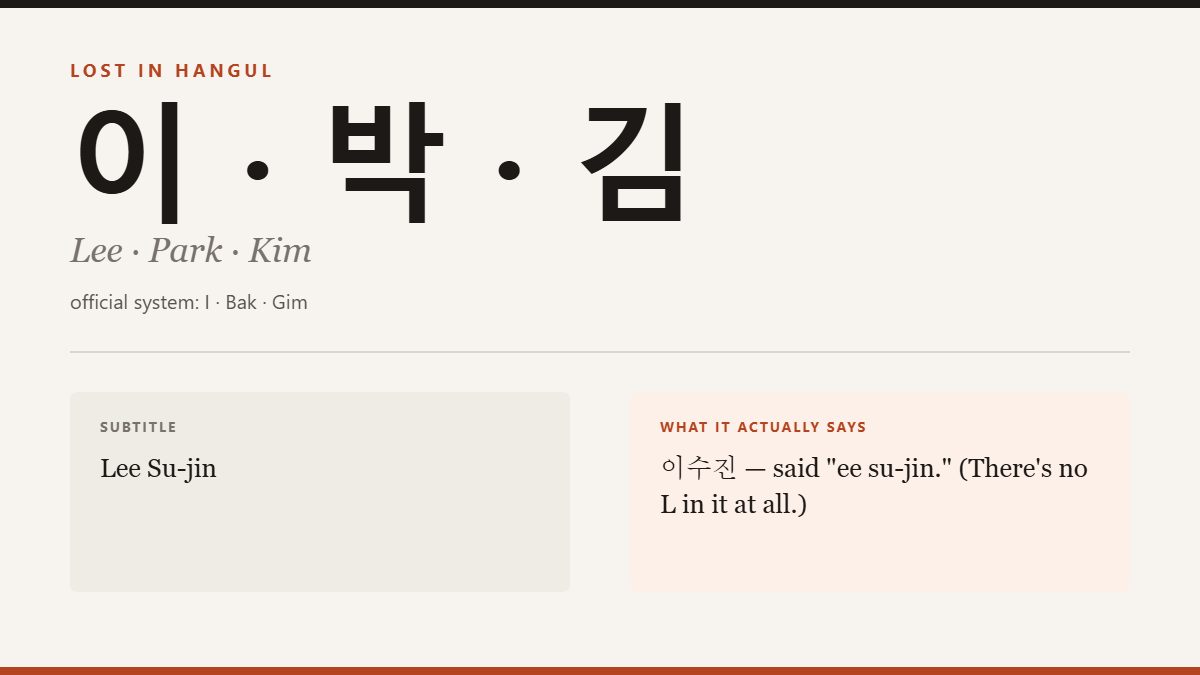
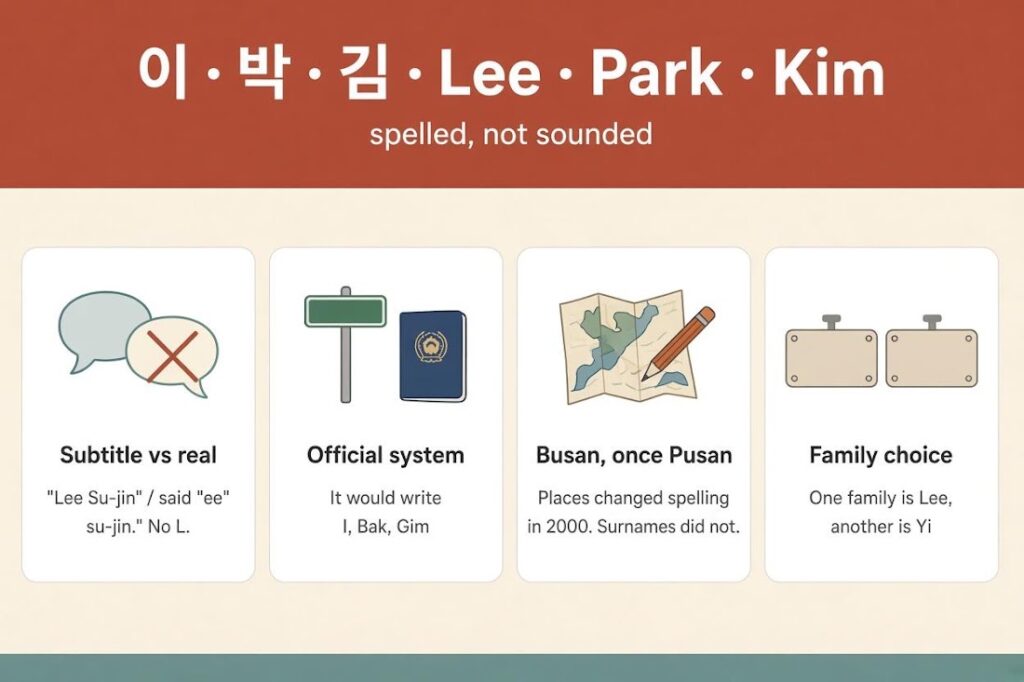
Short version: the three most common Korean surnames are usually written Kim, Lee and Park, but none of them sounds quite like that. 이 is just “ee.” 박 has no R. 김 starts with a sound between K and G. The spellings come from older romanization habits, and South Korea’s official system — which would give I, Bak and Gim — was deliberately not imposed on surnames. Subtitles use whatever spelling the person or production uses.
How common surnames are spelled
| Hangul | Usual spelling | Official system |
|---|---|---|
| 김 | Kim | Gim |
| 이 | Lee, Yi, Rhee | I |
| 박 | Park | Bak |
| 최 | Choi | Choe |
| 정 | Jung, Jeong, Chung | Jeong |
| 신 | Shin | Sin |
You can see why nobody rushed to adopt the official column. Very few people want to be Mr. I or Ms. Sin.
Why 이 is “Lee”
The surname is the character 李, which was once pronounced with an initial r/l sound, 리. In South Korean speech and spelling, a rule known as 두음법칙 drops that sound at the start of a word, so the name became 이. North Korea keeps the older form and writes 리. Spellings like Lee and Rhee echo that older sound — South Korea’s first president wrote his name Syngman Rhee — and Lee also happens to look like a name to English readers. Yi is closer to the modern sound and common in academic writing, as in Admiral Yi Sun-sin.
The same rule explains other pairs: 류 → 유 (Ryu or Yoo), 림 → 임 (Lim or Im), 라 → 나 (Ra or Na). Since a 2007 change to the family-registration rules, though, people may register these surnames in Hangul with the original sound, and many have — which is why the baseball pitcher 류현진 is written with 류, and in English as Ryu Hyun-jin.
Why 김 is “Kim” and 박 is “Park”
At the start of a word, Korean ㄱ and ㅂ are unaspirated, so to English ears they sit between k and g, and between p and b. Older romanization systems, including McCune–Reischauer, which South Korea used officially from 1984 to 2000, wrote them as k and p. Hence Kim — and, strictly, Pak.
Park is Pak with an R added, and the R has no Korean source. A common explanation is that it marks the long “ah” vowel, as in a British pronunciation of “park,” but no rule required it. It’s simply the spelling that stuck.
The 2000 system, and why names were left alone
In 2000 South Korea adopted the Revised Romanization of Korean, the system you see on road signs. That’s why the city once spelled Pusan became Busan. Names were treated differently. The official text says the romanization of surnames is to be decided separately, and in practice people keep the spellings their families already use. One family’s 이 is Lee, another’s is Yi.
The given name
Given names are usually two syllables, written with a hyphen or run together: Su-jin, Sujin. Both are allowed. And Korean puts the family name first, so 이수진 is Lee Su-jin. Some English-language publications flip the order to fit Western habits, so the same person can appear as Su-jin Lee.
For learners: when you hear “ee” before a name, it’s probably spelled Lee. When you see “Park,” say it with no R and a short, crisp first sound. Your Korean will sound noticeably better for it.
What subtitles do
They print names the way the production spells them, which is the only sensible choice. Nothing dramatic is lost. But it does mean English-speaking viewers who learn names from subtitles end up saying a Korean surname with an L that no character on screen ever pronounces.
Read next
- When they suddenly use your full name — the alarm subtitles can't ring
- “-ssi” and “-nim” (씨 · 님) — the suffix that sets your rank
- Two lines, forty characters: the rules subtitlers actually work under
Last reviewed: October 4, 2026