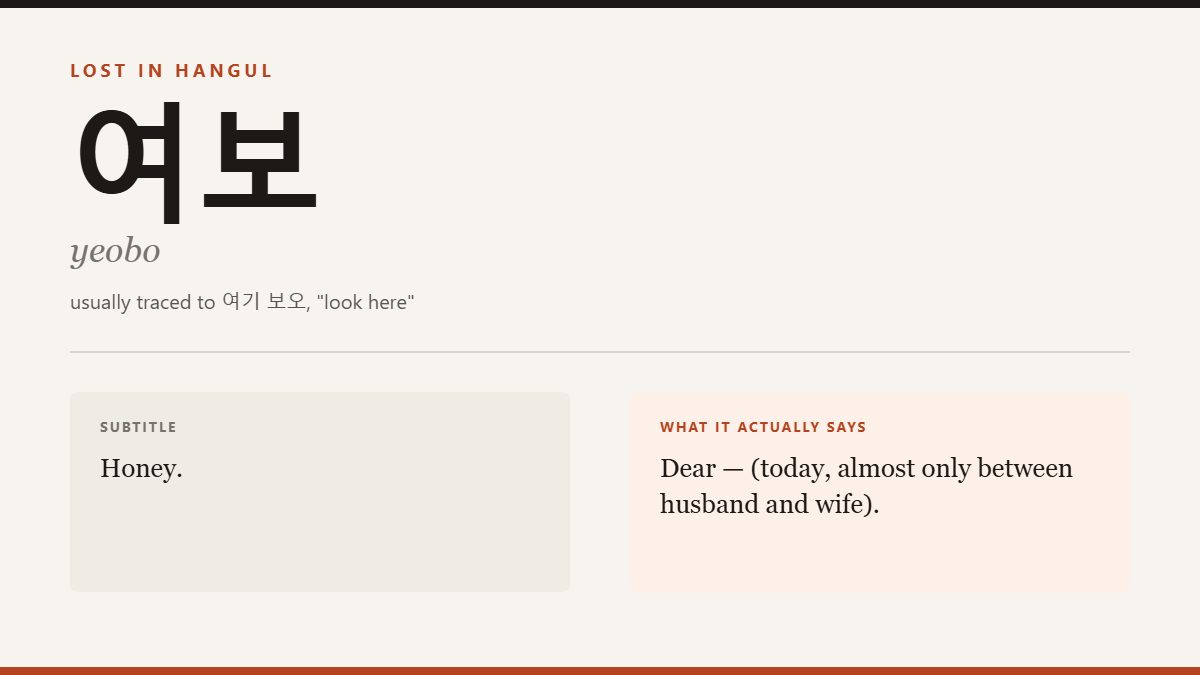
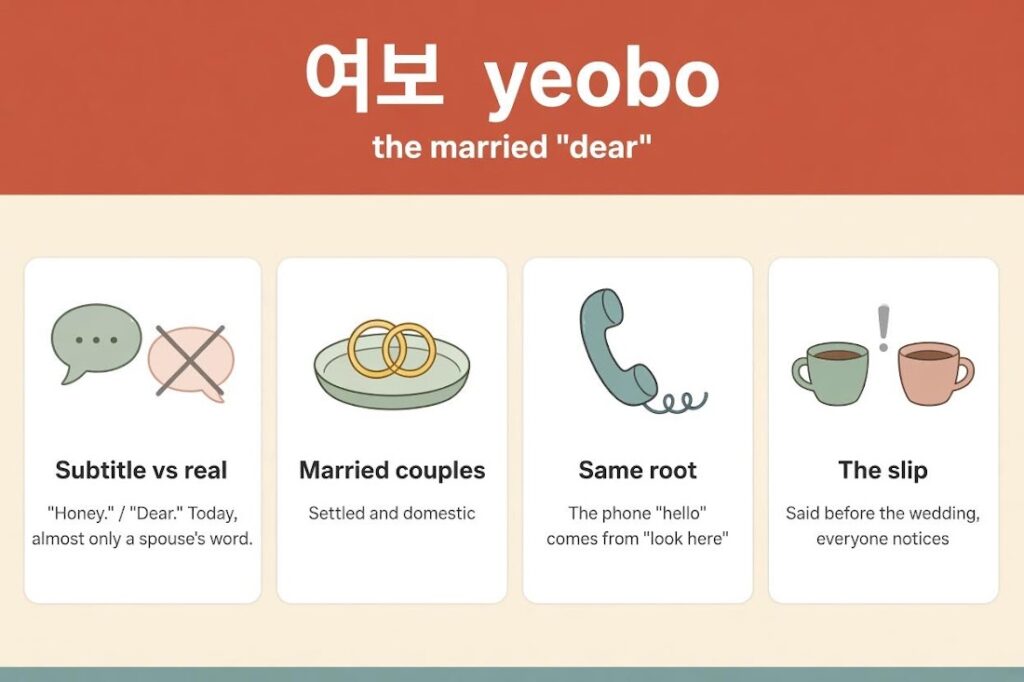
Short version: 여보 is what Korean husbands and wives call each other — roughly “honey” or “dear.” Unlike 자기야, which dating couples use too, 여보 today belongs almost entirely to marriage. It’s usually explained as a contraction of 여기 보오, “look here,” and its cousin 여보세요 is the “hello” Koreans say when they answer the phone.
Who says it
Husbands and wives, in both directions: 여보, 밥 먹어 — “Honey, come and eat.” It often comes paired with 당신, the spouse’s “you”: 여보, 당신이 그랬잖아 — “Dear, you’re the one who said that.”
| Term | Who uses it | Feel |
|---|---|---|
| 여보 | Married couples | Settled, domestic |
| 자기야 | Dating and married couples | Sweet, playful |
| 당신 | Spouses, as “you” | Intimate — or cold in a fight |
| Name + 아/야 | Many younger couples | Casual, equal |
Many couples move from 자기야 to 여보 after the wedding, or after children arrive, when 여보 starts to feel natural. Others never switch. Because 여보 now implies “my spouse,” an unmarried couple who use it are either joking or announcing that they’re serious, and their friends will tease them either way.
Where the word comes from
The usual explanation is 여기 보오 — “look here,” with the old polite ending –오 — shortened to 여보. Writing in the National Institute of Korean Language’s newsletter, the historical linguist Hong Yun-pyo called this account unproven but broadly right. He called a rival story — that 여보 comes from 如寶, “like a treasure” — not worth considering. It is a pretty folk etymology.
The same root gives a small family:
- 여보세요 — “please look here,” now the standard phone greeting.
- 여보시오 — an older “Excuse me!” or “You there!”, common in historical dramas.
- 여보게 — an older “Look here, my friend,” used to a friend or a junior, and by parents-in-law to a son-in-law.
So before it was a word for a spouse, 여보 was a way of getting someone’s attention, and it hasn’t completely lost that. The standard dictionary still lists it as a way for an adult to call someone of about the same age nearby, and Hong notes that it is also used between people of the same age. In everyday speech today, though, that use sounds old-fashioned, and outside a marriage it’s 여보세요 that survives.
여보세요 off the phone
여보세요 still works face to face, and not always politely. Said sharply to a stranger who has just pushed in — 여보세요, 줄 서세요 — it means “Excuse me? There’s a queue.” That one translates well, because English “Hello?” can carry exactly the same edge.
To many Korean ears, 여보 sounds a little middle-aged: settled, practical, a couple who have been through a few house moves together. That’s not a criticism. It’s what makes it sweet when a young couple try it out for the first time.
What subtitles do
Picture a couple who aren’t married yet. Mid-argument, he slips and calls her 여보 — and the room goes quiet, because the word assumes a marriage that hasn’t happened. Korean viewers laugh or gasp. The subtitle says “honey,” which commits to nothing, and the slip passes unnoticed. In ordinary married scenes, “honey” and “dear” do the job perfectly well.
Read next
- “Jagiya” (자기야) — how “self” became “honey”
- "Dangsin" (당신) — the "you" that can be tender, rude, or reverent
- "Appa" and "Eomma" (아빠·엄마) — and when they become 아버지 and 어머니
Last reviewed: October 4, 2026