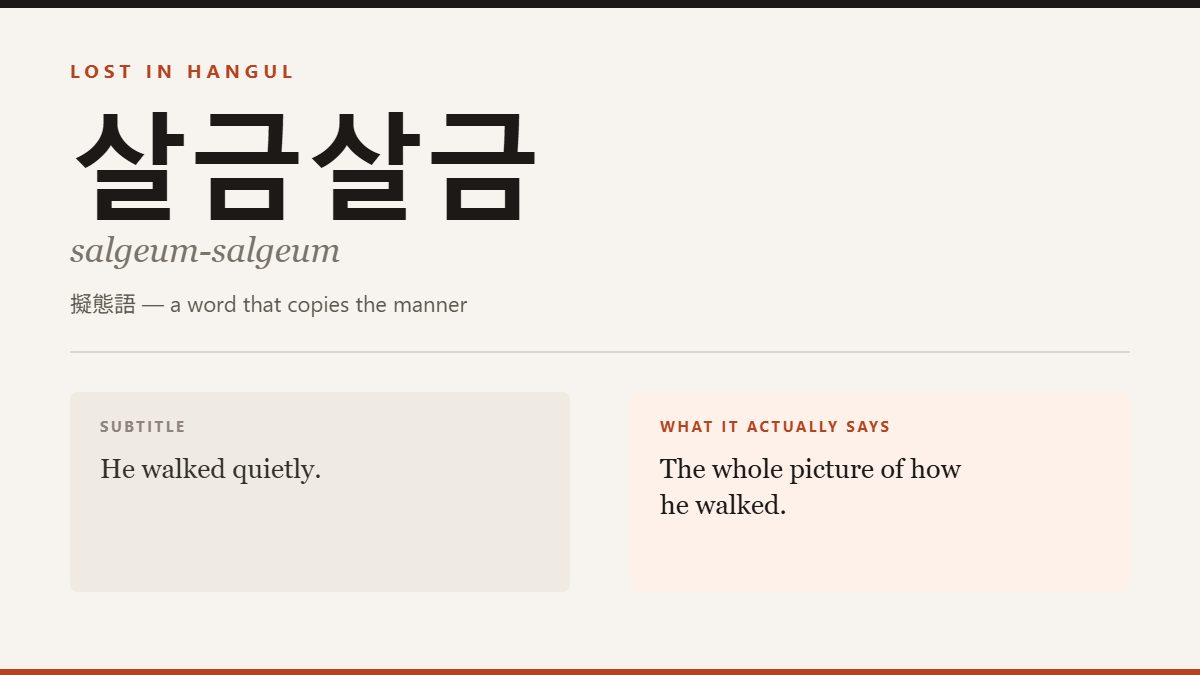
Short version: Korean has an enormous stock of words that describe how something looks, moves or sounds, and subtitles delete nearly all of them. They are not decoration. In Korean they carry information that English packs into adverbs and adjectives, or simply cannot carry at all.
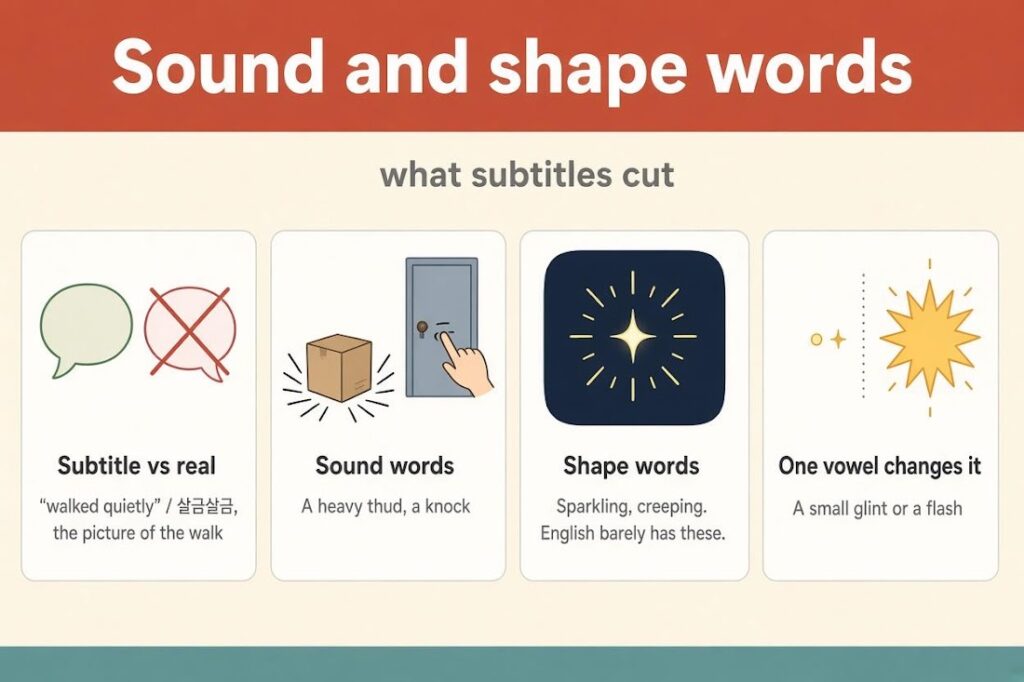
Two families
Korean grammar separates them, and the distinction is useful.
| Type | What it copies | Example |
|---|---|---|
| 의성어 (擬聲語) | Sound | 쿵 a heavy thud, 똑똑 knocking |
| 의태어 (擬態語) | Manner or appearance | 반짝반짝 sparkling, 살금살금 creeping |
English has the first family — bang, crash, knock — and barely has the second. There is no English word that means “the way something glitters”, used as a word rather than as a description.
They usually come doubled
반짝반짝, 두근두근, 알록달록, 울긋불긋, 살금살금. The repetition is part of the grammar, and it often signals that the action continues or repeats.
Changing one vowel changes the scale. 깜깜 is pitch dark; 컴컴 is dark in a heavier, gloomier way. 반짝 is a small glint; 번쩍 is a flash. Korean grades brightness, weight and size by swapping vowels, and native speakers hear the difference immediately.
This is the single most productive area of Korean vocabulary and the least translatable. A Korean children’s book is mostly these words. An English translation of it is mostly adjectives.
Where you meet them
- Variety captions. These words are the caption editor’s main tool. A cast member walks nervously and the screen says 살금살금.
- Descriptions of feeling. 두근두근 for a racing heart, 울컥 for a surge.
- Food writing. 쫄깃쫄깃 is a chewy springiness that English needs a sentence for.
- Everyday speech. They are not literary. People use them constantly.
What subtitles do
Cut them, or convert them into adverbs. 살금살금 걸었다 becomes “walked quietly”, which is accurate and loses the picture of the walk.
The on-screen Korean captions in variety shows are the worst-affected, because those captions are frequently only a sound word. There is nothing for the English track to put there, so the caption is dropped and English viewers see an empty moment where Korean viewers saw a joke.
If you want to use them
Start with the food ones. 바삭바삭 (crispy), 쫄깃쫄깃 (chewy), 촉촉 (moist). They are safe, common, and using them correctly is one of the fastest ways to sound less like a textbook.
Read next
- The Korean words subtitles always delete (and why translators do it)
- Two lines, forty characters: the rules subtitlers actually work under
- “Dapdaphae” (답답해) — not frustrated. Something tighter than that.
Last reviewed: September 21, 2026