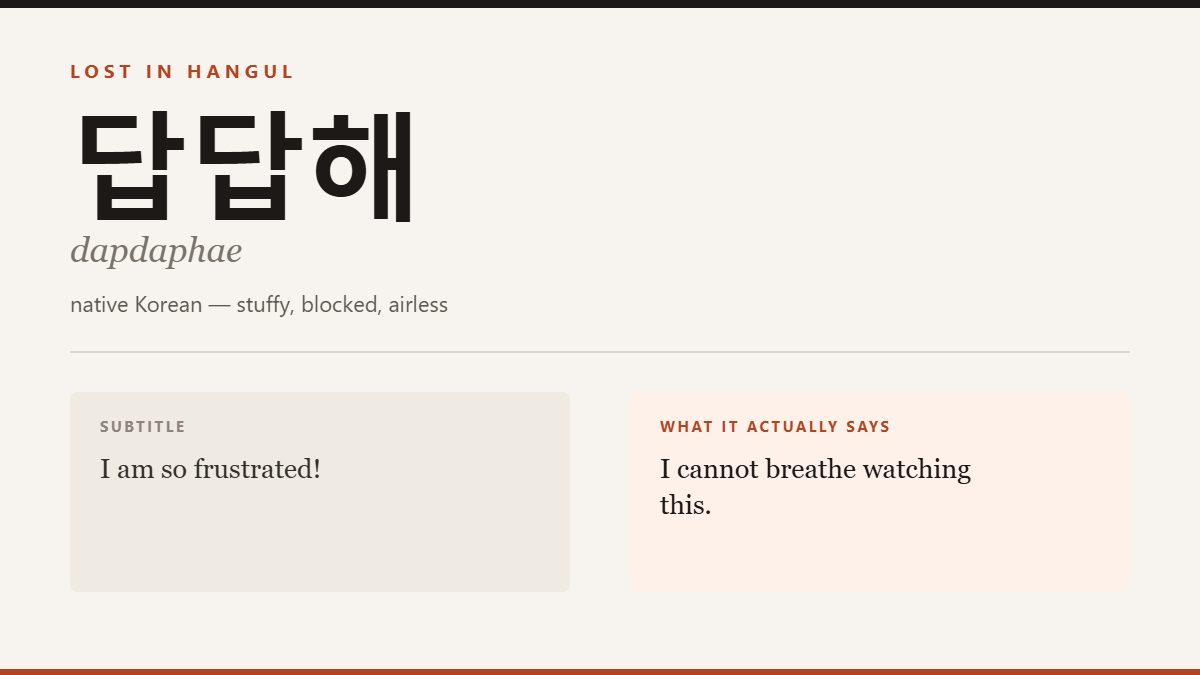
Short version: 답답하다 (dapdaphada) starts in the body. It means stuffy, blocked, unable to get air. When it is applied to a person or a situation, that physical image comes along with it. Subtitles write “frustrating,” which is the right neighbourhood and the wrong sensation.
Where the word comes from
Unlike 고생 or 정, this one is not built from hanja. It is native Korean, and it has the doubled shape that Korean uses constantly for sensory words: 답답, the same pattern as 깜깜 (pitch dark) or 빡빡 (tight, stiff). Words in this family tend to describe how something feels rather than what it is.
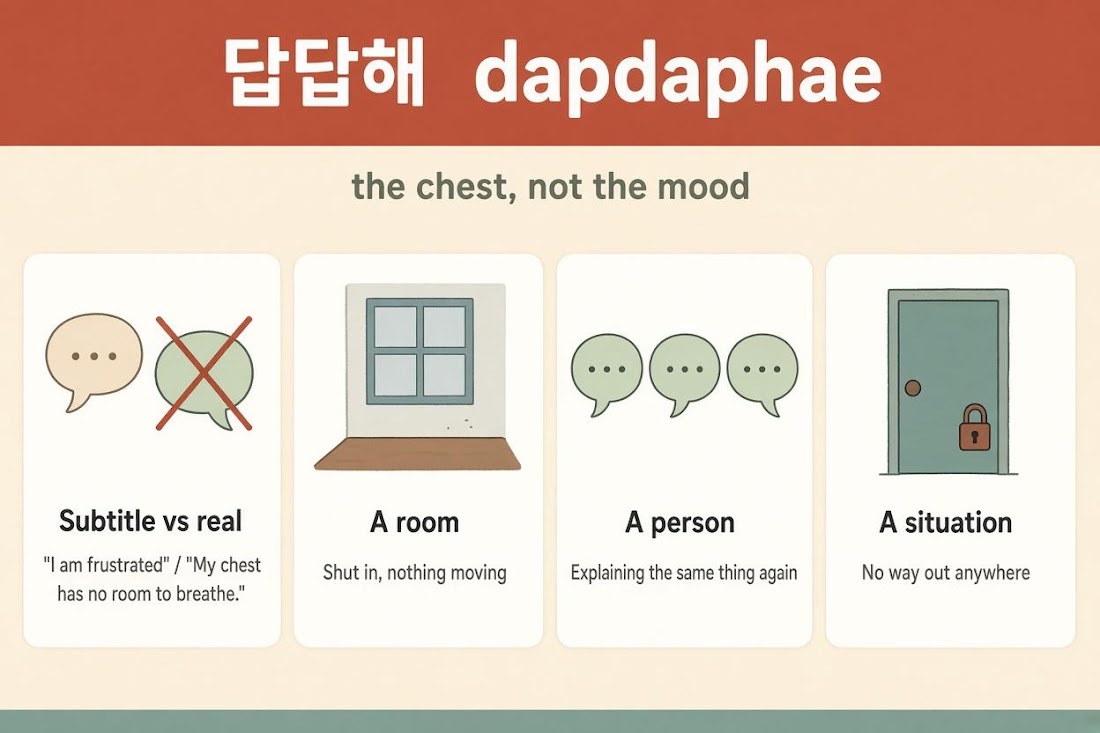
So the base meaning is physical and it stays physical. A room with no ventilation is 답답하다. A collar buttoned too tight is 답답하다. A blocked nose, a heavy meal sitting in your chest, a mask on a hot day.
Then it gets pointed at people
The extension is the interesting part. When you call a person 답답하다, you are not saying they annoy you. You are saying that being around them feels like a room with no air, because something that should be moving is not moving.
The two classic triggers:
- Someone who will not act. They know what they need to do and they are not doing it. The lead character who will not tell the truth, the friend who will not leave the bad relationship.
- Someone who is not following. You have explained twice and it has not landed. This use is harsher and can be genuinely rude.
Both share the same shape: you are stuck behind something that should have moved by now.
You can feel it on someone else’s behalf
This is where English quietly loses the plot. In English, frustration is normally yours: your goal is blocked, so you are frustrated. 답답하다 is routinely used about a situation that costs you nothing at all.
Watching a drama character fail to say the one sentence that would fix everything, while you sit on your sofa with no stake in it whatsoever, is the purest form of 답답해. Nothing of yours is blocked. You still cannot breathe.
The fandom vocabulary this produced: 고구마 and 사이다
If you watch K-dramas with an English-speaking fandom, you have seen these two words untranslated in comments, and this is where they come from.
| Term | Literally | In use |
|---|---|---|
| 고구마 | sweet potato | A plot or character so 답답한 it feels like dry sweet potato stuck in your throat |
| 사이다 | cider (fizzy soda) | The scene that finally clears it. Someone says the true thing out loud. |
| 고구마 전개 | sweet potato development | A stretch of episodes where nothing gets resolved |
| 사이다 발언 | cider remark | The line that cuts through. Usually clipped and shared on its own. |
The image is physical and completely literal: sweet potato is dry and sticks, carbonated drink washes it down. The whole metaphor only works because 답답하다 was about the throat and chest to begin with. An English fandom that learns 사이다 as “satisfying moment” gets the function right and misses that it is the antidote to a specific bodily feeling.
What it is not
| Word | What it actually covers |
|---|---|
| 답답해 | Blocked. Nothing is moving. Often about someone else. |
| 짜증나 | Irritated. Something is grating on you. |
| 억울해 | Wronged. You are being blamed unfairly and cannot prove it. |
| 화나 | Angry, plainly. |
억울하다 is the other famous one on that list and deserves its own article. For now the useful contrast is that 답답해 points at a blockage and 짜증나 points at a source of irritation. Mixing them up makes you sound like you are blaming the wrong thing.
One practical note
가슴이 답답하다 — “my chest feels tight” — is also the everyday phrase people use to describe real chest tightness to a doctor. If you are using it about your actual chest rather than about a drama, that is a sentence for a medical professional, not a vocabulary lesson.
If you want to use it
답답해 on its own, said while watching something, is natural and needs no object. 진짜 답답하다 is the everyday intensified version.
What to avoid is calling a person 답답해 to their face. In the “you are not following” sense it is close to telling someone they are slow, and it lands harder than the English word “frustrating” would lead you to expect.
The stronger version: 속 터져
When 답답해 is not enough, Korean escalates to 속이 터지다, literally “my insides are bursting.” 속 is the inside of the body, the same word used for an upset stomach, and the image is of pressure that has built past what the container can hold.
The two are on the same scale. 답답해 is a blocked pipe. 속 터져 is what happens if nobody unblocks it. A viewer saying 속 터진다 about an episode is saying they have been watching a character fail to speak for six weeks and can no longer sit still.
There is also 답답이, a mildly affectionate noun for a person who is habitually like this. It is the sort of thing said about a friend who takes forty minutes to order, and it is not a compliment, but it is not cruel either.
How subtitlers actually handle it
There is no single solution, and you can usually tell which strategy a given subtitler picked.
The common choice is “frustrating,” which is accurate about the emotion and silent about the body. Some go with “suffocating,” which keeps the physical image and overshoots in seriousness, since 답답해 is an everyday word and “suffocating” is not. A few reach for “I can’t stand it,” which fixes the intensity and loses the specific blockage.
Occasionally you will see a subtitler simply leave 고구마 as “sweet potato” and trust the audience to work it out from context. Ten years ago that would have been a mistake. With an audience that has been reading fan commentary for a decade, it now sometimes lands better than the explanation would.
What to listen for
Watch for 답답해 being said by someone who is not personally affected. That is the use that English has no clean equivalent for, and it is far and away the most common one in drama commentary, reaction clips and variety edits.
Read next
- “Daebak” (대박) — one word, four completely different meanings
- The Korean words subtitles always delete (and why translators do it)
- “Eogulhada” (억울하다) — wronged, and unable to prove it
Last reviewed: September 20, 2026