Skip to content

Lost in Hangul

  • Home
  • Untranslatable Words
  • Honorifics & Titles
  • Things They Say
  • Slang & Internet Korean
  • Subtitle Notes
  • About
  • Contact
  • Privacy Policy

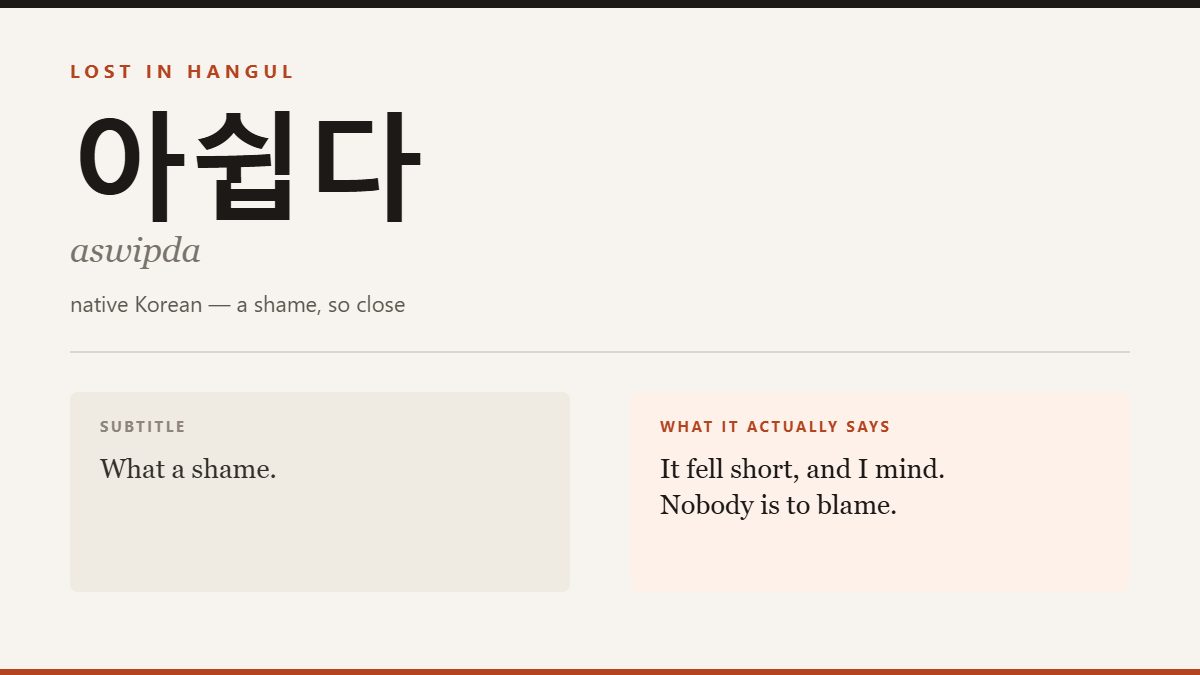
“Aswipda” (아쉽다) — a shame, and not the same as 서운하다
September 24, 2026September 21, 2026 by mataXinfo
아쉽다 (aswipda) word card

One of these is a warm goodbye and the other is an accusation. In English they both look like mild disappointment, which is how learners end up insulting people they meant to compliment.
Categories Untranslatable Words Tags aswipda, regret, seounhada, untranslatable Leave a comment

“-ssi” and “-nim” (씨 · 님) — the suffix that sets your rank

September 24, 2026September 20, 2026 by mataXinfo
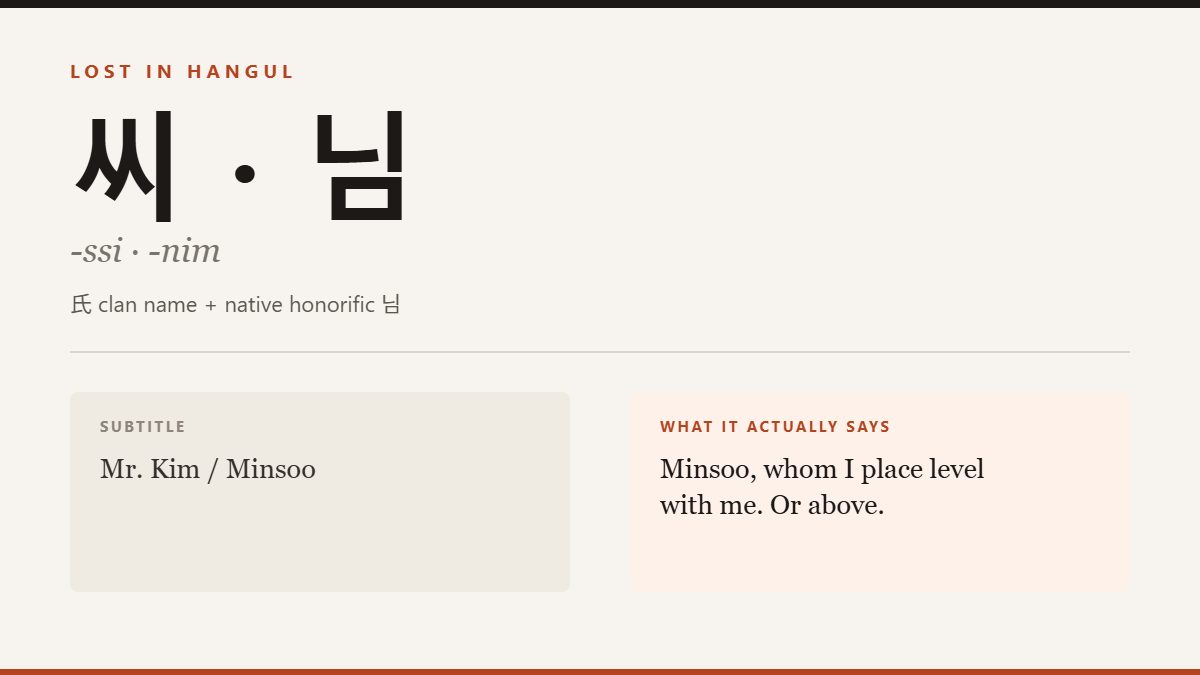
씨 · 님 (-ssi · -nim) word card

Every textbook teaches 씨 as “the polite one”. Attach it to a surname alone, or to anyone senior to you, and it is the opposite of polite.

Categories Honorifics & Titles Tags honorifics, nim, ssi, titles, workplace korean Leave a comment

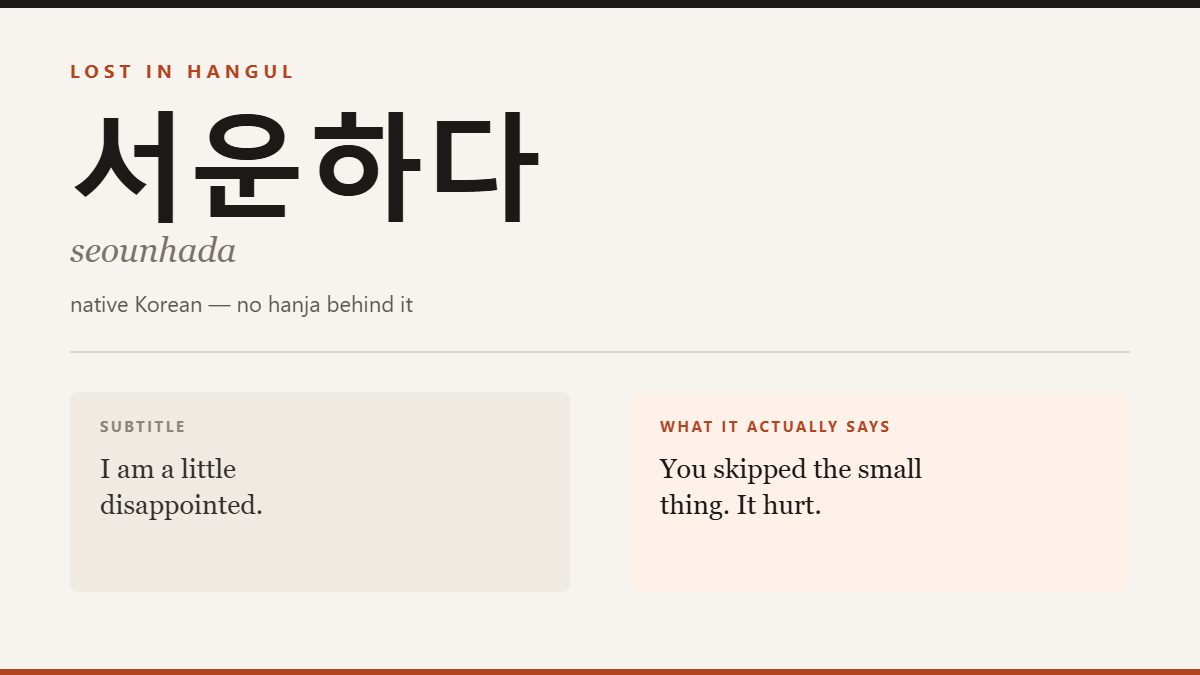
“Seounhada” (서운하다) — the hurt you feel slightly embarrassed about

September 24, 2026September 20, 2026 by mataXinfo
서운하다 (seounhada) word card

Not anger and not betrayal. The quiet hurt when someone close skipped the small thing, and saying it out loud is itself an admission that they matter.

Categories Untranslatable Words Tags relationships, seopseophada, seounhada, untranslatable Leave a comment

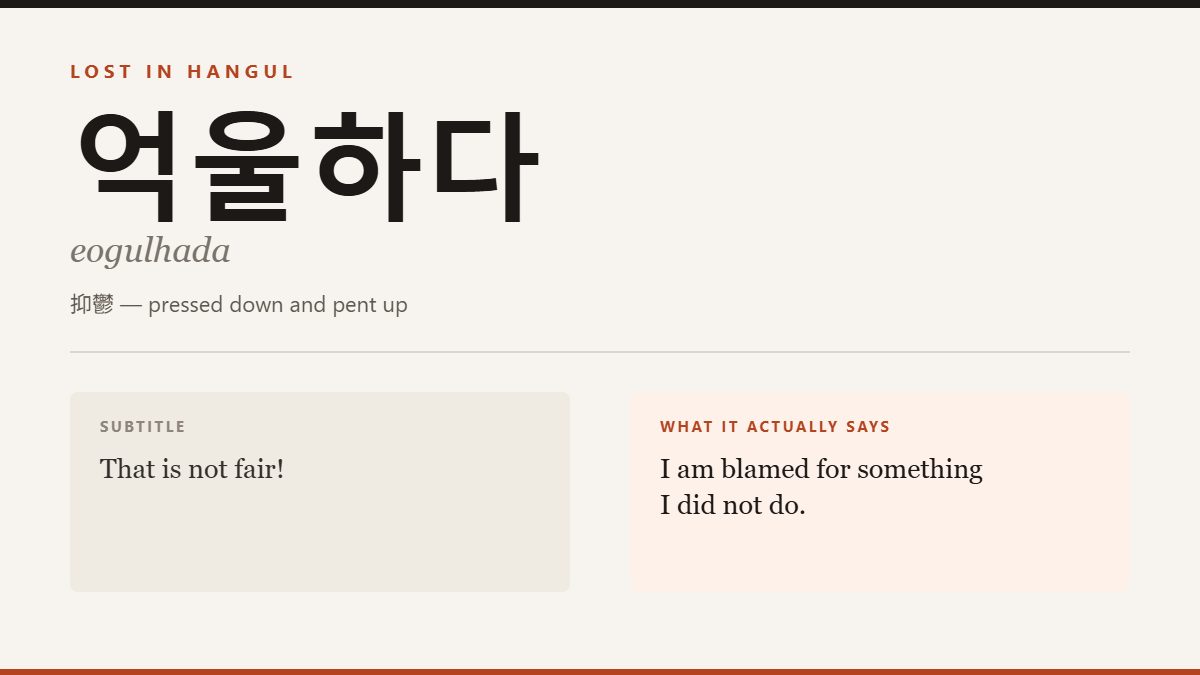
“Eogulhada” (억울하다) — wronged, and unable to prove it

September 24, 2026September 20, 2026 by mataXinfo
억울하다 (eogulhada) word card

The same two hanja mean “depression” in Chinese and Japanese. Korean sent them somewhere else: the pressure of being blamed for something you did not do, in front of people who believe otherwise.

Categories Untranslatable Words Tags eogulhada, han, k-drama, untranslatable Leave a comment

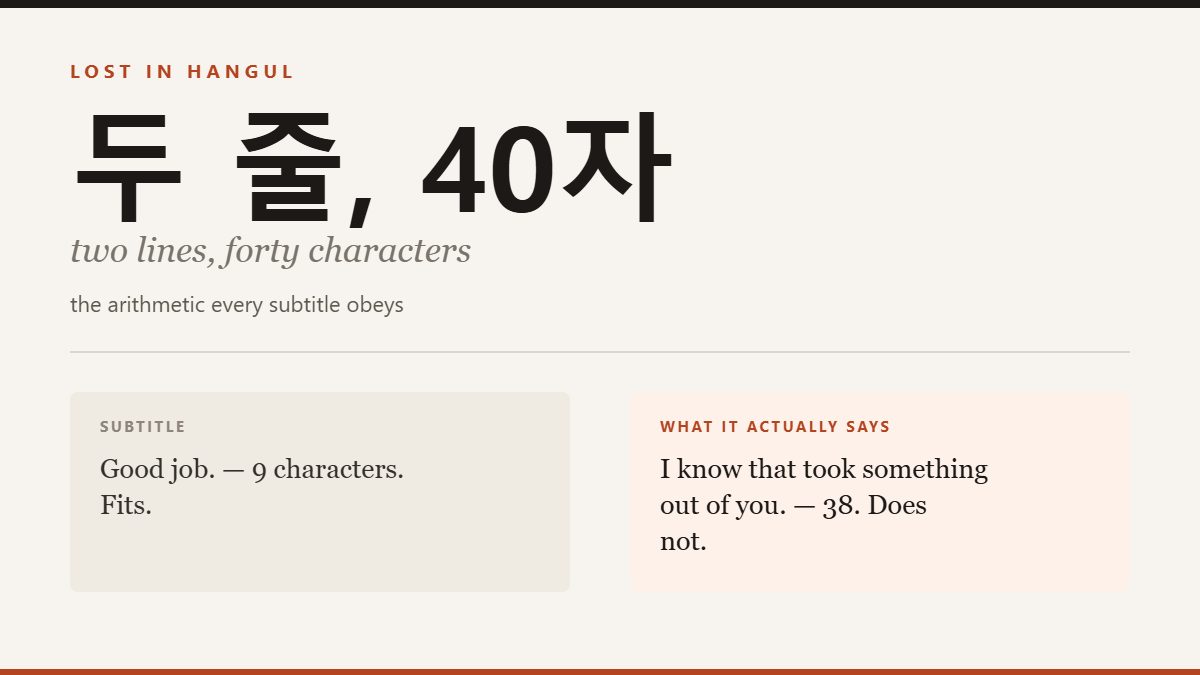
Two lines, forty characters: the rules subtitlers actually work under

September 24, 2026September 20, 2026 by mataXinfo
두 줄, 40자 (two lines, forty characters) — what the subtitle says versus what was actually said

Most of what gets lost between Korean and an English subtitle is lost to arithmetic: two lines, about forty characters each, read at the speed an audience can manage while watching.

Categories Subtitle Notes Tags craft, localisation, subtitles, translation Leave a comment

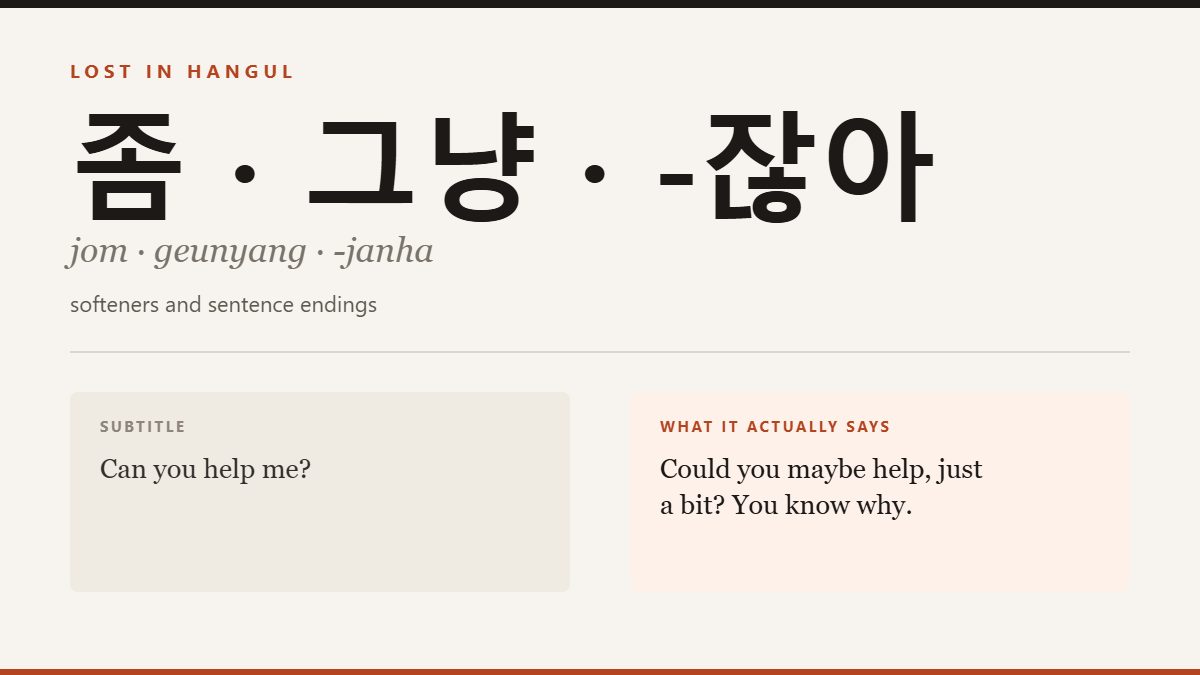
The Korean words subtitles always delete (and why translators do it)

September 24, 2026September 20, 2026 by mataXinfo
좀 · 그냥 · -잖아 (jom · geunyang · -janha) — what the subtitle says versus what was actually said

좀, 그냥, 막, -네, -잖아. None of them carry facts, all of them carry tone, and a subtitle rationed by the character cuts them first. That is why subtitled Korean sounds curter than it is.

Categories Subtitle Notes Tags geunyang, jom, sentence endings, subtitles, translation Leave a comment

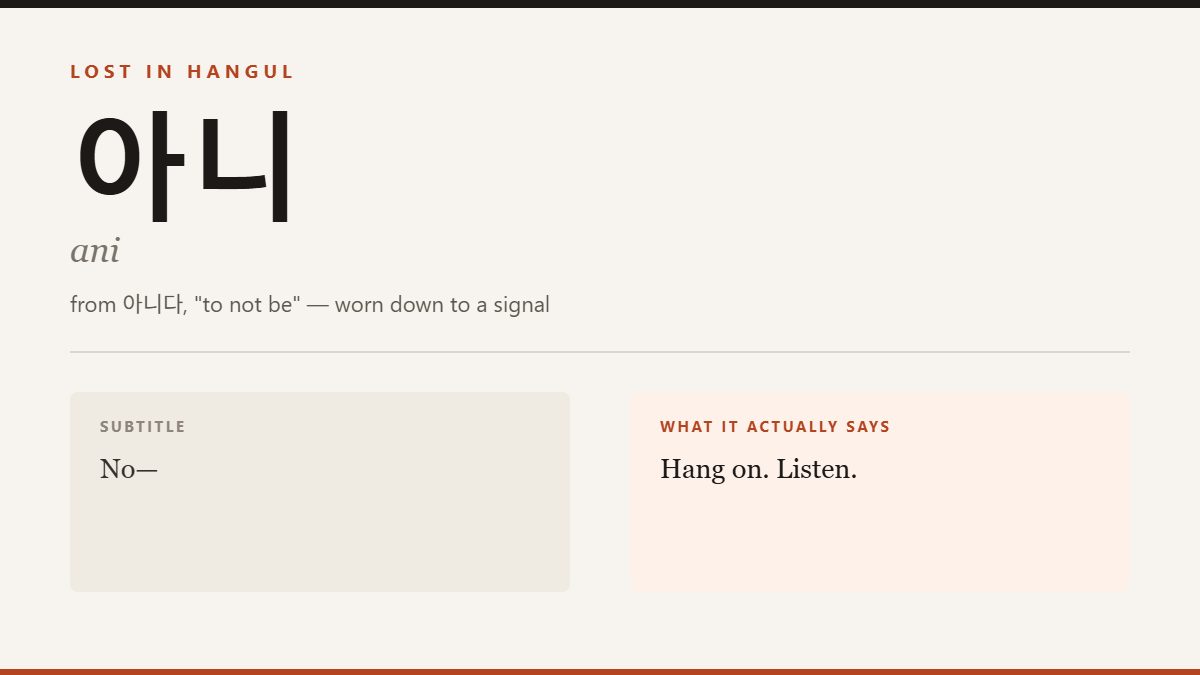
“Ani” (아니) — the word that usually is not “no”

September 24, 2026September 20, 2026 by mataXinfo
아니 (ani) — what the subtitle says versus what was actually said

Subtitles print “No—” and then the speaker agrees with everything. The bare 아니 at the front of a sentence is closer to “wait” or “hang on”, and it denies nothing.

Categories Subtitle Notes Tags ani, conversation, discourse markers, subtitles Leave a comment

“Kkuljaem” and “Nojaem” (꿀잼·노잼) — how Koreans rate whether it was fun

September 24, 2026September 20, 2026 by mataXinfo
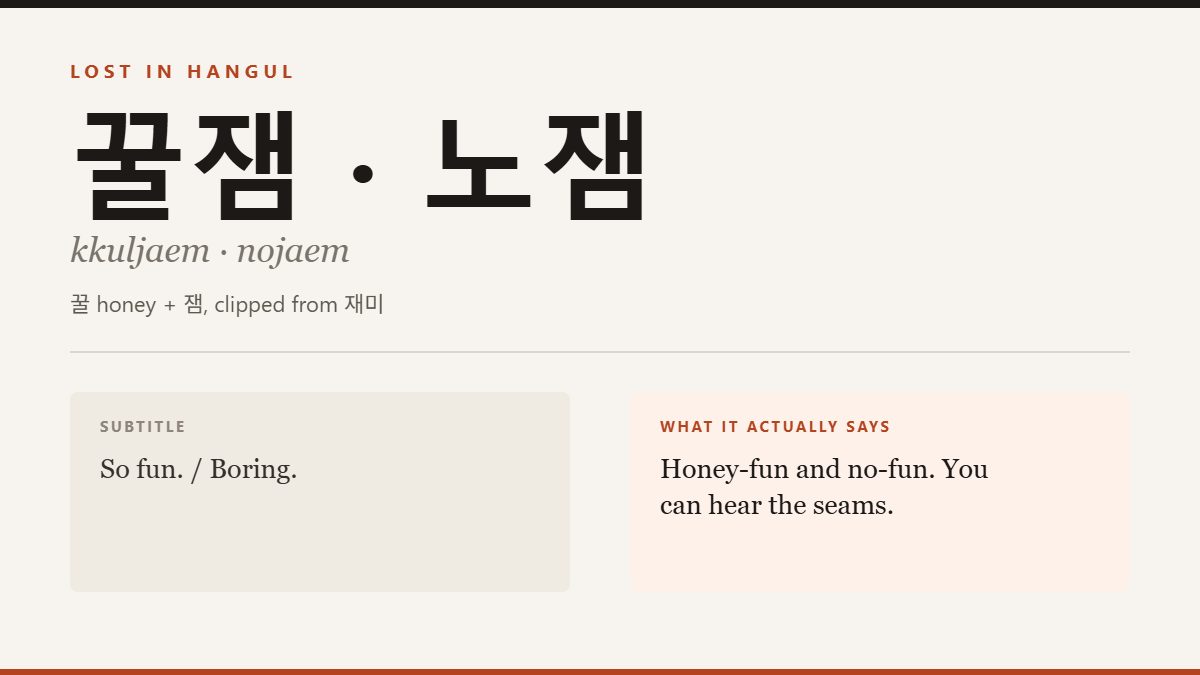
꿀잼 · 노잼 (kkuljaem · nojaem) — what the subtitle says versus what was actually said

Honey-fun and no-fun. Both are built from parts, and once you can see the seams you can decode a whole shelf of Korean internet vocabulary you have never met.

Categories Slang & Internet Korean Tags internet korean, kkuljaem, nojaem, slang, word formation Leave a comment

“Injeong” (인정) — the one-word agreement that took over Korean variety

September 24, 2026September 20, 2026 by mataXinfo
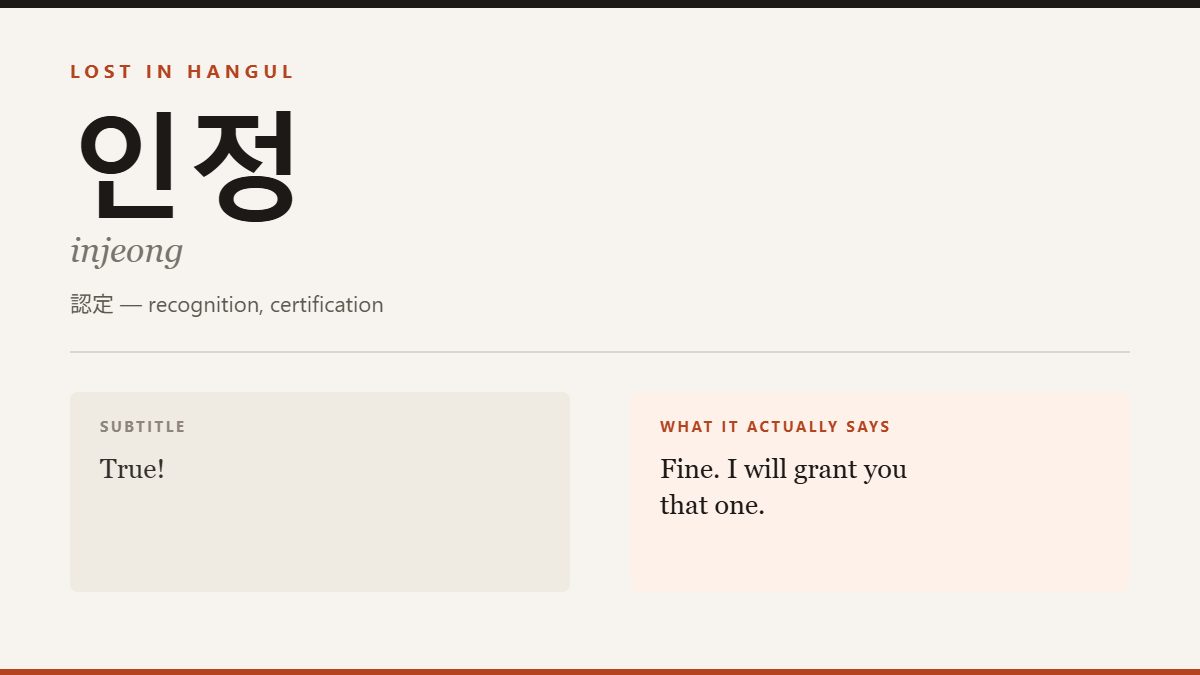
인정 (injeong) — what the subtitle says versus what was actually said

A stiff legal word for recognition, clipped down to a single shouted syllable pair. It does not mean “I agree”. It means “fine, I’ll grant you that”, which is a different move.

Categories Slang & Internet Korean Tags injeong, internet korean, slang, variety show Leave a comment

“Daebak” (대박) — one word, four completely different meanings

September 24, 2026September 20, 2026 by mataXinfo
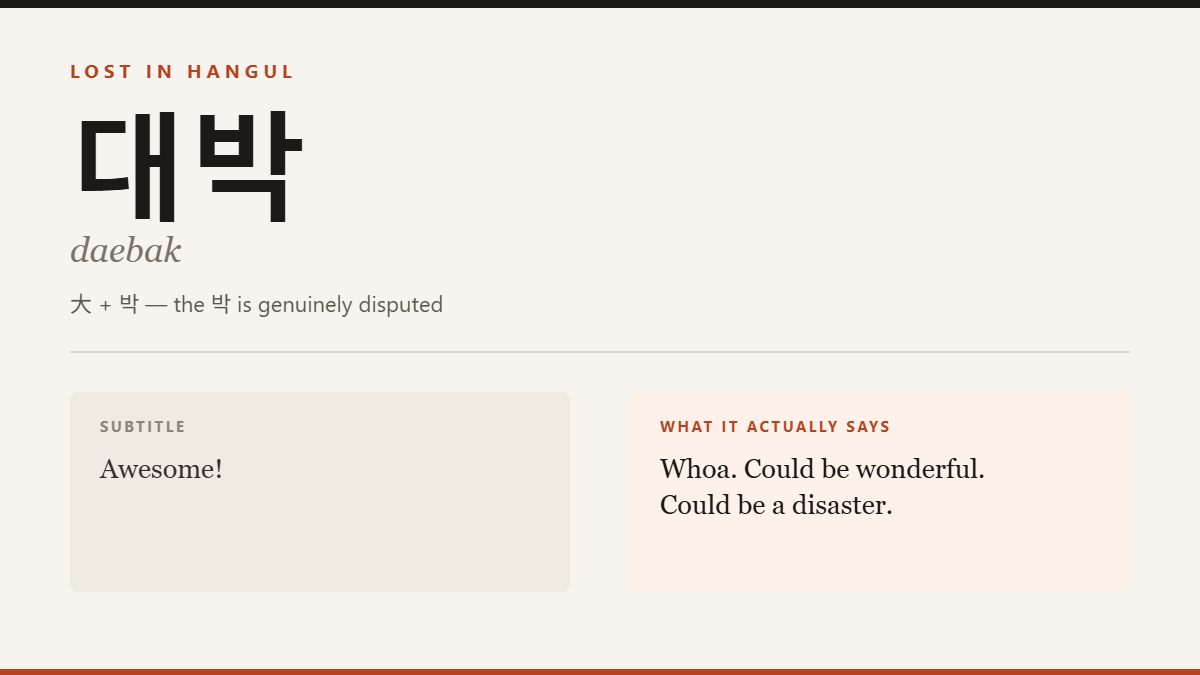
대박 (daebak) — what the subtitle says versus what was actually said

A windfall, a hit, a delighted whoa and an appalled whoa, all in two syllables sorted by tone alone. Its origin is genuinely disputed, whatever the internet tells you about gourds.

Categories Slang & Internet Korean Tags daebak, exclamations, jjokbak, slang, variety show Leave a comment

“Hwaiting” (화이팅) — not “fighting”, and not quite “you got this”

September 24, 2026September 20, 2026 by mataXinfo
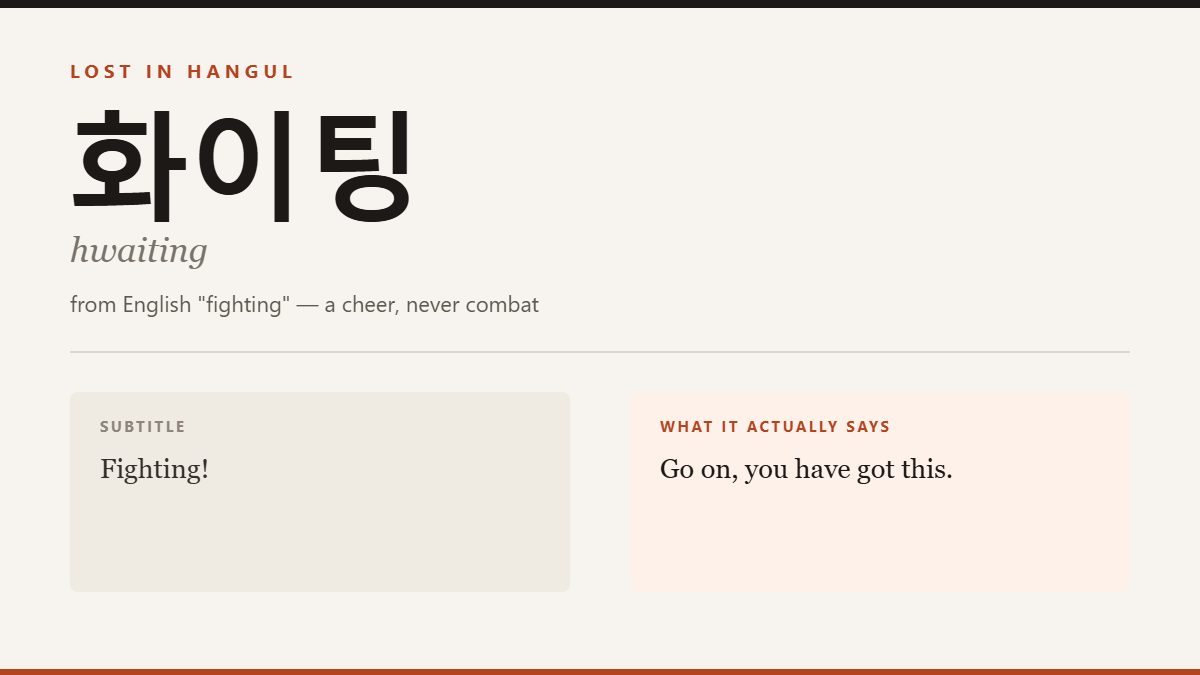
화이팅 (hwaiting) — what the subtitle says versus what was actually said

It comes from the English word “fighting” and means the opposite of what an English speaker hears. It is a cheer said before the hard thing, and there is a different word for after.

Categories Things They Say Tags encouragement, fighting, himnae, hwaiting, loanwords Leave a comment

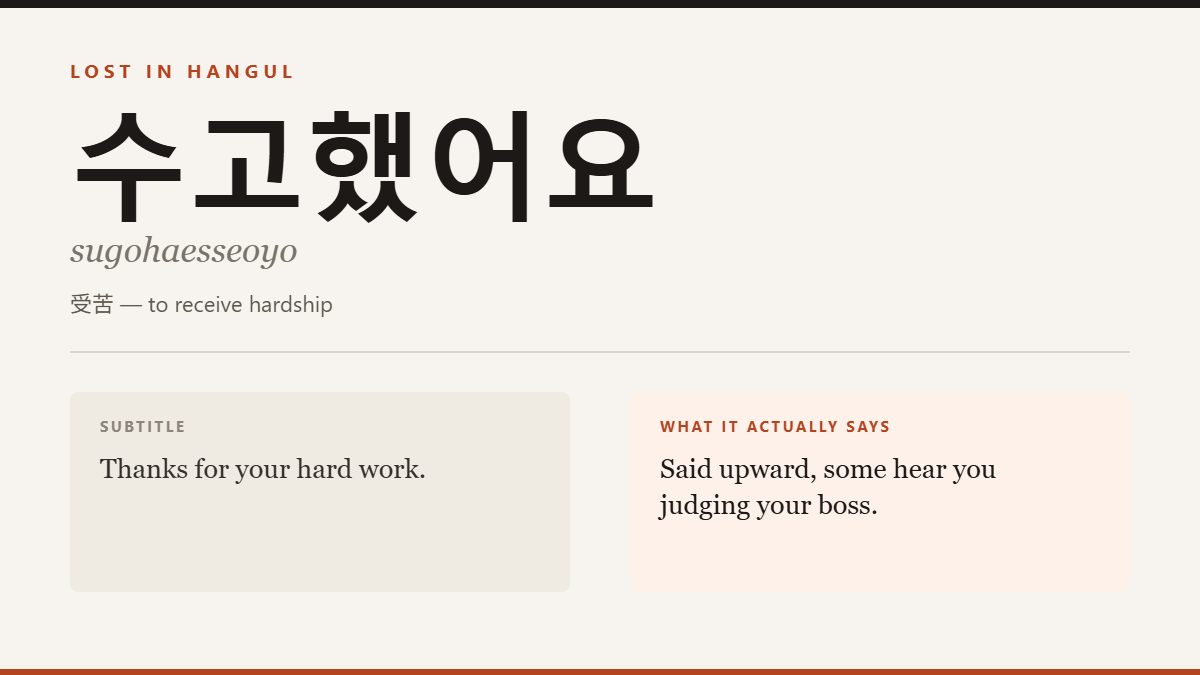
“Sugohaesseoyo” — the everyday phrase that can still get you in trouble

September 24, 2026September 20, 2026 by mataXinfo
수고했어요 (sugohaesseoyo) — what the subtitle says versus what was actually said

The most-used sentence in Korean working life, and there is a live argument about whether you are allowed to say it to your boss. Both sides are real and it splits by age.

Categories Things They Say Tags etiquette, honorifics, sugohaesseoyo, workplace korean Leave a comment
Older posts
Newer posts
← Previous Page1 … Page6 Page7 Page8 Next →

What this is

Korean words, honorifics and lines that subtitles cannot carry across. One word per article: what it means, what the subtitle says, and what got dropped.

How these are written →

Start here

  • Gosaenghaesseo — not "good job"
  • Jeong — attachment you did not choose
  • Why she calls him Oppa
  • Ani — the word that is not "no"

Categories

  • Honorifics & Titles (18)
  • Slang & Internet Korean (18)
  • Subtitle Notes (16)
  • Things They Say (20)
  • Untranslatable Words (19)

Search

© 2026 Lost in Hangul • Built with GeneratePress